
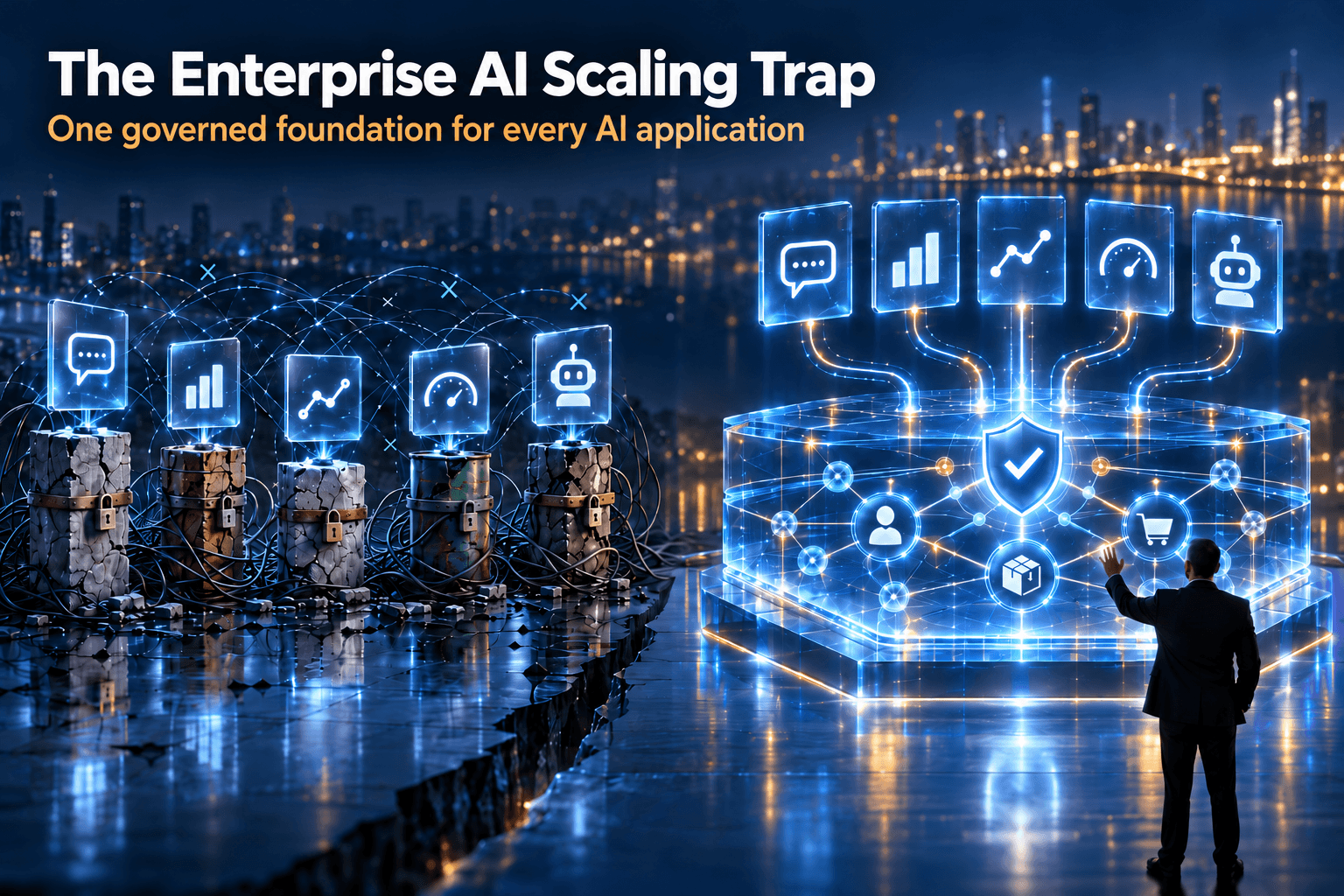
Your First AI Application Is Easy. Your Fifth Exposes the Problem.
Building AI applications has never been easier.
Modern cloud, data, and AI platforms give developers powerful tools to connect large language models to enterprise data, build intelligent assistants, and automate complex business processes. What once required months of specialized development can now be prototyped in days or weeks.
Consider a familiar scenario.
A development team builds an AI assistant to help sales representatives understand customer accounts. They connect an LLM to their CRM and data warehouse, implement some business logic, add access controls, and create prompts that help the AI interpret customer information.
The application works. Business users are impressed. Leadership wants more.
Finance wants an AI assistant to analyze revenue and profitability. Customer Success wants an agent to identify accounts at risk. Operations wants an intelligent assistant to investigate service delays. Executives want conversational access to business performance.
The organization has developers. It has AI platforms. And now it has momentum.
So everyone starts building.
But by the third, fourth, or fifth application, something becomes apparent.
Each team isn't simply building an AI application. It's also reconstructing the business knowledge, definitions, data relationships, validation rules, and governance mechanisms required to make that application trustworthy.
And much of that work has already been done somewhere else.
The first AI application demonstrates what's possible. The fifth exposes what's missing from the architecture.
This is an emerging challenge for enterprises scaling AI: the accumulation of what we call semantic governance debt.
The Hidden Cost of Building Trust One Application at a Time
Most organizations already recognize that AI hallucinations are a problem. They understand that LLMs can generate inaccurate responses and that enterprise applications require appropriate safeguards.
And this is where our story starts. Developers jump into their platform and start coding the guardrails, business logic and calculations. They quickly realize it is not that easy to cater for every scenario. Even when an AI model generates technically correct answers, those answers can still be inconsistent with how the business actually operates.
Imagine three AI applications answering a question about customer revenue.
The Sales AI assistant calculates revenue using booked orders. The Finance assistant uses invoiced revenue, excluding credits and returns. The Customer Success agent calculates revenue based on recognized subscription payments.
Each application may produce an accurate result based on its underlying logic.
But which one represents the organization's official definition of customer revenue?
Now imagine the same problem across hundreds of business concepts: active customers, gross margin, product profitability, customer churn, inventory availability, equipment utilization, or operational risk.
Each concept may require a combination of technical metadata, business definitions, data relationships, calculation logic, exclusions, and policies. And possibly specific AI skills to correctly reason and respond.
Developers must understand these rules, encode them into their applications, validate the results, and maintain the implementations.
And when the next application comes along, much of that work starts again.
The challenge isn't simply making an LLM more accurate. It's ensuring that every AI application operates with the same approved understanding of the business.
An AI application can be technically correct and still be business-wrong.
That distinction becomes increasingly important as AI moves beyond answering questions toward recommending decisions and executing actions.
Introducing Semantic Governance Debt
Software engineering has long recognized the concept of technical debt: the future cost of shortcuts, duplicated code, and architectural decisions that prioritize immediate delivery over long-term maintainability.
Enterprise AI is creating a related problem, and it is reflected in the low rate at which these applications make it into production use across enterprises.
Semantic governance debt is the accumulated cost and risk of embedding business definitions, relationships, rules, and validation logic independently across applications rather than managing them through a shared, governed foundation.
It accumulates quietly. And quickly!
One application defines an active customer in its prompts. Another implements the same definition in SQL. A third uses a configuration file. A fourth relies on custom Python code. A fifth uses a platform-specific semantic model.
Initially, this seems manageable. Each development team is solving its immediate problem.
But as applications multiply, the organization inherits three increasingly expensive challenges.
1. Duplicated development effort
Every application team must discover and implement the business knowledge it needs.
Developers interview subject matter experts, inspect database schemas, interpret documentation, establish relationships, and write business rules.
Much of this work overlaps with what other teams have already completed.
Instead of investing development resources in differentiated AI capabilities, organizations repeatedly spend time reconstructing the same business context.
2. Expensive and risky change management
Business rules don't remain static.
Finance changes how revenue is recognized. Sales modifies customer segmentation. Operations introduces new utilization thresholds. Regulatory requirements evolve.
Consider an enterprise with 15 AI applications that use the definition of an active customer.
The business changes that definition from a customer who purchased within the past 12 months to one who purchased within the past 18 months.
How many applications need updating?
Who knows where the original definition was implemented? Which applications are still using the old logic? How can the organization verify that every change has been implemented correctly?
What should be a straightforward business policy change becomes a distributed software maintenance project.
3. Fragmented governance and accountability
When business logic is embedded in application code, prompts, SQL queries, and configuration files, governance becomes difficult.
A business glossary might document the approved definition of a metric, but that doesn't guarantee every AI application uses it.
Data catalogs can identify assets and document definitions, but documentation alone doesn't ensure those definitions are consistently enforced at runtime.
Then there is the transparency and traceability of AI responses in the hands of decision makers. Where did this definition come from? Is there a way to see who approved it?
The result is an expanding collection of independently implemented business rules with limited visibility into where they're used, who approved them, and whether they're current.
The problem isn't that organizations lack governance policies. It's that business governance hasn't become reusable infrastructure for AI.
Who Owns the Golden Version of Business Truth?
This raises an important organizational question.
Who is responsible for ensuring that every AI application operates with a consistent understanding of the enterprise? And what bar of compliance with these standards do we expect across our organization?
Application developers own application functionality. Platform teams manage infrastructure. Security teams establish access controls. Business leaders understand the rules governing their domains.
But someone must be accountable for the enterprise-wide framework that connects these responsibilities.
This is where the Chief Data Officer has an opportunity to play a much more strategic role.
The CDO should become the custodian of the organization's governed business foundation.
That doesn't mean the CDO personally defines every metric, business rule, or operational policy.
Finance should continue to own financial definitions. Sales should own relevant customer and pipeline definitions. Operations should own operational performance measures.
The CDO's responsibility is to establish the architecture, governance processes, stewardship model, and technology foundation that make those definitions consistent, discoverable, certified, and reusable.
This represents an important evolution of the Data Office.
Historically, data governance has often been perceived as a control function: establishing policies, maintaining catalogs, monitoring data quality, and ensuring compliance.
In the AI era, the CDO can transform governance into an enterprise-wide enablement capability.
Instead of reviewing AI applications individually to determine whether they interpret business data correctly, the Data Office can provide a certified business foundation that applications consume from the outset.
The CDO shouldn't have to govern dozens of competing versions of business truth. The CDO should establish the foundation that prevents those competing versions from emerging.
From Application-Specific Guardrails to a Shared Semantic Foundation
The architectural answer is to separate the management of business meaning from the development of individual AI applications.
Rather than embedding business definitions and rules independently in each application, organizations need a shared, governed, business-enriched semantic foundation.
This foundation connects technical data structures with the business knowledge required to interpret them. And it forms the deterministic foundation for AI to accurately and consistently respond to business questions.
It understands business entities such as customers, products, suppliers, contracts, and transactions. It establishes relationships between those entities, connects them to underlying data, and incorporates approved business definitions, calculations, policies, and rules.
Critically, it provides governance and certification mechanisms so applications can distinguish approved business knowledge from assumptions or unverified interpretations.
When you productize this foundation, it becomes a reusable enterprise service for AI applications, BI, and AI workflows.
A Sales AI assistant, Finance copilot, Customer Success agent, operational analytics application, or autonomous workflow can all access the same governed business understanding.
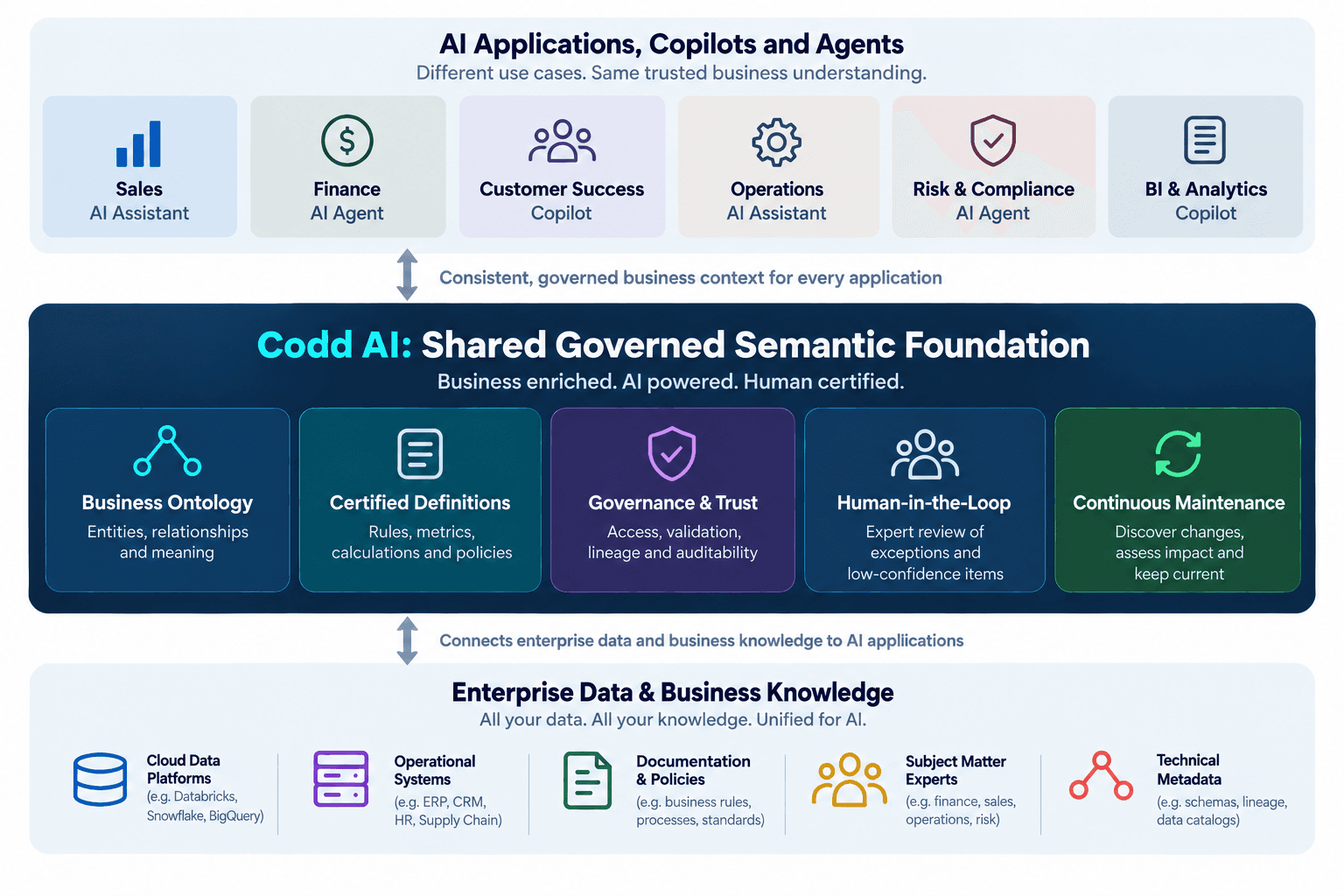
Each application remains free to implement its own user experience, reasoning workflows, and specialized capabilities.
But developers no longer need to independently reconstruct the business semantics underlying those capabilities.
This doesn't eliminate every application-specific guardrail. AI applications still require appropriate security controls, workflow permissions, safety checks, and human approval mechanisms.
What changes is that the organization no longer needs to repeatedly develop and maintain the same foundational business definitions and validation logic.
The distinction matters.
The objective isn't to centralize every AI application. It's to centralize the business understanding those applications share.
Your Existing AI Platform Isn't the Problem
An important point often gets lost in discussions about enterprise AI architecture.
Organizations don't need to replace their existing cloud, data, or AI platforms to solve this problem.
Platforms such as Databricks, Snowflake, Microsoft Azure, AWS, and Google Cloud provide powerful infrastructure for data processing, application development, AI model integration, and governance.
They have dramatically accelerated the ability to build AI applications.
Many also offer semantic modeling capabilities, catalogs, access controls, and tools for defining business metrics.
These are valuable capabilities.
However, having the technical ability to define business semantics is not the same as having a complete, governed, continuously maintained understanding of the enterprise.
Some semantic implementations remain closely tied to specific data platforms, analytical use cases, or individually authored metrics. Organizations may still need to discover business knowledge, reconcile conflicting definitions, model relationships, certify logic, and coordinate changes across applications.
And those responsibilities don't disappear simply because developers have better tools.
A shared business-enriched semantic foundation should complement existing platforms, not compete with them.
Think of it as an enterprise trust and context layer that sits across the technology environment.
Developers continue building on their preferred AI platforms. Data engineers continue managing pipelines and data infrastructure. Business teams continue defining the rules governing their operations.
The semantic foundation ensures that applications can reuse the same certified business knowledge regardless of where they're developed or deployed.
This also reduces dependence on any single LLM, application framework, or data platform.
As AI technology evolves, the enterprise's approved business understanding remains a durable, reusable asset.
Why Productizing the Semantic Foundation Changes the Economics
Of course, creating a shared semantic foundation introduces an obvious question.
Doesn't building and maintaining this foundation become another massive development project?
It can, if organizations approach it as another manual, developer-centric initiative.
Traditional semantic modeling often requires technical specialists to inspect schemas, define relationships, author metrics, encode business rules, and maintain configurations. And then program all of it in YAML files and scripts.
Doing this across a large enterprise can become a significant undertaking.
But what if the creation and maintenance of the foundation itself could be substantially automated?
This is where AI-powered productization changes the economics.
At Codd AI, for instance, the approach begins with discovering and integrating business knowledge from multiple sources: database schemas, technical metadata, business documentation, existing analytical artifacts, policies, and subject matter experts.
AI powers much of the gathering, and AI helps transform that knowledge into an analytical ontology and underlying data model that represent the enterprise's business entities, relationships, and logic.
From that certified foundation, additional semantic artifacts, including business metrics and data quality measures, can be generated.
Rather than requiring technical teams to manually author every definition, AI accelerates the creation process and provides a confidence score on every item. For example, it might show 100% confidence in a relationship between Customers and Orders because your business knowledge explicitly states it. But it might show a 75% confidence score that Supplier is related to Product because your knowledge indicated that Vendor and Product are related.
Human experts remain essential, but their role changes.
Instead of spending most of their time creating semantic artifacts from scratch, they review AI-generated results, resolve ambiguity, certify critical definitions, and address exceptions or low-confidence items.
The foundation becomes governed through human-in-the-loop validation, rather than relying on either unchecked AI generation or entirely manual development.
Equally important, business knowledge discovery shouldn't be treated as a one-time project.
As underlying systems, business rules, and operational processes evolve, the discovery and certification process can be repeated to identify changes and keep the foundation current.
This creates a fundamentally different operating model:
AI performs much of the repetitive discovery and generation work. Human experts govern meaning, resolve exceptions, and certify what the enterprise can trust.
Change the Business Rule Once. Govern It Centrally.
Return to our earlier example of 15 AI applications using the definition of an active customer.
In a fragmented architecture, changing that definition may require identifying, modifying, testing, and coordinating changes across 15 separate implementations.
With a shared semantic foundation, the approved definition can be changed centrally.
The appropriate business owner reviews the change. Data stewards certify the updated definition. The platform records the change and its dependencies. Applications consuming the shared semantic definition can then use the updated logic according to established versioning and release policies.
There will still be testing, particularly for applications where the change affects decisions, workflows, or automated actions.
But the organization no longer needs to independently rewrite the same business rule in every application.
The benefits go beyond reducing development effort.
A centrally governed foundation provides a clearer view of which applications depend on particular definitions, who approved changes, and how those changes affect downstream consumers.
It also helps prevent semantic drift: the gradual divergence of business meaning across systems and applications.
The real advantage isn't simply defining business logic once. It's being able to change it once, govern it centrally, and understand where that change matters.
The CDO's New Mandate: Make Trusted AI a Shared Enterprise Service
For years, organizations have invested heavily in modernizing their data infrastructure.
They've built cloud data platforms, established governance programs, implemented catalogs, and improved data quality.
Now AI is creating a new requirement: business knowledge must become operational, reusable, and accessible to every application that needs it.
This is a natural extension of the CDO's mandate.
A governed semantic foundation allows the Data Office to move beyond documenting business definitions toward making those definitions executable and consistently available across enterprise AI.
- For development leaders, this means faster application delivery and less duplicated work.
- For CIOs and CTOs, it means reduced architectural fragmentation and a more maintainable AI environment.
- For business executives, it means more consistent answers and decisions.
- And for the CDO, it means establishing a durable enterprise capability that accelerates innovation while strengthening governance.
The choice isn't between rapid AI development and responsible AI governance.
A well-designed foundation enables both.
Stop Rebuilding Trust with Every AI Application
Enterprise AI adoption is accelerating, and developers will continue building new applications at an extraordinary pace.
That's a good thing.
But without a shared approach to business meaning and governance, every new application risks adding another layer of semantic governance debt.
More duplicated logic. More inconsistent definitions. More difficult maintenance. More fragmented accountability.
The solution isn't to slow developers down or replace the platforms they've already adopted.
It's to give them a governed, business-enriched semantic foundation they can reuse.
And by using AI to automate the discovery, generation, and maintenance of that foundation, with human experts responsible for certification and oversight, organizations can make trusted AI scalable rather than turning governance into another development bottleneck.
Build AI applications as fast as you want. Just don't rebuild business truth every time.
About Codd AI
Codd AI helps enterprises establish a governed, business-enriched semantic foundation for AI analytics and agentic applications. By combining automated knowledge discovery, AI-generated semantic models, and human-in-the-loop certification, Codd AI transforms technical and business knowledge into reusable, trusted context. The platform complements existing data, cloud, and AI environments, helping organizations accelerate AI development, reduce duplicated business logic, and deliver consistent, governed intelligence across applications.
If you are interested in learning more about Codd AI, schedule a chat with our founders.