
For the past two decades, analytics leaders have invested heavily in building modern data platforms. These investments promised that we would go from on-premise data warehouses to cloud-native architectures, from ETL (extract, transform, load) to ELT (extract, load, transform), from batch pipelines to real-time streaming, and from static dashboards to interactive BI.
And yet, despite all this progress, we continue to see a lot of the old technologies hanging around. But perhaps a far bigger issue is that the dream of the data driven enterprise remains elusive to all but a very select few.
Even if we can unify the data, the challenge of extracting business insights remains heavily bottlenecked due to a lack of the critical ingredient: people. People that can translate a business question into the right query and then represent that back in a business relevant manner.
The issue is that the data is a raw artefact and contains no business logic and rules. That lives in the minds of people or coded in reports or dashboards.
Today, as generative AI reshapes how people interact with data, that gap is no longer just a bottleneck or inconvenience. It is becoming a systemic risk.
Every platform now comes with its own AI copilot. Every tool promises natural language access to data. Every vendor claims to democratize analytics.
But beneath the surface, something is breaking.
Not because the models are weak. Not because the data is missing. But because context is fragmented.
What is emerging now is the next critical layer in the analytics stack, one that will determine whether AI-driven decision-making scales or collapses: the AI Control Plane for Analytics, powered by a contextual semantic layer.
We Solved Data Infrastructure. We Didn't Solve Meaning.
Modern data architectures have done an exceptional job solving for:
- Data storage at scale
- Compute elasticity
- Pipeline orchestration
- Data accessibility
Platforms like Snowflake, Databricks, and BigQuery have effectively become the system of record for data.
But they were never designed to be the system of understanding.
That responsibility has historically fallen to humans:
- Data analysts embedding logic into dashboards
- Engineers defining transformations in dbt
- BI developers creating semantic models in Tableau or Power BI
In other words, the business meaning of data, including metrics, definitions, relationships, and assumptions, has been distributed across people, tools, and artifacts.
It is tribal. It is fragmented. And most importantly, it is not machine-readable at scale.
Enter GenAI: A New Interface Without a Foundation
Generative AI has changed the interface to analytics almost overnight.
Users no longer want dashboards. They want answers to natural language questions.
They expect to ask:
- "What's driving churn in enterprise accounts?"
- "Why did revenue drop in the Northeast last quarter?"
- "Which customers are most likely to expand?"
And they expect accurate, consistent answers.
To meet this demand, vendors have rushed to embed AI copilots into every layer of the stack:
- BI tools
- Data platforms
- Transformation tools
- Catalogs
Each copilot translates natural language into queries. Each one attempts to interpret intent. Each one generates answers.
But here is the problem: every copilot operates on its own partial understanding of the business. There is no shared context.
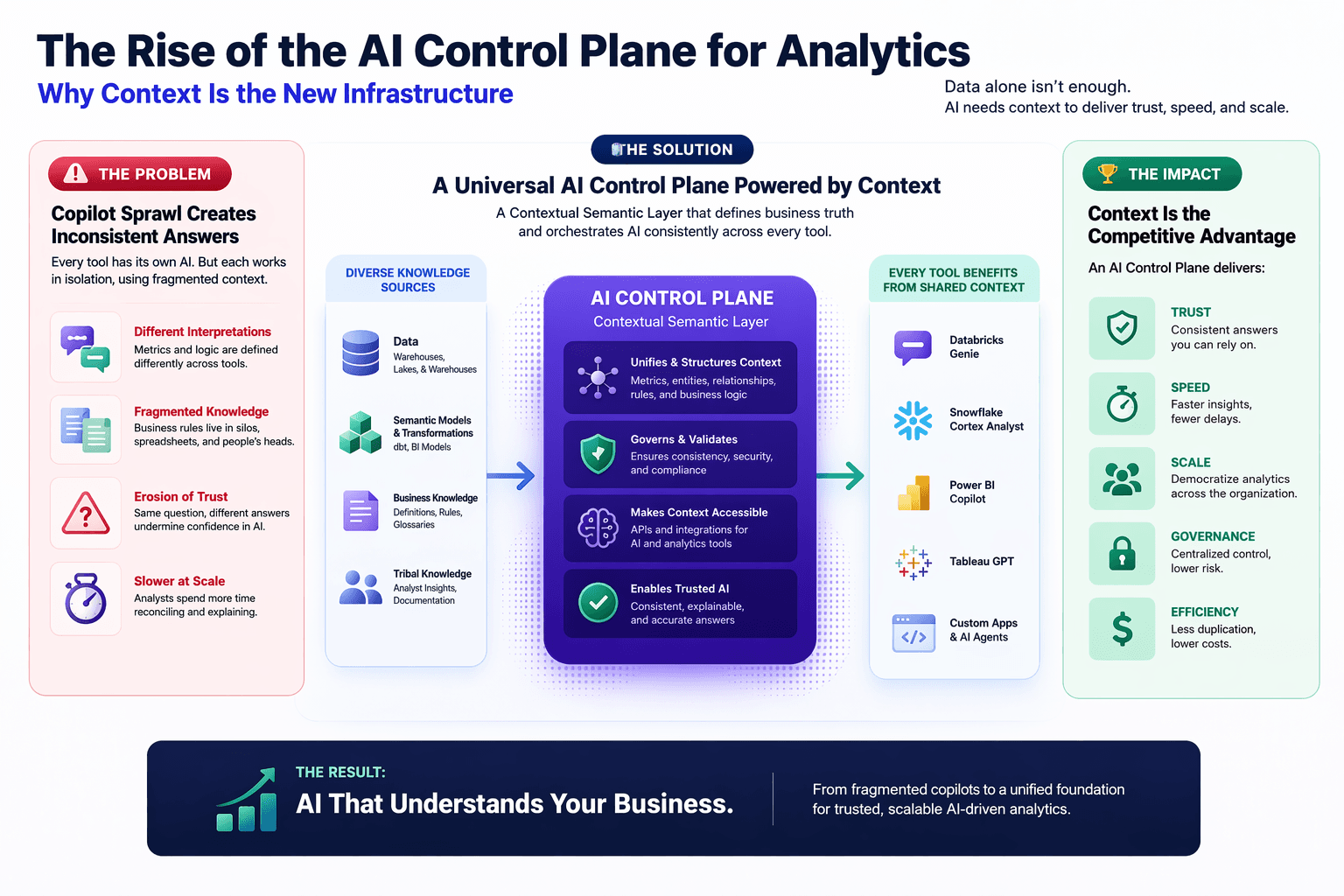
The Copilot Fragmentation Problem
Imagine a typical enterprise today:
- Tableau has its own semantic model and at least two copilots
- Power BI has a semantic layer and copilot
- dbt defines transformations in code
- Snowflake has semantic views and Cortex
- Databricks has metric views, Unity Catalog, and Genie
- Business logic lives in spreadsheets, docs, and people's heads
Now layer AI on top of all of this.
Each copilot:
- Interprets metrics differently
- Applies different filters and assumptions
- Joins data in slightly different ways
- Surfaces different answers to the same question
The result? Inconsistent insights at scale. And worse, confidently delivered inconsistencies.
This is not just a technical issue. It is a trust crisis.
Because when executives get different answers to the same question depending on the tool they use, the natural response is not to trust AI more. It is to trust it less.
Why This Is an Architecture Problem, Not an AI Problem
The instinctive reaction is to improve the AI:
- Better prompts
- Better models
- Fine-tuning
- More training data
But this misses the core issue.
AI models are incredibly good at language. They are not inherently good at business understanding. They require structured, explicit context for your business:
- What does "revenue" mean?
- How is "customer" defined?
- What filters are always applied?
- What relationships exist between entities?
Without that, the model is forced to infer meaning, which leads to variability.
So the real problem is not: "How do we make AI smarter?"
It is: "How do we give AI a consistent understanding of the business?"
And that is fundamentally an infrastructure challenge.
The Missing Layer
To scale AI-driven analytics, organizations need a new layer in the stack. A layer that:
- Centralizes business definitions
- Encodes relationships and logic
- Integrates structured and unstructured knowledge
- Is accessible to both humans and machines
- Applies governance and validation
This is what we refer to as a Contextual Semantic Layer.
But more importantly, at scale, this becomes something bigger: an AI Control Plane for Analytics.
What Is an AI Control Plane?
Borrowing from cloud architecture, a control plane is responsible for:
- Defining policies
- Managing configurations
- Enforcing consistency
- Orchestrating behavior across systems
In Kubernetes, the control plane ensures containers behave consistently across environments. In networking, the control plane determines how traffic flows.
Now apply that concept to analytics.
An AI Control Plane:
- Defines how business logic is interpreted
- Governs how metrics are calculated
- Standardizes how relationships are applied
- Ensures consistency across all AI interactions
Instead of each tool "figuring things out," the control plane tells every tool what is true.
From Tool-Centric to Context-Centric Architecture
Traditional analytics architectures are tool-centric:
- Logic is embedded within each platform
- Semantic models are duplicated
- Governance is fragmented
The AI era requires a shift to context-centric architecture:
- Business meaning is centralized
- Tools become consumers of context
- AI operates on a shared foundation
This changes the role of every component in the stack:
| Layer | Old Role | New Role |
|---|---|---|
| Data Platform | Store and process data | Provide raw data |
| BI Tools | Define metrics and logic | Visualize governed outputs |
| AI Copilots | Interpret everything | Execute against shared context |
| Context Layer | (Didn't exist) | Define business truth |
This is the architectural shift analytics leaders need to internalize.
Why Context Becomes Infrastructure
Historically, context has been treated as documentation:
- Data catalogs
- Glossaries
- Wikis
Helpful, but passive.
In the AI era, context must be:
- Machine executable
- Enforced
- Integrated into every query
Because AI does not read documentation. It depends on structured context.
This elevates context from a "nice-to-have" to a core piece of enterprise infrastructure.
Just like you would not build applications without a database, and you would not run pipelines without orchestration, soon you will not deploy AI analytics without a context layer.
The Business Impact of an AI Control Plane
For analytics leaders, this is not just about architectural elegance. It directly impacts:
1. Trust. Consistent answers across tools and users, leading to increased confidence in AI-driven decisions.
2. Speed. No need to reinterpret logic per query, leading to faster time to insight.
3. Scale. AI can serve more users without human mediation, enabling true democratization.
4. Governance. Centralized control over definitions and access, reducing risk.
5. Efficiency. Less duplication of semantic models and logic, lowering operational overhead.
In short, you move from AI experimentation to AI operationalization.
Why Copilots Alone Will Not Get You There
Copilots are valuable. They improve usability. They reduce friction.
But they are fundamentally interface enhancements, not architectural solutions.
Without a shared context layer, copilots will always:
- Produce variable results
- Require human validation
- Struggle with complex business logic
This is why many vendors subtly position copilots as assistive, non-authoritative, and not a system of record. Because they know they lack the underlying context to guarantee correctness.
The Strategic Imperative for Analytics Leaders
This is the moment of decision.
Do you:
- Continue investing in tool-specific copilots
- Accept fragmented understanding
- Manage inconsistency through process
Or do you:
- Establish a universal context layer
- Create a shared foundation for AI
- Enable consistent, scalable analytics
This is not a tooling choice. It is an architectural commitment.
The Future: AI That Understands Your Business
We are moving toward a world where users interact with data in natural language, systems generate insights autonomously, and decisions are augmented in real time.
But none of this works without AI that understands your business.
Not just your schemas. Not just your tables. But your:
- Metrics
- Definitions
- Relationships
- Rules
- Assumptions
That understanding does not emerge from models alone. It must be designed, structured, and governed.
Final Thought: Context Is the New Competitive Advantage
In the early days of cloud, companies that built modern data platforms gained a competitive edge. Today, that advantage is table stakes.
The next frontier is not who has the most data. It is not even who has the best AI. It is who has the most reliable, scalable, and governed understanding of their business.
That is what a contextual semantic layer enables. That is what an AI control plane delivers.
And that is why context is no longer documentation. It is infrastructure.
Introducing Codd AI Contextual Semantic Layer
Codd AI is a leading provider of the new contextual semantic layer for AI. Codd AI was born in the world of AI and it was designed from the ground up to provide a governed shared context for AI, regardless of what databases you use or what BI tools you use.
It fits seamlessly and frictionlessly into your current architecture.
It uses AI to do the heavy lifting of generating ontologies, data models, and business metrics while retaining a human in the loop to review and certify the semantic foundation.
And Codd AI brings business fluent AI into the environments your business users want to use: conversational canvas, dashboards, BI tools, Slack, Teams, Chatbots, MCP servers and endpoints.
To find out more, schedule a 30 minute chat with me!