

Background
Over the past few weeks I've had some interesting questions about why one would need a knowledge graph or a context graph. The background to these questions is rooted in the AI washing that now dominates every software category (and arguably every product category). Worse, most organizations are facing the same dilemma.
AI isn't something you "adopt" anymore. It is embedded in everything:
- BI tools
- Data platforms
- SaaS applications
- Chat interfaces
And the result isn't clarity. It is overload.
Every vendor claims intelligence. Every tool promises insight. And yet, the practical question remains:
Where does any of this actually make a difference?
That is the right question. Because the answer is not "more AI." It is understanding when context becomes the limiting factor.
Reframing the Issue
Before deciding whether you need knowledge graphs, or any context layer at all, there is a more important distinction to make. There are fundamentally different types of AI use cases.
1. Low-Context Use Cases (AI Works Out of the Box)
These are scenarios where AI performs well without deep business understanding:
- Writing SQL queries
- Generating dashboards
- Summarizing data
- Exploring trends
In these cases, copilots and embedded AI tools are often good enough. You don't need to over-engineer context here.
2. High-Context Use Cases (Where AI Breaks Down)
This is where things get interesting, and where most organizations struggle. These include:
- Executive decision-making
- Cross-functional metrics (e.g., revenue, churn)
- Operational reporting used for planning
- Questions that involve ambiguity or interpretation
Examples:
- "What is our true churn rate?"
- "Why did revenue decline last quarter? And what offers, based on the customer segment, can we propose to help revenue growth?"
- "Which customers should we prioritize?"
These are not just data questions. They are business questions that require shared meaning.
And this is where AI starts to struggle. Not because AI is weak, but because it lacks context.
Introduce Knowledge Graphs (At the Right Level)
This is where knowledge graphs, or more broadly, context graphs, come into play. Not as a technology choice, but as a capability.
What they actually do is encode:
- Relationships (customer to account to product)
- Definitions (what "revenue" actually means)
- Dependencies (how metrics are calculated)
- Business logic (filters, rules, exclusions)
In simple terms, a knowledge graph is a way of making your business and data understandable to machines.
When You Actually Need It (A Decision Framework)
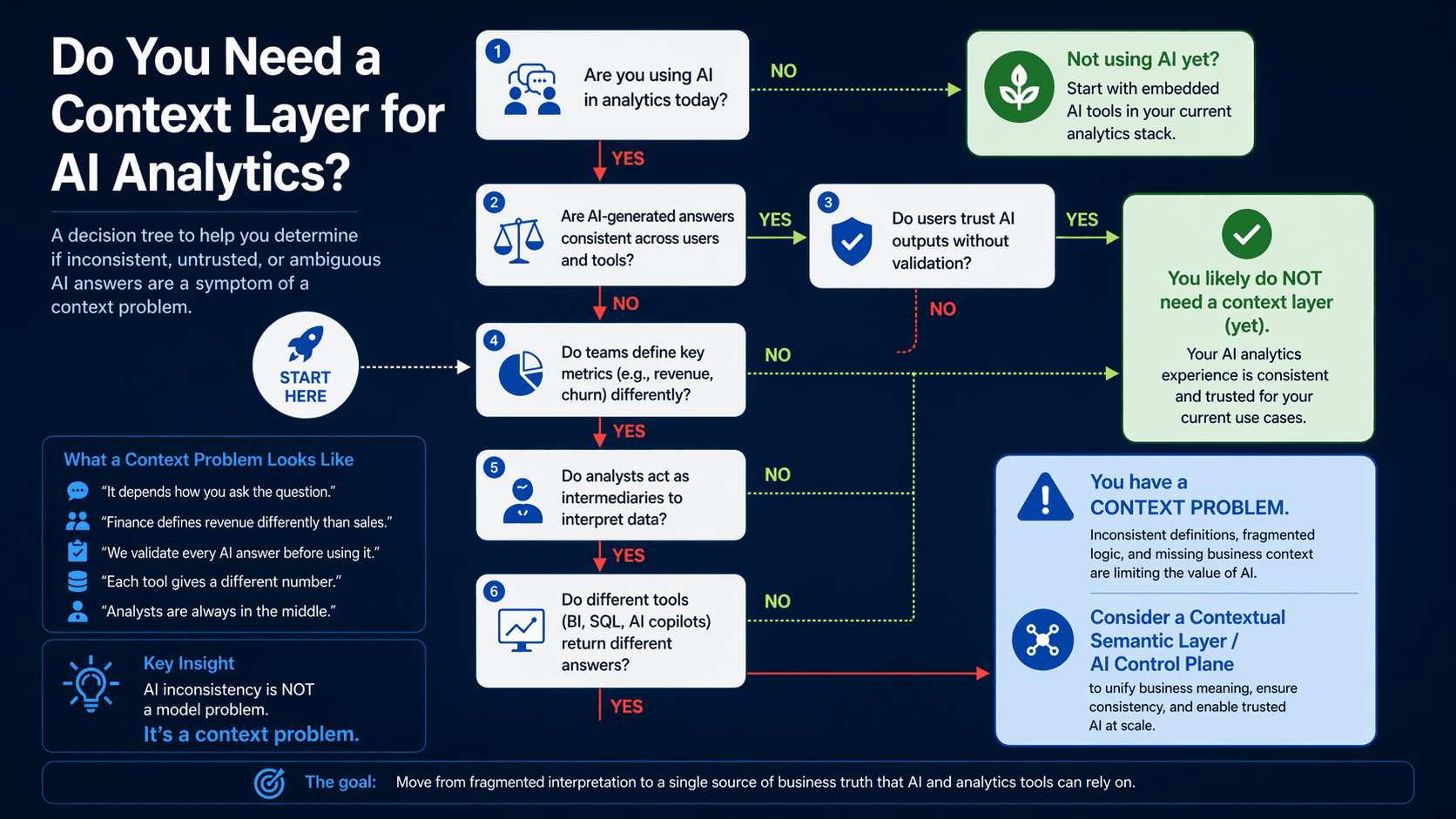
Instead of asking, "Do we need a knowledge graph?" ask these questions:
1. Do different teams define key metrics differently? If yes, you have a context problem.
2. Do AI tools give different answers to the same question? If yes, you have a consistency problem driven by missing context.
3. Do analysts act as interpreters between data and business users? If yes, context is not systematized.
4. Do decisions require validating numbers before they are shared? If yes, trust is not embedded.
5. Do you have multiple tools each with their own logic? If yes, context is fragmented.
If you answered "yes" to 2 or 3 of these, that's the point where investing in context (including knowledge graphs) starts to make sense.
What Most Organizations Get Wrong
When teams explore this space, they often:
- Start with technology selection instead of use cases
- Try to build a universal model upfront
- Over-index on data modeling instead of business meaning
As a result, they don't see value quickly.
A More Practical Way to Approach This
Instead of asking, "Should we invest in knowledge graphs?" start with the following steps.
Step 1: Identify 1 or 2 High-Impact Use Cases
- Revenue reporting
- Customer health
- Sales pipeline
Step 2: Test for Context Gaps
- Are definitions consistent?
- Do answers vary by tool or user?
Step 3: Introduce Context Selectively
- Define metrics clearly
- Map relationships
- Capture business rules
Step 4: Evaluate Impact
- Are answers more consistent?
- Is trust improving?
- Are analysts less of a bottleneck?
The Bottom Line
You don't need to adopt knowledge graphs everywhere. But you also can't ignore the problem they solve.
Because as AI becomes embedded in every tool, one thing becomes inevitable. The organizations that win won't be the ones with the most AI. They will be the ones with the most consistent understanding of their business.
If this resonates, schedule a 30 minute chat with me to talk about where context matters most in your analytics stack.