In a recent VentureBeat Pulse Research study, enterprise leaders painted a picture that will feel familiar to almost every Chief Data and AI Officer. Organizations are rapidly deploying AI platforms, copilots, and autonomous agents, yet confidence in governance has not kept pace. Multiple AI platforms are proliferating, ownership is fragmented, and many organizations still lack consistent mechanisms for detecting or governing AI behavior across the enterprise. Even more telling, nearly one-quarter of respondents said responsibility for AI governance is either unclear or contested between teams.
These findings shouldn't surprise anyone.
Enterprise AI is evolving faster than most governance programs were ever designed to accommodate.
The response from the industry has been equally predictable. Organizations are investing in AI governance platforms, model registries, evaluation frameworks, policy engines, security controls, approval workflows, and runtime monitoring. Every week another announcement promises more guardrails, more observability, and more control.
These are all necessary investments.
But they address only part of the problem.
In our previous article, Building Trusted Enterprise AI: A Blueprint for Chief Data Officers, we argued that trusted enterprise AI requires more than increasingly capable models. It requires a shared contextual foundation that allows every AI system to reason from the same understanding of the business.
That distinction becomes even more important as organizations move from copilots to autonomous AI agents.
The uncomfortable reality is this: most organizations don't have an AI governance problem. They have a shared business understanding problem.
Governance determines what an AI system is allowed to do.
Business context determines whether it does the right thing.
Those are fundamentally different challenges.
Governance Has Matured. Trust Hasn't.
The VentureBeat research highlights a paradox that many organizations are now experiencing.
On one hand, confidence appears relatively high. More than half of surveyed organizations reported being "very confident" they could detect a misbehaving AI model. Yet nearly one-third admitted they have no systematic way to detect AI misbehavior until users or audits expose it.
At the same time, enterprises are wrestling with platform sprawl. According to the research, 72% of organizations identify two or more AI platforms as their primary environment, while governance ownership is frequently divided across platform teams or left ambiguous altogether. Vendor opacity and unclear accountability emerged as two of the largest governance obstacles.
These findings reveal something important.
The challenge isn't simply controlling AI.
It's coordinating intelligence across an increasingly fragmented AI ecosystem.
Most enterprises are no longer deploying a single assistant. They are deploying dozens, and soon hundreds, of AI-enabled applications, specialized agents, embedded copilots, and autonomous workflows.
Each one can be individually governed.
Yet collectively, they may still produce inconsistent answers.
Governance Answers the Wrong Question
Traditional governance frameworks are designed to answer questions such as:
- Who owns this AI system?
- What data can it access?
- Which models are approved?
- Can it modify production systems?
- Is every action logged?
- Can it be audited?
These are essential questions.
But they are operational questions.
They don't answer the question executives ultimately care about: does the AI understand our business the same way our people do?
Imagine three AI agents. One supports Finance. One supports Sales. One supports Customer Success.
Each has passed security reviews. Each has access only to approved systems. Each follows organizational policy. Each is fully auditable.
Now ask each one a seemingly simple question:
"How many active customers do we have?"
If each agent was built independently, with different prompts, different metadata, different business rules, or different interpretations of "active customer," the answers may differ dramatically.
None of those agents violated governance.
Yet every one of them undermined trust.
The problem wasn't permissions.
The problem was business understanding.
Every Agent Is Learning Your Business Independently
This is one of the most overlooked architectural challenges in enterprise AI.
Today's AI projects often begin by solving individual business problems. A finance team builds an expense analysis agent. Marketing deploys a campaign optimization copilot. Supply chain introduces an inventory assistant. Customer support launches a service agent.
Each team enriches prompts. Creates retrieval pipelines. Adds documentation. Defines terminology. Tunes responses.
Over time, every project develops its own interpretation of the enterprise.
The organization doesn't intentionally create multiple versions of business truth.
It simply happens.
One team defines revenue one way. Another excludes refunds. Another applies regional adjustments. Another follows historical finance rules.
Eventually, every AI application begins reasoning from a different version of the business.
Ironically, the better each individual project becomes, the more fragmented the enterprise becomes.
The Missing Layer Is Shared Business Context
This is where the conversation must evolve beyond governance.
Before organizations can consistently govern AI behavior, they must establish a shared understanding of the business itself.
That shared understanding includes:
- Business terminology
- Certified metric definitions
- Organizational hierarchies
- Business rules
- Policies
- Relationships between business concepts
- Domain expertise
- Historical decisions
- Analytical reasoning patterns
These assets are not prompts.
They are enterprise knowledge.
Unlike prompts, enterprise knowledge should not be recreated every time a new AI application is deployed.
It should become reusable infrastructure.
Just as the data warehouse became the shared foundation for reporting, enterprise business context must become the shared foundation for AI reasoning.
Every AI system should inherit that understanding rather than rebuild it independently.
Governance Without Context Creates Consistent Inconsistency
One of the most valuable lessons from the VentureBeat research is that governance alone does not create confidence.
Organizations can have security controls. Approval workflows. Audit logs. Identity management. Evaluation pipelines. Runtime monitoring.
And still struggle to trust AI-generated decisions.
Why?
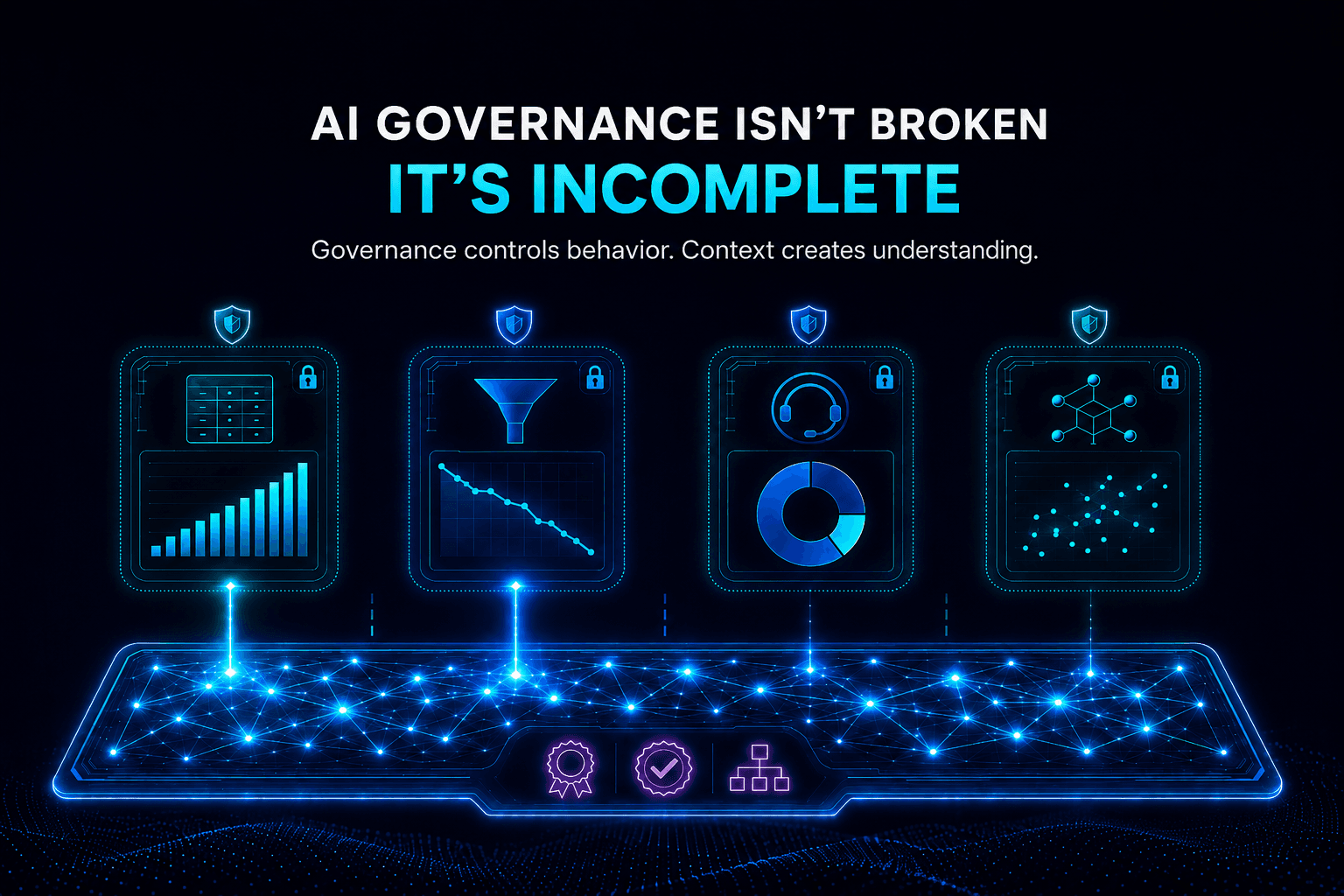
Because governance controls behavior. It does not create understanding.
An AI agent can faithfully follow every security policy while misunderstanding the meaning of gross margin, customer lifetime value, or qualified pipeline.
It can remain fully compliant while producing inconsistent recommendations.
It can pass automated evaluations while failing to align with how the business actually operates.
Interestingly, VentureBeat's more recent research also highlights another trust gap: although organizations are increasingly allowing agents to make production changes based on automated evaluations, only a very small percentage express complete confidence in those evaluations. That disconnect suggests enterprises are scaling AI faster than they are scaling confidence in how AI reasons.
The implication is profound.
Organizations are investing heavily in governing AI behavior while investing far less in governing the business knowledge that shapes AI reasoning.
From Governing Models to Certifying Knowledge
This is where the next evolution of enterprise AI architecture begins.
Instead of attempting to govern every prompt, every conversation, or every individual agent, organizations should focus on certifying the enterprise knowledge those systems share.
Imagine certifying once:
- Business concepts
- Semantic relationships
- Metric definitions
- Policies
- Regulatory rules
- Domain terminology
- Analytical playbooks
Now every copilot, every dashboard, every AI assistant, every autonomous workflow, and every future AI agent starts from the same trusted understanding of the business.
Governance becomes dramatically simpler because organizations are no longer governing isolated AI systems.
They are governing shared enterprise knowledge.
The Next Stage of AI Governance Is AI Trust
AI governance will continue to mature. Organizations will improve security. Identity management. Policy enforcement. Observability. Runtime controls.
These capabilities are essential.
But they represent only one half of the architecture.
The next competitive advantage won't come from deploying more AI agents.
It will come from ensuring every AI system reasons from the same certified understanding of the enterprise.
Consider the following governance versus trust perspectives:
| Governance asks | Trust asks |
|---|---|
| "Can this agent access payroll?" | "Does this agent understand how payroll costs are allocated?" |
| "Can this agent update Salesforce?" | "Does it understand what qualifies as pipeline?" |
| "Who approved this AI system?" | "Which certified business knowledge informed its reasoning?" |
Those are different questions.
The organizations that recognize that distinction will build AI ecosystems that are not only secure and compliant, but also consistent, explainable, and trusted.
Looking Beyond Governance
The VentureBeat research is an important signal that enterprise AI governance is entering its next phase.
Organizations have rightly focused on controlling access, reducing risk, and improving oversight.
The next challenge is ensuring every AI system shares the same business understanding.
That requires moving beyond governance as a collection of controls toward governance as a foundation of trusted enterprise knowledge.
In our previous article, we described this as the blueprint for trusted enterprise AI.
This article extends that blueprint with a simple observation:
Governance controls what AI is permitted to do.
Shared business context determines whether AI makes the right decision once it's allowed to act.
The enterprises that master both won't simply deploy more AI.
They will build AI that the business can trust.
About Codd AI
At Codd AI, we believe enterprise AI should reason from a shared, trusted understanding of the business, not from isolated prompts or disconnected data sources. Our AI-powered contextual semantic layer combines technical metadata, business knowledge, governance, and human certification into a reusable enterprise foundation for conversational analytics, AI copilots, and agentic workflows.
By helping organizations capture and govern business context once, Codd AI enables every AI and BI application to deliver more consistent, explainable, and trusted insights, today and as the AI landscape continues to evolve. To learn more, visit www.codd.ai or schedule a conversation with one of our co-founders.