Artificial intelligence has moved beyond experimentation, although multiple studies continue to report that the flow into production use cases remains on the lower end. Across every industry, organizations are embedding AI into customer service, supply chain operations, finance, sales, marketing, and software development. Large language models (LLMs) have made natural language interfaces commonplace, while autonomous agents promise to execute increasingly complex business processes with minimal human intervention.
For Chief Data Officers (CDOs) and Chief Data and AI Officers (CDAIOs), this represents both an extraordinary opportunity and an unprecedented challenge.
For the past decade, the mandate of the CDO has largely centered on building trusted data foundations: improving data quality, modernizing data platforms, establishing governance, and enabling analytics. Those responsibilities remain critical, but they are no longer sufficient. Today, the CDO is increasingly responsible for something far more strategic: ensuring that AI can reason about the business accurately, consistently, and transparently.
That shift changes the conversation entirely.
The question is no longer whether your organization has enough data to power AI. Nearly every enterprise does. The real question is whether AI understands your business well enough to make recommendations, support decisions, or eventually automate actions without creating new risks.
Many organizations are discovering that the greatest barrier to enterprise AI adoption isn't model capability. It's trust.
Different copilots generate different answers. Metrics vary across business units. AI agents interpret business terms differently. Analysts spend more time validating AI-generated insights than acting on them. Confidence erodes, adoption slows, and promising AI initiatives quietly stall before delivering meaningful business value.
These problems are often treated as model issues or prompt engineering challenges. In reality, they are architectural problems.
The organizations that succeed over the next decade won't simply deploy better AI. They'll build architectures that allow every AI application, copilot, and autonomous agent to reason from the same trusted understanding of the business.
That begins with rethinking the role of enterprise data.
AI Has Changed the Value of Enterprise Data
For years, organizations viewed data as a competitive asset. Today, business context has become an even more valuable asset.
Every enterprise has access to increasingly capable AI models. OpenAI, Anthropic, Google, Meta, and others continue to push the boundaries of reasoning, language understanding, and multimodal capabilities. As these models improve, access to AI itself becomes less of a differentiator.
What remains unique is the knowledge that exists inside each organization.
- Business terminology.
- Operational policies.
- Metric definitions.
- Regulatory requirements.
- Customer hierarchies.
- Product relationships.
- Approval processes.
- Historical business decisions.
These represent decades of accumulated institutional knowledge, and that knowledge rarely exists in a single database or application.
Large language models excel at understanding language, but they don't inherently understand your language. They don't know how your organization defines "active customer," how finance calculates recurring revenue, or which exceptions apply to regional sales reporting.
Without that understanding, AI can generate answers that sound plausible while subtly contradicting established business definitions.
Trust begins to erode one inconsistent answer at a time.
Clean Data Doesn't Create Trusted AI
Many enterprises have spent years improving data quality. They have invested in governance programs, master data management, metadata catalogs, and modern cloud data platforms.
Those investments remain essential.
But AI introduces a new requirement.
Traditional analytics answered structured questions against structured data. AI is expected to answer ambiguous questions expressed in natural language, explain reasoning, synthesize information across systems, and increasingly recommend or execute actions.
That requires more than accurate records.
It requires context.
Context includes business concepts, semantic relationships, metric definitions, governance policies, organizational vocabulary, business rules, and domain expertise.
Consider a simple executive question:
"Why did gross margin decline in Europe last quarter?"
Answering that reliably requires far more than retrieving numbers from a warehouse.
The system must understand how gross margin is calculated, which currencies should be normalized, how regional hierarchies are defined, whether promotional discounts are included, which supplier costs apply, and whether any acquisitions changed reporting structures during the quarter.
Those aren't prompt engineering problems.
They're enterprise knowledge problems.
Trust Must Be Designed Into the Architecture
Many organizations attempt to solve inconsistent AI behavior by continually improving prompts.
Prompt engineering certainly has value. Better prompts often produce better answers.
But prompts are temporary instructions.
Architecture is permanent.
If every AI application requires engineers or business users to repeatedly explain business definitions, metric calculations, and organizational policies, trust will remain inconsistent because context is being recreated with every interaction.
Instead, organizations should ask a different question:
"How do we ensure every AI system starts from the same understanding of our business, before the first prompt is even entered?"
The answer lies in treating business knowledge as reusable enterprise infrastructure rather than disposable prompt text.
Just as organizations standardized data warehouses to provide a single source of data, they now need a trusted source of business understanding that every AI system can share.
Enterprise AI Needs a Shared Context Layer
One of the greatest risks facing enterprise AI is fragmentation or proliferation.
Marketing adopts one copilot.
Finance adopts another.
Operations builds autonomous agents.
Customer service deploys conversational assistants.
Each system becomes increasingly intelligent, but each develops its own interpretation of the business.
Over time, organizations risk creating multiple versions of enterprise truth rather than eliminating them.
The solution isn't forcing every team to use the same AI model.
It's ensuring every model reasons from the same trusted context.
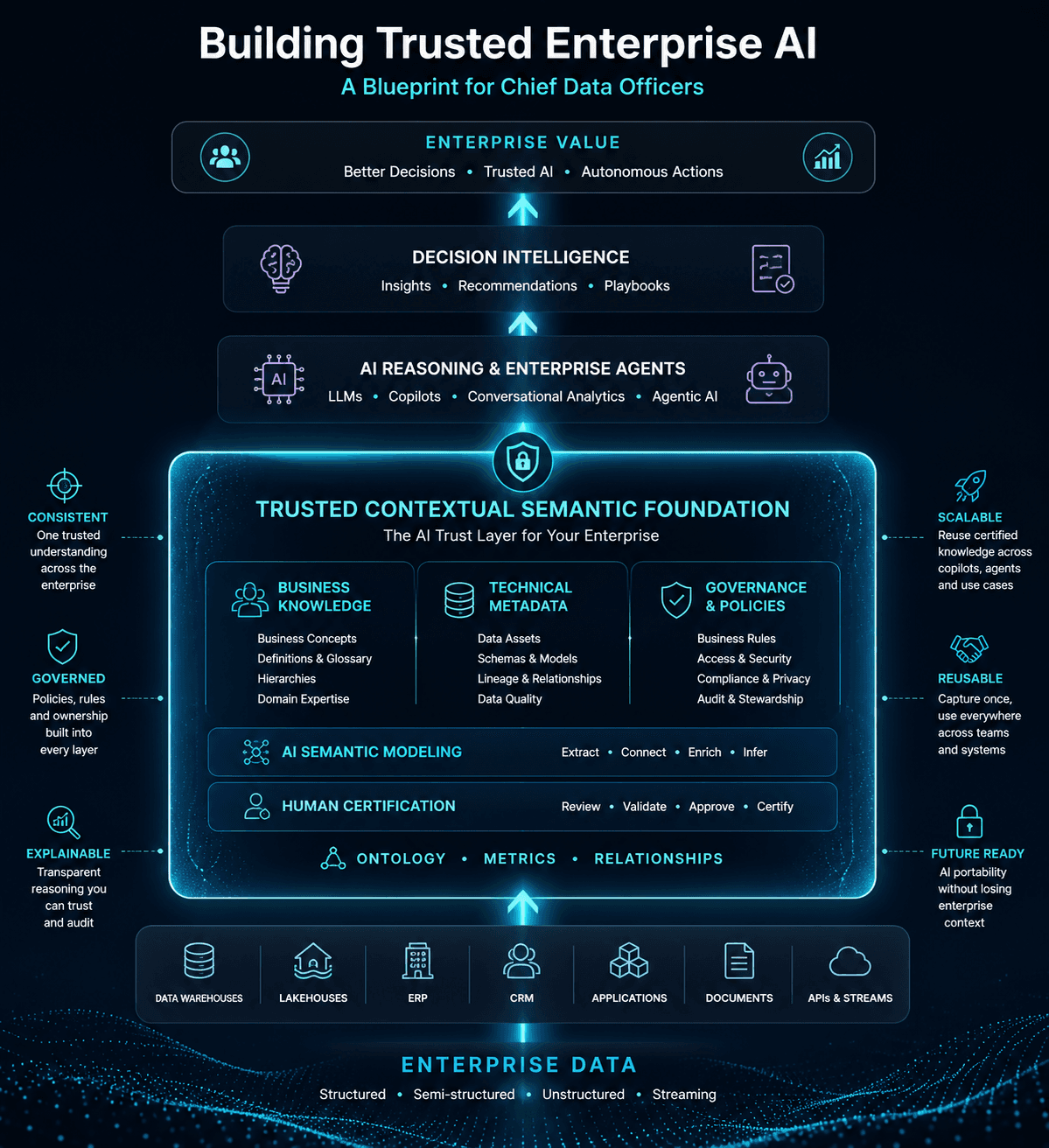
A contextual semantic layer provides that common understanding by combining technical metadata, business terminology, semantic relationships, governance policies, and certified metric definitions into a reusable enterprise knowledge foundation.
Instead of teaching every AI application independently, organizations teach the enterprise once.
Every application benefits.
This creates consistency not because AI models become identical, but because their understanding of the business becomes shared.
Human Expertise Becomes More Valuable, Not Less
Perhaps the greatest misconception surrounding enterprise AI is that human involvement should disappear.
The opposite is true.
As AI generates more content, more analyses, and more recommendations, the value of human expertise increases.
Subject matter experts possess years of accumulated business knowledge that rarely exists in documentation. They understand exceptions, historical decisions, organizational nuances, and regulatory constraints that AI cannot reliably infer from raw data alone.
The objective should never be removing humans from enterprise decision-making.
The objective should be capturing their expertise once and allowing AI to apply it consistently at scale.
This changes governance from a reactive process into a strategic capability.
AI can accelerate the creation of semantic models, business metrics, ontologies, and analytical assets.
Business and technical experts review, refine, and certify those artifacts.
Once approved, every AI application benefits from that trusted and governed knowledge.
Human judgment becomes reusable rather than repeatedly requested.
The Next Frontier Is Capturing How Experts Think
Business intelligence transformed reporting.
Self-service analytics transformed exploration.
Conversational analytics transformed how people ask questions.
The next transformation is far more significant.
Organizations must begin capturing not only what experts know, but how they reason. In our previous blog, From Dashboards to Decisions: Why the Next Generation of Analytics Is About Automating Human Expertise, we discussed at length the process of capturing human reasoning playbooks.
Experienced analysts rarely answer important business questions in a single step.
- They compare metrics.
- Investigate anomalies.
- Validate assumptions.
- Analyze contributing factors.
- Consult historical patterns.
- Consider business context.
- Evaluate alternatives.
- Recommend actions.
These investigative processes represent some of an organization's most valuable intellectual property.
Today they largely exist inside people's heads.
Tomorrow they should become reusable organizational assets.
By capturing trusted analytical reasoning as repeatable playbooks, organizations create consistent approaches to solving complex business problems. AI can execute portions of those playbooks while remaining transparent about the reasoning process and allowing humans to review recommendations before action is taken.
This represents a shift from simply generating answers toward scaling institutional expertise.
Build for AI Portability, Not Vendor Lock-In
Enterprise technology has always evolved.
Databases changed.
Analytics platforms changed.
Cloud providers changed.
AI models will change even faster.
The frontier model available today may not be the preferred enterprise model next year. Regulatory requirements, geographic restrictions, cost considerations, or new technological breakthroughs will inevitably influence future AI strategies.
Organizations that tightly couple business knowledge to individual models risk rebuilding context every time technology changes.
Instead, business context should remain independent of any single AI vendor.
Enterprise knowledge should outlive today's models.
A portable, governed knowledge foundation enables organizations to adopt new AI technologies without recreating years of accumulated business understanding.
The AI changes.
The business context remains.
A Blueprint for Trusted Enterprise AI
As CDOs evaluate their AI strategies, several architectural principles are becoming increasingly important.
Successful organizations are beginning to treat trusted AI as an architectural discipline rather than a collection of isolated projects.
A practical blueprint includes:
- Establishing governed business definitions that are shared across the enterprise.
- Building semantic models that connect technical metadata with business meaning.
- Embedding governance and certification into AI-generated artifacts.
- Creating reusable business metrics rather than redefining calculations for every application.
- Capturing expert analytical reasoning as repeatable playbooks.
- Ensuring every AI application operates from a common contextual foundation.
- Designing business knowledge independently from any individual AI model or technology platform.
These capabilities create consistency, transparency, and trust, qualities that become increasingly valuable as AI systems move closer to influencing or automating business decisions.
Trust Will Become the Competitive Advantage
The history of enterprise technology shows that competitive advantage rarely comes from adopting new technology first.
It comes from operationalizing that technology better than competitors.
AI will follow the same pattern.
Within a few years, access to advanced models will be commonplace. Autonomous agents will become standard features of enterprise software. Natural language interfaces will be expected rather than exceptional.
What will remain difficult to replicate is an organization's ability to deliver consistent, explainable, and trusted decisions across every AI interaction.
That capability cannot be purchased off the shelf.
It must be designed into the enterprise architecture.
For Chief Data Officers, the opportunity is profound.
Rather than viewing AI as another technology initiative, they have the opportunity to establish the trusted business foundation upon which every future AI capability will depend.
Organizations that invest in trust today won't simply deploy AI faster.
They will build enterprises capable of scaling AI confidently, transparently, and responsibly for years to come.
About Codd AI
At Codd AI, we believe enterprise AI should reason from a shared, trusted understanding of the business, not from isolated prompts or disconnected data sources. Our AI-powered contextual semantic layer combines technical metadata, business knowledge, governance, and human certification into a reusable enterprise foundation for conversational analytics, AI copilots, and agentic workflows.
By helping organizations capture and govern business context once, Codd AI enables every AI application to deliver more consistent, explainable, and trusted insights, today and as the AI landscape continues to evolve. To learn more, visit www.codd.ai or schedule a conversation with one of our co-founders.