Why the future of enterprise AI depends on Context Portability, not just LLM independence.
The old adage that the only constant is change is being turned upside down in the world of AI. If you have been following the AI industry over the past two years, it is not just the constant changes but the velocity of change and how fast things develop.
Every few months a new frontier model emerges claiming higher benchmark scores, better reasoning, lower costs, or larger context windows. GPT-5 raises the bar. Claude introduces new capabilities. Gemini closes the gap. Open-weight models rapidly improve. New agent frameworks appear almost weekly, promising to orchestrate increasingly sophisticated autonomous workflows.
For enterprise technology leaders, this pace of innovation is both exciting and unsettling.
The question many organizations are beginning to ask isn't simply, "Which model performs best today?"
It's a much more strategic question:
How do we avoid building tomorrow's AI strategy on yesterday's technology?
That question is reshaping enterprise architecture.
The organizations that succeed won't necessarily be those that select the "best" foundation model. They'll be the organizations that build an AI architecture capable of evolving as the technology evolves.
The key isn't choosing the right model.
It's ensuring your business knowledge isn't permanently tied to any vendor or model at all.
The New Technology Lock-In
Technology lock-in isn't a new concern.
For decades, enterprises have worked to avoid becoming overly dependent on proprietary databases, cloud providers, integration platforms, or operating systems. Open standards, APIs, containerization, and cloud portability all emerged because organizations understood that flexibility creates long-term resilience.
AI introduces a new form of lock-in.
It's easy to think of lock-in as simply selecting one LLM vendor over another. But in reality, the risk is much deeper.
Many organizations are embedding business logic, prompts, governance rules, semantic definitions, and even organizational knowledge directly into AI applications, copilots, and agent frameworks.
Initially, this seems efficient.
Until the technology changes.
Imagine spending two years developing hundreds of AI-powered business assistants, only to discover that a different model offers dramatically better reasoning, lower inference costs, or superior privacy controls.
Switching models should be straightforward.
Instead, organizations often discover they have coupled their business understanding to the very technology they hoped would remain interchangeable.
What looked like an AI deployment has quietly become an AI dependency.
AI Is Becoming More Than Just Models
Even if the industry eventually converges on a handful of dominant LLM providers, the surrounding AI ecosystem will continue to evolve.
Foundation models are only one layer of the stack.
Above them sit:
- AI copilots
- Autonomous agents
- Workflow orchestration engines
- Prompt management systems
- Agent frameworks
- Retrieval pipelines
- Guardrail technologies
- AI gateways
Each of these technologies is advancing independently.
Some will disappear.
Others will become industry standards.
Many will be replaced before organizations finish implementing their first generation of AI applications.
This means enterprises shouldn't simply ask:
"Can we change foundation models?"
They should ask something much broader:
Can we change any AI technology without rebuilding our business intelligence?
That's a very different architectural challenge.
Regulation Adds Another Layer of Uncertainty
Technology isn't the only force driving architectural flexibility.
Regulation is rapidly becoming just as important.
Organizations operating globally must navigate an increasingly complex landscape of privacy laws, data residency requirements, sovereign AI initiatives, and industry-specific compliance obligations.
In Europe, for example, organizations face evolving regulatory expectations around AI transparency, governance, and data protection. Similar initiatives are emerging in other regions, reflecting growing concerns over how AI systems are trained, deployed, and governed.
The practical implication is clear.
A model that is appropriate today may not be the preferred, or even available, choice tomorrow in every geography.
Whether driven by regulation, contractual obligations, customer requirements, or internal governance policies, enterprises increasingly need the ability to adopt different AI technologies across different regions and use cases.
Architectures that assume a single AI provider for the next decade are becoming increasingly difficult to justify.
Separate What Changes Quickly from What Doesn't
One of the oldest principles in enterprise architecture is separating stable assets from rapidly changing technologies.
Consider what changes frequently:
- Foundation models
- Copilots
- Agent frameworks
- Prompt engineering techniques
- Workflow orchestration platforms
- AI infrastructure
Now consider what changes much more slowly:
- Business definitions
- Revenue calculations
- Customer hierarchies
- Financial policies
- Compliance rules
- Operational metrics
- Product taxonomies
- Domain knowledge
One evolves every quarter.
The other often evolves over years.
Yet many organizations are storing long-lived business understanding inside technologies that may change every few months.
That's an architectural mismatch.
Moving Beyond LLM Independence Towards AI Portability
A first step towards architectural flexibility often starts with becoming "LLM agnostic."
That's a good start. But it's not enough.
True architectural flexibility isn't simply about replacing one language model with another.
It's about ensuring that every AI technology, from copilots to autonomous agents, can evolve without forcing the organization to redefine how the business itself works.
Think of it as AI Portability.
Just as cloud portability allows workloads to move between infrastructure providers, AI portability enables organizations to adopt new AI technologies without rebuilding business logic, governance, or semantic understanding.
AI components become interchangeable.
Business understanding remains constant.
But AI portability raises one final question.
If business knowledge shouldn't live inside individual AI systems, where should it live?
Introducing Context Portability
This is where a new architectural principle begins to emerge. Every enterprise already treats its data as a strategic asset. Increasingly, enterprises are recognizing that their business context is equally valuable.
- Business definitions
- KPIs
- Governance policies
- Business rules
- Semantic relationships
- Domain expertise
- Organizational vocabulary
These aren't features of an AI model. They're intellectual property. They're part of the enterprise itself.
Rather than recreating this knowledge inside every copilot, every agent, every prompt library, and every AI application, organizations should manage it once and make it available everywhere.
This is what we call Context Portability.
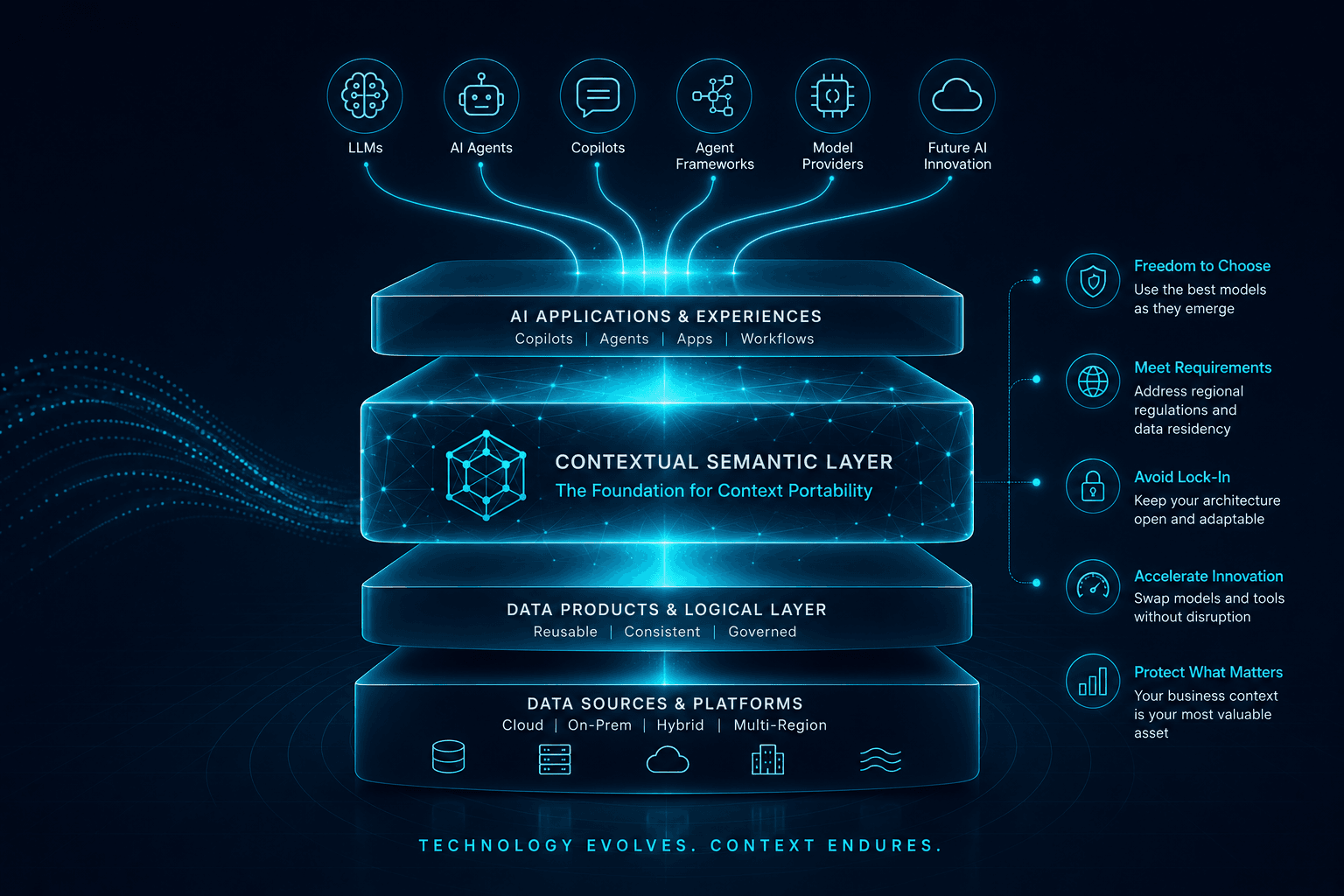
Context Portability means your certified business understanding can move freely across AI technologies without being rewritten, reinterpreted, or reimplemented every time the AI landscape changes.
The Role of the Contextual Semantic Layer
A contextual semantic layer makes Context Portability possible.
Rather than embedding business logic inside individual AI applications, it provides a governed, reusable representation of how the enterprise understands its data.
It combines technical metadata with business definitions, relationships, policies, metrics, synonyms, and domain knowledge into a shared context that every AI consumer can access.
That includes:
- Business intelligence platforms
- AI copilots
- Autonomous agents
- Conversational analytics applications
- Custom enterprise AI solutions
- Future AI technologies that haven't yet been invented
Each of these systems can continue evolving independently.
The business context they rely upon remains consistent.
Instead of every AI application maintaining its own interpretation of "customer," "revenue," "gross margin," or "active subscriber," every system reasons from the same certified business understanding.
Why Agentic AI Makes This Essential
The importance of Context Portability becomes even greater as enterprises embrace agentic AI.
Most organizations won't deploy a single AI agent.
They'll deploy dozens. Eventually, perhaps hundreds.
- Sales agents
- Finance agents
- Supply chain agents
- Customer service agents
- Planning agents
- Risk management agents
Each will perform different tasks. Each may even use different AI models. But none of them should invent their own version of the business.
Without shared context, organizations risk creating a fragmented AI workforce where every agent develops slightly different interpretations of customers, products, financial metrics, and operational processes.
That isn't intelligent automation.
It's distributed inconsistency.
Shared context allows autonomous agents to specialize in execution while maintaining a common understanding of the enterprise they serve.
Designing for the Next Decade of AI
The AI industry will continue evolving.
Models will improve.
Costs will decline.
Capabilities will expand.
Regulations will mature.
New frameworks will emerge.
Others will disappear.
Organizations cannot predict which technologies will dominate five years from now.
They don't need to.
They simply need to ensure that the parts of their architecture that represent enduring business knowledge remain independent of the technologies that consume them.
The most valuable asset in enterprise AI isn't the model.
It's the business context that allows every model, every copilot, and every autonomous agent to reason consistently about the enterprise.
The future belongs to organizations that build architectures where AI technologies are replaceable, but business understanding is permanent.
That's the promise of AI Portability.
And that's the power of Context Portability.
About Codd AI
Codd AI is a leading provider of contextual semantic layers that operate independently of your LLMs, databases, agentic platforms, BI tools, and popular end user productivity tools. Our focus is building an AI native, business fluent foundation that will bring accuracy, trust, and governance to your AI initiatives. If you are interested in finding out more, you can schedule an appointment directly.