For years, the purpose of a semantic layer has been relatively straightforward.
It provided a business-friendly representation of enterprise data so business intelligence tools could answer questions consistently. It defined metrics, relationships, hierarchies, dimensions, and calculations so analysts didn't have to repeatedly rebuild business logic in every dashboard or report.
But artificial intelligence is changing what a semantic layer can become.
As AI begins to automate the creation of semantic artifacts, many organizations naturally focus on one benefit: speed. Instead of spending months manually modeling data, documenting business definitions, and building metrics, AI can now generate much of that work automatically.
Speed is valuable.
But it isn't the most important innovation.
The real transformation begins after the semantic foundation has been built.
Once AI truly understands your business and your data, why stop at generating business metrics?
Why not teach it entirely new skills?
AI Can Build the Foundation Faster Than Ever
Modern AI models have become remarkably capable of understanding both technical metadata and business documentation.
Given database schemas, data dictionaries, business glossaries, business knowledge and rules, policies, and sample data, AI can now generate many of the core artifacts required for an enterprise semantic layer.
These include:
- Analytical ontologies
- Business concepts and entities
- Logical data models
- Relationships between business objects
- Synonyms and business vocabulary
- Calculated measures
- Dimensions
- Initial business metrics
Tasks that previously required weeks of manual effort can now be accelerated dramatically.
This changes the economics of building semantic models.
But speed alone doesn't create trust.
Automation Without Trust Doesn't Scale
Many AI-powered platforms stop once the artifacts have been generated. The assumption is that if AI created them, they must be good enough.
Enterprise organizations know better.
Business definitions aren't simply technical constructs.
Revenue may have different meanings across business units.
A customer may be defined differently by finance, sales, and operations.
Gross margin calculations often include organization-specific business rules.
Regulatory policies vary across industries and geographies.
These aren't details AI should invent. They require human expertise.
That's why one of the most important architectural principles behind platforms like Codd AI is that AI accelerates creation, but humans certify understanding.
AI proposes.
Business and technical experts review.
Definitions are refined.
Relationships are validated.
Business rules are confirmed.
Only after certification does the semantic foundation become a trusted enterprise asset.
This human-in-the-loop process isn't a bottleneck. It's the mechanism that transforms automation into repeatable enterprise trust.
Without certification, every downstream AI capability inherits uncertainty.
With certification, every future capability inherits confidence.
The Real Opportunity Begins After Certification
This is where something interesting happens.
Once AI has generated (and humans have certified) a rich understanding of the enterprise, you've created far more than a reporting model.
You've created a reusable knowledge foundation. The AI no longer needs to rediscover how your business or data works.
It already understands:
- Customers
- Products
- Orders
- Suppliers
- Financial relationships
- Business policies
- KPIs
- Metadata
- Business terminology
- Data relationships
The expensive work of understanding the business has already been completed.
Now, instead of teaching AI the business again, you simply change what you ask it to accomplish.
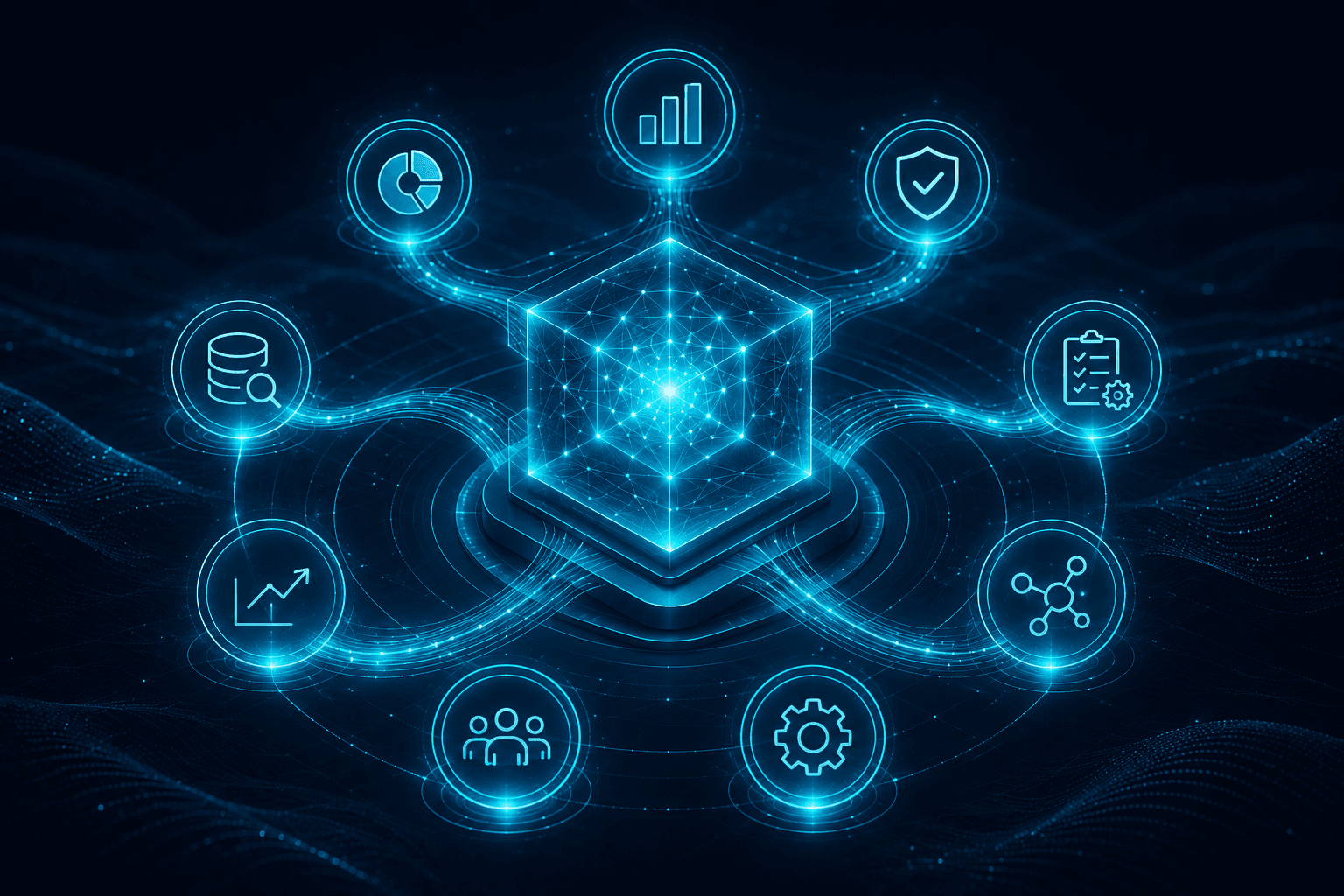
That is the idea behind Semantic Skills.
Introducing Semantic Skills
A Semantic Skill is a reusable AI reasoning capability that operates on a certified contextual semantic foundation.
The foundation remains unchanged.
Only the objective changes.
Think of it this way: the semantic layer already understands your enterprise. A Semantic Skill tells AI how to apply that understanding.
Today, one skill may generate business metrics.
Tomorrow, another skill may evaluate data quality.
Another may identify governance risks.
Another may assess regulatory compliance.
Each skill builds upon exactly the same certified semantic understanding.
The intelligence is reused rather than recreated.
Instead of rebuilding business knowledge for every new use case, organizations teach the semantic foundation new skills.
Business Metrics Are Only the Beginning
The first and most obvious Semantic Skill is business metric generation.
Given a certified semantic model, AI can derive meaningful business metrics such as:
- Revenue by product family
- Gross margin by region
- Customer lifetime value
- Inventory turnover
- Order fulfillment performance
These are the kinds of metrics business users expect from modern analytics platforms.
But they're only one possible outcome.
The same semantic understanding can be directed toward entirely different objectives.
Teaching AI a Data Quality Skill
Consider the perspective of a data engineering team.
Their priorities are very different from those of a sales executive.
Instead of asking "What is gross margin?", they ask:
- "How many products don't have suppliers?"
- "Which orders reference customers that don't exist?"
- "How many invoices contain invalid dates?"
- "Which records violate our business rules?"
Traditionally, answering these questions requires custom SQL, manually developed validation scripts, or dedicated data quality platforms.
But a certified semantic foundation already understands the relationships between these business entities.
It knows that:
- Orders should reference customers.
- Products should reference suppliers.
- Invoices should contain line items.
- Employees should belong to departments.
- Locations should map to regions.
Instead of generating business KPIs, AI can generate data quality metrics such as:
- Orders without customer codes
- Products without suppliers
- Customers missing territories
- Duplicate business entities
- Invalid effective dates
- Orphaned relationships
- Missing mandatory attributes
The underlying semantic understanding hasn't changed.
Only the Semantic Skill has.
One Foundation. Multiple Audiences.
What's particularly powerful is that these insights can now be delivered through exactly the same experiences organizations already use.
Business users continue consuming trusted business metrics through dashboards, conversational analytics, and BI platforms.
At the same time, technical teams gain an entirely new layer of operational intelligence.
Data quality dashboards can continuously monitor:
- Data quality scores
- SLA compliance
- Referential integrity
- Missing business relationships
- Data completeness
- Critical validation failures
The same contextual semantic layer serves both business and technical audiences.
One foundation.
Different perspectives.
Different skills.
From Insight to Action
The opportunity becomes even more compelling when combined with agentic AI.
Imagine a Semantic Skill identifies that hundreds of new orders have been received without valid customer codes.
A traditional dashboard simply displays the problem.
An intelligent workflow can do much more.
The Semantic Skill detects the issue.
An AI agent immediately begins a predefined playbook.
It identifies which business units are affected.
Determines which downstream reports may be compromised.
Calculates the business impact.
Identifies the responsible data steward.
Creates a ServiceNow incident.
Notifies the appropriate Microsoft Teams channel.
Suggests probable root causes based on historical patterns.
Monitors remediation until the SLA has been restored.
The semantic layer is no longer simply describing the state of the business.
It is enabling intelligent operational workflows that continuously improve it.
The Beginning of a Library of Semantic Skills
Data quality is only the first example.
Once organizations possess a certified semantic foundation, they can continue extending its capabilities.
Imagine Semantic Skills for:
- Governance monitoring
- Compliance validation
- Master data management
- Regulatory reporting
- Risk identification
- Forecasting
- Sustainability metrics
- Data product certification
- AI readiness assessments
- Security policy validation
Every new skill reuses the same certified understanding of the enterprise.
No rebuilding.
No rediscovery.
No duplicated business logic.
Each new capability compounds the value of the original semantic foundation.
A Different Way to Think About Enterprise AI
For years, organizations viewed semantic layers as infrastructure supporting business intelligence.
Today, they're becoming essential infrastructure for AI.
Tomorrow, they may become something even more valuable: a programmable intelligence foundation.
One where AI continuously generates new enterprise capabilities simply by applying new Semantic Skills to an already trusted understanding of the business.
This is why human certification matters so much.
Without trust, every downstream capability becomes questionable.
With trust, every new Semantic Skill inherits the confidence established during the original certification process.
Business metrics become trusted.
Data quality becomes trusted.
Governance becomes trusted.
Autonomous AI workflows become trusted.
The return on investment isn't limited to building one semantic model faster.
It's creating an enterprise intelligence foundation that can be reused again and again.
The organizations that gain the greatest value from AI won't necessarily be those deploying the largest number of models or autonomous agents.
They'll be the organizations that build a certified semantic foundation once, and continue teaching it new skills for years to come.
About Codd AI
The future of enterprise AI won't be defined by how many copilots, agents, or LLMs an organization deploys. It will be defined by the strength, trustworthiness, and reusability of the semantic foundation that powers them all.
Codd AI was built for that future. Our AI-powered platform automatically generates the core semantic artifacts that form your contextual semantic foundation (from analytical ontologies and data models to business metrics and Semantic Skills), dramatically accelerating what has traditionally been a manual, time-consuming process. Unlike approaches that rely solely on AI-generated outputs, Codd AI places domain experts and data stewards directly in the loop to review, refine, and certify every artifact before it becomes part of your trusted enterprise foundation.
The result is a certified semantic foundation that AI can reason over with confidence: whether delivering conversational analytics, generating business and data quality insights, or orchestrating autonomous agentic workflows. As your business evolves, you don't rebuild your enterprise knowledge; you simply teach your semantic foundation new skills.
If you're ready to build a trusted semantic foundation that grows with your business and your AI strategy, we'd love to show you what's possible. Visit www.codd.ai or schedule a conversation with the Codd AI founders here.