There is a pattern I keep seeing in conversations with data and analytics leaders.
You start talking about AI in analytics: natural language queries, conversational interfaces, "ask your data anything."
And almost immediately, there is alignment.
"Yes, this is exactly where we need to go."
Everyone agrees that traditional BI has limitations:
- It is too slow
- Too dependent on analysts
- Too rigid for how businesses actually operate
And most people also agree on something else:
The current wave of copilots and chatbots is not quite there yet.
They are helpful. They are impressive. But they are not something you would fully trust for decision-making.
So here is the real question:
If everyone agrees on the problem, why is there not more urgency to fix it?
It Is Not an Analytics Problem. It Is a Trust Problem
Most organizations still frame this as:
"We need better analytics tools."
But the issue is much deeper:
We are making decisions on systems that cannot guarantee consistent answers.
That is a very different conversation. Because once you frame it that way, it is no longer about dashboards or UX.
It becomes about:
- Trust
- Alignment
- Decision quality
Let me make it concrete.
If two executives ask the same question and get different answers, what happens next?
They do not move faster. They do not trust the system. They start debating the numbers.
And suddenly, you are back in the same place AI was supposed to fix.
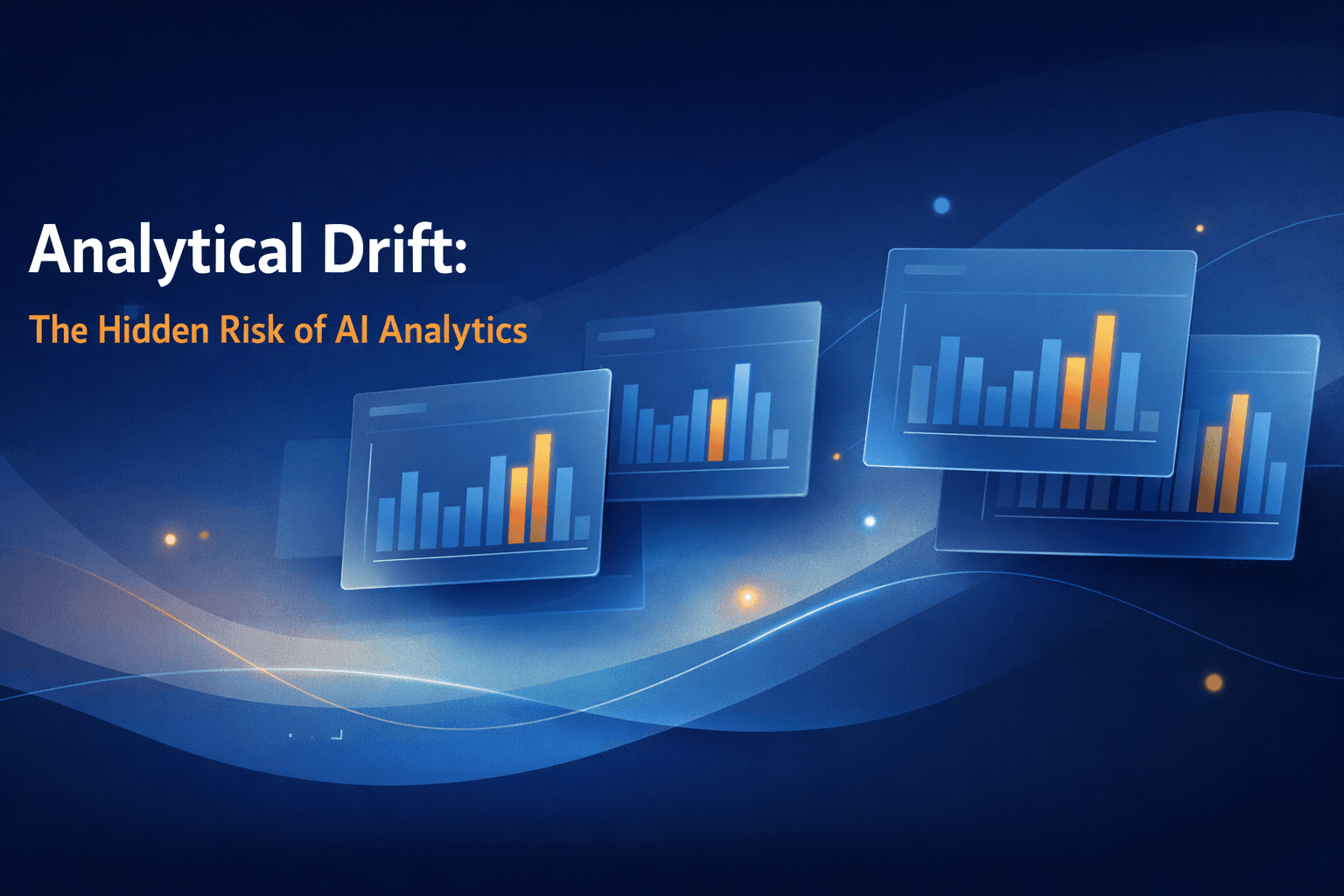
The Problem No One Is Naming: Analytical Drift
There is a concept that is quietly emerging in modern data environments:
Analytical Drift.
It is simple:
The same business question produces different answers depending on who asks it, how it is asked, or which tool is used.
You have probably seen this already.
- One team pulls revenue one way
- Another team uses a slightly different definition
- A copilot generates SQL based on its interpretation
- A chatbot answers based on whatever context it has
Individually, each answer looks reasonable. Collectively, they do not line up.
At a small scale, this feels like noise. At enterprise scale, it becomes something much bigger:
- Conflicting KPIs
- Endless "which number is right?" conversations
- Slower decision-making
- Erosion of trust in data
And ironically, the more you adopt AI, the worse this can get.
"Helpful" AI Is Not Good Enough for Analytics
One of the most common things I hear is:
"It is not perfect, but it is helpful."
That is fine in the right context. If AI helps you draft an email or summarize a document, 80% accuracy is great.
But analytics requires a different rigor. Analytics drives decisions. And decisions require consistency.
An answer that is usually right is not actually helpful in this context.
It is risky. Because the real issue is not just that the answer might be wrong. It is that you do not know when it is wrong.
The Illusion That You Have Already Solved This
A lot of organizations feel like they are making progress.
They have rolled out:
- Copilots in their data platforms
- Natural language querying in BI tools
- Chatbots connected to internal data
On paper, it looks like a big step forward.
But here is the reality:
Most of these tools were never designed to be systems of record for decisions.
They are designed to assist. They help:
- Generate queries
- Explore data
- Speed things up in the tool itself
But they do not guarantee:
- Consistent metric definitions
- Shared business logic
- Repeatable answers across users
And yet, that is exactly how they are starting to get used.
When This Becomes a Leadership Problem
At first, this shows up as a data problem. But it does not stay there. It quickly becomes a leadership issue.
Because now you are in a situation where:
- Sales has one version of the number
- Finance has another
- Marketing has a third
All coming from the same data.
Now what? Who is right? Which number do you take to the board?
This is no longer a data problem. This is about organizational alignment and credibility.
The Scaling Problem No One Talks About
This is where things get really interesting.
AI does not just expose this issue. It amplifies it.
In traditional BI:
- A limited number of dashboards exist
- A limited number of people use them
- Inconsistencies are somewhat contained
In AI-driven environments:
- Everyone can ask questions
- Questions can be phrased differently
- Answers can vary based on context
So as adoption increases, so does inconsistency.
That is the paradox.
The more successful your AI rollout is, the more variability you introduce, unless something governs it.
What Is Actually Missing
At the core of all of this is something surprisingly simple:
There is no consistent, shared understanding of the business.
Most systems today operate on:
- Tables
- Schemas
- Column names
- Maybe some light semantic labeling
But they do not truly understand:
- What a metric actually means
- How different concepts relate
- What rules and assumptions apply
- How the business really operates
So what does AI do? It fills in the gaps. It guesses. It infers.
And that is where inconsistency is born.
The Fork in the Road
At this point, most organizations are heading down one of two paths.
Path 1: Keep Layering AI on Top
- More copilots
- More chat interfaces
- More tools trying to interpret the data
It is easy. It is incremental.
But it comes with a tradeoff: you never fully trust the answers.
Path 2: Fix the Foundation
- Establish shared business context
- Standardize definitions and logic
- Ensure consistency across all interfaces
This takes more effort upfront.
But it unlocks something fundamentally different: AI you can actually trust.
A Simple Test
If you want to pressure-test where you are, ask this:
If 100 people in your company ask the same question in natural language, will they get the same answer?
If the answer is no, that is the problem.
And it is not something better dashboards or faster copilots will fix.
Why This Is Becoming Urgent
In the past, inconsistencies in data were manageable.
- Access was limited
- Usage was controlled
- The impact was contained
That is no longer true.
Now:
- Anyone can ask questions
- AI can generate answers instantly
Which means inconsistency is now:
- More visible
- More frequent
- More damaging
At the same time, organizations are increasingly relying on data for:
- Real-time decisions
- Automated workflows
- AI-driven operations
So the tolerance for "mostly right" is disappearing.
The Real Risk
The risk is not that your AI tools are not perfect.
The risk is that they are:
- Widely adopted
- Easy to use
- And not consistently reliable
That combination is dangerous.
Because it creates:
High usage + low consistency = systemic decision risk
And over time, that leads to:
- Slower decisions (because people do not trust the data)
- Worse decisions (because sometimes the data is wrong)
- More friction (because teams do not align)
Final Thought
The industry has done an incredible job solving:
- Data infrastructure
- Data storage
- Data access
We have made it easier than ever to get answers.
But we have not solved something much more important:
Making sure those answers are consistent.
And until we do, AI in analytics will always fall short of its promise.
That is the difference between experimenting with AI and actually transforming how decisions get made.
Introducing Codd AI
Codd AI is the leader in the emerging category of contextually-aware AI platforms. Codd AI automatically builds a governed Contextual Semantic Layer comprising your technical metadata, business knowledge, and rules. This semantic layer then becomes the foundation for AI to drive conversational analytics, reasoning about your data and your business like one of your own subject matter experts.
If you are interested in learning more, visit us at www.codd.ai or schedule a quick chat!