Last week I attended the Gartner Data & Analytics Summit 2026 in Orlando FL. The conversations were no longer about whether AI would change analytics. That debate is over. The conversations were about why so many AI initiatives are failing to deliver value, and what it will take to fix them.
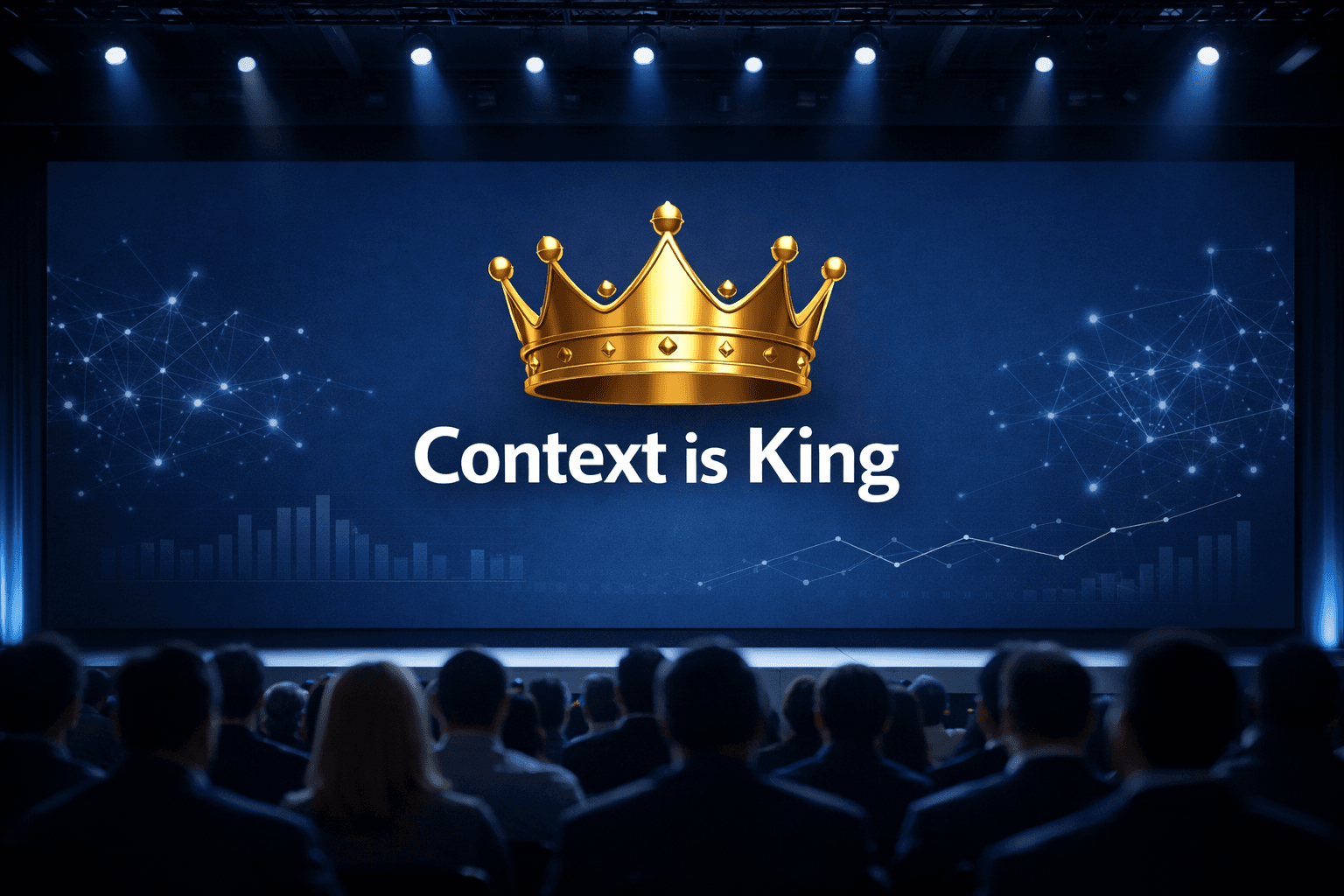
What I took away from the summit reinforced something we have believed at Codd AI since the very beginning: without deep business context, AI analytics will never deliver on its promise. Hearing Gartner arrive at the same conclusion, and declare "Context is King", was a powerful moment of validation for everything we have been building.
Here are my key observations from the summit and why they matter.
The Industry Is Deploying AI Everywhere, and Struggling Everywhere
The overall message from the summit was sobering. AI deployments have surged dramatically. Nearly every organization is investing in GenAI, AI, or analytics. But the return on that investment is nowhere close to matching the ambition.
The gap between AI adoption and AI value was a dominant theme. Organization after organization described the same pattern: AI pilots that generate plausible-looking answers but fail to earn trust, scale, or deliver consistent results in production.
My takeaway: this is not a technology problem. It is a context problem. AI models are extraordinarily capable, but when they operate without a structured understanding of how the business actually works, its metrics, rules, definitions, and relationships, they produce confident nonsense. We recognized this from Codd AI's inception, and it is why we built the Contextual Semantic Layer as the foundation, not an afterthought.
Context Is Not Just Important. It Is the Foundation
One of the strongest themes running through the summit was the critical role of context. Gartner reframed ROI itself into three new dimensions: Return on Intelligence, Return on Integrity, and Return on Individuals. What struck me is the connective tissue running through all three: context.
You cannot achieve Return on Intelligence if AI does not understand your business. You cannot achieve Return on Integrity if governance is detached from business meaning. And you cannot achieve Return on Individuals if people cannot trust the answers AI gives them.
This maps directly to what we have been writing about for the past two years. Having context, retrieving documents, injecting metadata into prompts, is not the same as understanding context. The difference is the Contextual Semantic Layer: a structured representation that bridges business language and data language in a way AI can actually reason over.
Business users speak in terms of revenue, margins, customer segments, and KPIs. Data systems speak in tables, columns, joins, and SQL. The bridge between them has historically been manual, fragile, and incomplete. When AI enters this picture without that bridge, the results are predictable: plausible SQL, plausible numbers, wrong answers.
At Codd AI, bridging business language and data language has been our core mission from day one. Our Contextual Semantic Layer combines technical metadata with business logic, rules, KPI definitions, and entity relationships into a single unified semantic model. This is not a traditional semantic layer with friendly names on top of SQL. It is a structured representation of how the business actually works.
Governance Must Evolve from Trusted Data to Trusted Decisions
Another observation that resonated deeply: the summit made it clear that governance in the AI age needs to go beyond data quality and access control. The shift is from asking "Is this data fit-for-purpose?" to asking "Should we use AI for this? Under what constraints? And can we trust the decisions it produces?"
Several speakers described governance not as a regulator but as a value accelerator. The organizations getting real value from AI are the ones embedding governance into the fabric of their AI systems, not bolting it on after the fact.
This is exactly how we designed Codd AI. Our human-in-the-loop validation with confidence scoring ensures that governance is baked into the semantic layer from creation. Business users validate and refine what AI discovers. The result is a governed model that people trust because they helped build it.
And because our common Contextual Semantic Execution Engine sits underneath every AI agent, every BI tool, and every analytical endpoint, governance is not a separate process. It is inherent in every query path. Business rules and metric definitions are encoded as executable context, as policy-as-code, not policy-in-a-document that AI cannot access.
We have been building this way from inception because we saw early on that trust is the prerequisite for AI adoption at scale. It was gratifying to hear the industry arriving at the same conclusion.
The "Break, Not Shift" Moment
One of the most striking observations from the summit was the framing that this is not an incremental evolution. The old approaches to analytics and data management do not gradually mature into AI-ready platforms. This is a fundamental break.
Most enterprises are stuck in what I would call the opportunistic middle ground. They have deployed pilots, built proof-of-concepts, and stood up copilots. But they are struggling to move from experimentation to production. The organizations that succeed are the ones that invest in the foundational layer, the Contextual Semantic Layer, before scaling AI across the enterprise. Without that foundation, every new AI deployment creates another inconsistency.
Codd AI was built for exactly this break. We did not retrofit a legacy BI tool. We designed and built from scratch for a world of GenAI. Both the semantic layer creation (automated with AI, validated by humans) and the end-user conversational analytics are natively AI-powered. This was a deliberate architectural choice from our founding, and it is the reason we can move organizations from raw data estate to governed, contextual AI analytics in days rather than months.
Three Takeaways for Data & Analytics Leaders
Based on what I observed at the summit and what we see working with organizations building AI-powered analytics, here are three priorities worth acting on now:
1. Treat Context as the Foundation, Not a Feature
Without a structured representation of business meaning, AI will keep producing inconsistent results. A Contextual Semantic Layer is not a nice-to-have enhancement to your analytics platform. It is the foundation. If you do not have one, every AI initiative you deploy is building on sand.
Additional reading: AI with Context vs AI with a Contextual Semantic Layer
2. Automate Semantic Layer Creation
The modern data estate is a sprawl of tables, columns, and undocumented business logic. Manual data modeling cannot keep pace. Use AI to discover entities, relationships, and metrics from your existing data, then validate with human-in-the-loop governance. This is the only way to achieve the speed the business demands while maintaining the trust governance requires.
Additional reading: The Contextual Semantic Layer: Powering Trusted GenAI Analytics
3. Unify Your AI Truth
As AI proliferates across your organization, with copilots in BI tools, agents in Slack, and assistants in every SaaS product, every endpoint needs to operate from the same contextual foundation. Without a common semantic execution engine, you are multiplying inconsistency by the number of AI touchpoints in your organization. One semantic layer. One version of truth. Every AI, everywhere.
Additional reading: Beyond Co-Pilots and Chatbots: Why the Future of AI Is Context-Aware
The Bottom Line
Walking out of the summit, the message was clear: the industry is catching up to what we have believed and built at Codd AI since inception. Context is King.
The question for every data leader is no longer whether to invest in a Contextual Semantic Layer. It is how fast you can get one in place.
The organizations that will lead in the age of AI are not the ones with the most models, the most agents, or the most dashboards. They are the ones that gave AI something every other approach has failed to provide: a genuine understanding of the business itself.
If you are exploring how a Contextual Semantic Layer can accelerate your AI analytics journey, we would love to have a conversation. Schedule a discussion with our team.