Every enterprise is feeling the same pressure right now:
"We need to figure out our AI analytics strategy, fast."
Dashboards are not keeping up with the pace of business. Ad-hoc questions are overwhelming analytics teams. Executives want conversational access to data, not SQL queries, not Looker skills, not another training session. And GenAI has introduced a new expectation: You should be able to ask a question in natural language and get the right answer back instantly.
So the question every data and analytics leader eventually hits is:
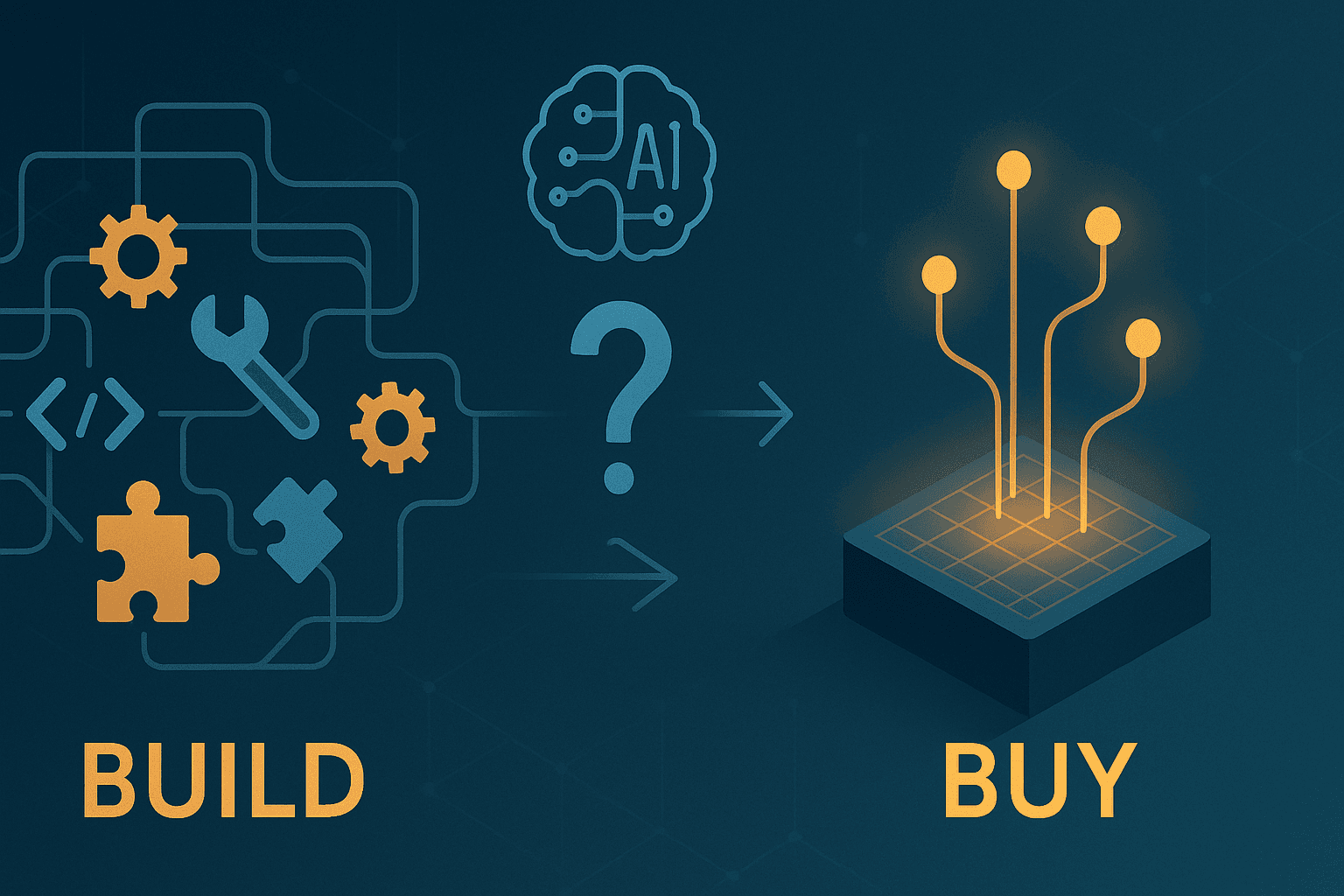
Do we build our own AI-powered analytics stack, or do we buy something that is already built?
At first glance, this feels like a simple technology decision. But in reality, it is an architectural, operational, and long-term strategic choice. And the nuances matter.
Let's break it down.
AI Analytics Isn't "Another BI Tool": It's a New Architectural Layer
Generative AI has created a massive misconception:
"If we just bolt an LLM on top of the warehouse or BI layer, we'll have AI analytics."
Unfortunately, that is not how it works.
For AI analytics to be accurate, consistent, governed, and safe enough for enterprise use, you need three foundational building blocks:
Business context
- Your metric definitions
- Your business logic
- Your data relationships
- Your hierarchies and rules
- Your domain knowledge
Governance and security
- Permissions
- Row-level policies
- Sensitive data handling
- Explainability
Agent intelligence
- Multi-step planning
- SQL generation
- Validation loops
- Error correction
- Tool use orchestration
This is a platform, not a wrapper around ChatGPT. And that is why the build vs. buy question is so important, because what you're deciding whether to build is significantly bigger than a chatbot.
What "Build" Really Means in the World of AI Analytics
Most organizations underestimate what it takes to deliver AI-powered analytics that people can trust.
Here is what actually goes into building it yourself:
1. Engineering a Contextual Semantic Layer
You need to codify:
- your metric definitions
- your business rules
- your data relationships
- your ontologies and taxonomies
- your logic about how different domains interact
This becomes the "business brain" the AI relies on. Without it, the AI hallucinates or guesses.
2. Building High-Quality Retrieval Infrastructure
RAG is deceptively hard. Beyond embeddings, you need:
- chunking strategies
- indexing pipelines
- metadata enrichment
- refresh logic
- relevance tuning
- evaluation frameworks
This is a full-time job for a dedicated AI platform team.
3. Governance, Security, and Permissions
Your AI system must respect:
- user access rules
- row-level filtering
- data masking
- auditability
- compliance requirements
This is non-negotiable in enterprise environments.
4. Multi-Agent Orchestration
Reliable GenAI analytics requires multiple agents working together:
- a planner
- a retriever
- a SQL generator
- a validator
- a reasoning engine
- a summarizer
These must be coordinated and error-resistant.
5. Continuous Maintenance
Once you build it, you are on the hook for updating logic, adjusting definitions, retraining prompts, fixing inaccurate reasoning, updating embeddings, evaluating outputs, and managing drift.
AI systems degrade without constant tuning.
So "build" does not mean building a chatbot. It means building an entire AI analytics platform and maintaining it indefinitely.
The Pros of Building Yourself
Let's be fair: there are reasons why building your own system might make sense.
You get total customization Your logic, your workflows, your rules, exactly the way you want.
You control the entire stack Infrastructure, pipelines, security posture, and roadmap all stay internal.
You can differentiate If your business model is unusual or proprietary, building may unlock competitive advantage.
You align with engineering culture Some organizations simply prefer to build core systems themselves.
If you have a large, highly skilled AI/ML engineering team and want AI to be a core competency, building might make sense.
But for everyone else...
The Tradeoffs (and Risks) of Building
This is where the real friction appears.
1. Talent is extremely hard to hire and retain
True GenAI platform engineers, semantic modelers, and retrieval specialists are scarce. Even Big Tech struggles to fill these roles.
2. Time-to-value is long
Even with a strong team, building a reliable, governed AI analytics system typically takes 12 to 24 months. And that is optimistic.
3. Business logic changes constantly
Fine-tuning or retraining an LLM does not fix this. Your definitions evolve weekly, and your AI needs to reflect that instantly.
4. Inconsistency becomes a real problem
If different teams build different layers of context, you can expect metric drift, conflicting answers, loss of trust, and alignment issues.
5. Higher risk of failure
Most internal AI analytics projects stall after the POC stage because teams hit the context governance wall.
In short: Most organizations underestimate 80% of the complexity involved in building.
The Case for Buying: What Purpose-Built Platforms Deliver
Buying is not about outsourcing innovation. It is about starting with the right foundation so you can innovate faster.
A purpose-built AI analytics platform (like Codd AI) typically provides:
1. A Prebuilt Contextual Semantic Layer
This is the engine that:
- codifies business rules
- synchronizes definitions
- maps data relationships
- unifies organizational context
- explains outputs
It is the part that is hardest to build and easiest to get wrong.
2. Governance-First Architecture
Including:
- RBAC
- row/column-level security
- audit logs
- lineage
- safe execution
Essential for enterprise trust.
3. Proven Retrieval and Reasoning Frameworks
The retrieval, prompting, validation, and agent orchestration are already engineered and continuously improved.
4. Rapid Time-to-Value
You get:
- usable insights in weeks, not years
- immediate access to best practices
- faster iteration
- lower cost of ownership
5. Built-in Evolution
Vendors continuously update:
- context modeling
- retrieval techniques
- agent capabilities
- evaluation systems
- model integrations
- connectors to your tech stack (databases, document repositories)
Your system gets better over time without your team rebuilding everything. Buying gives you the platform, so your team can focus on the outcomes.
The Hybrid Insight: Even If You Build, You Still Need a Context Layer
This is the key truth:
Even if you build your own AI agents...
Even if you fine-tune your own models...
Even if you develop your own RAG pipelines...
You still need a single, governed, enterprise-wide contextual semantic layer that defines:
- your metrics
- your business logic
- your rules
- your hierarchies
- your data relationships
Without it, you cannot get consistency, trust, or accuracy, no matter how good your agents are. This layer is the foundation for AI-powered analytics. Everything else sits on top of it.
So... Build or Buy? A Practical Decision Guide
You are probably a Build organization if:
- You have a 40+ person AI platform team
- You have already invested in semantic modeling
- Your business model is highly specialized
- AI is a core strategic differentiator
- You are comfortable with a 12 to 24 month build cycle
You are probably a Buy organization if:
- You want results in months, not years
- You have inconsistent metric definitions today
- You lack deep GenAI + semantic engineering talent
- Governance and accuracy are non-negotiable
- You want AI to scale across the entire organization
- You want a stable foundation without long-term maintenance cost
Most companies fall into the second category.
Conclusion: It's Not Build vs. Buy, It's Build vs. Buy the Foundation
AI-powered analytics requires more than an LLM. It requires context, governance, and multi-agent intelligence working together.
The real decision is not:
"Should we build our own AI analytics tool?"
It is:
"Should we build the foundational context and intelligence layer ourselves... or buy that layer and focus on delivering business impact?"
The organizations that get this right will deliver AI-powered insights faster, more accurately, and more safely than anyone else.
And they will be the ones who turn AI from a curiosity into a true competitive advantage.
If you are interested in learning more about Codd AI, have a look at our overview demo videos or schedule a 30 minute call with our team.