Over the past year, as enterprises accelerate their GenAI adoption, a common question emerges in strategy meetings:
"Should we fine-tune an LLM on our data, or should we focus on providing better context?"
It's the right question to ask. But the answer isn't either/or. It's understanding what each approach actually solves, and when to use them together.
The Two Paths to AI Customization
When organizations want to make AI work better for their specific needs, they typically consider two approaches:
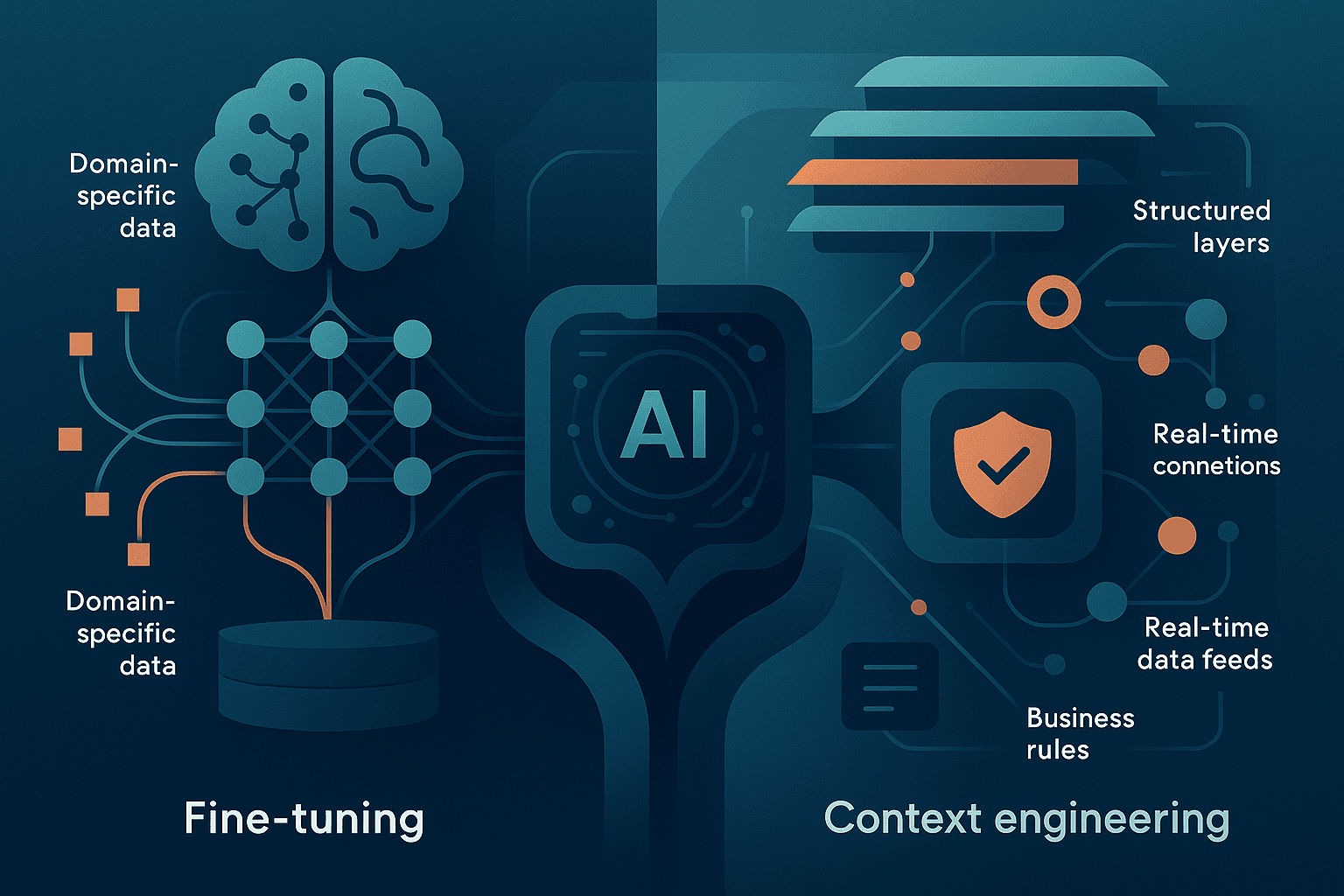
Fine-tuning: Retraining a model on domain-specific examples to teach it patterns, terminology, and domain knowledge.
Context engineering: Providing the model with structured business rules, data definitions, and real-time information at query time through techniques like semantic layers and retrieval-augmented generation (RAG).
Both are valuable. Both have limitations. And most successful enterprise AI implementations use both strategically.
What Fine-Tuning Does Well
Fine-tuning excels at teaching models domain-specific patterns that would be inefficient to provide as context every time:
- Industry terminology and jargon: Medical codes, legal terminology, technical vocabulary specific to your field
- Communication style: How your organization writes reports, emails, or documentation
- Common task patterns: The typical structure of analyses or reports in your domain
- Domain knowledge: Background information that's stable and doesn't change frequently
If your sales team uses specific frameworks or your industry has unique acronyms and concepts, fine-tuning can make the model fluent in your domain's language.
What Fine-Tuning Struggles With
However, fine-tuning has real limitations for certain enterprise needs:
Business Rules Aren't Statistical Patterns
Fine-tuning teaches patterns through examples. But many business requirements are deterministic rules, not patterns:
- "Active customers" must exclude trial accounts and require at least one paid transaction in the last 90 days
- Revenue must be calculated using our fiscal calendar, not standard months
- Pipeline coverage uses a custom formula that differs from industry standards
These aren't statistical tendencies. They're exact specifications. While a fine-tuned model might learn approximations of these rules from examples, it can't guarantee consistent application the way explicit rule definitions can.
Your Data Model Contains Hidden Semantics
Much of your business logic lives in your data architecture:
- Which tables are authoritative for specific metrics
- Join paths that avoid double-counting
- Filters that must be applied together
- Deprecated fields that shouldn't be used
Fine-tuning on SQL query examples can teach a model about your schema, but it's difficult to capture all the implicit knowledge that data engineers know about why certain joins work and others create bad results.
The Currency Problem
Your business evolves constantly:
- New product lines launch
- Organizational structures change
- KPI definitions get refined
- Systems get integrated or deprecated
Each change requires retraining, testing, and redeployment. For rapidly evolving business logic, this cycle may be too slow. You can end up with a model that's always slightly out of date.
Consistency Requirements
Fine-tuned models, like all LLMs, generate outputs probabilistically. Ask the same question with slightly different phrasing and you might get variations in the response.
For many enterprise use cases (financial reporting, compliance, executive dashboards) this variability is problematic. Stakeholders expect the same metric calculated the same way, every time, regardless of who asks or how they phrase the question.
Where Context Engineering Shines
This is where context engineering provides distinct advantages:
Real-Time Business Rules
A semantic layer acts as a centralized source of truth for business logic. When definitions change, the update is immediate and affects all users simultaneously. No retraining required.
Deterministic Outputs
By providing explicit rules and calculations to the LLM at query time, you ensure that the underlying logic is applied consistently. The data retrieval and calculation follow deterministic paths, even though the natural language explanation may still vary.
Governance and Access Control
Context engineering lets you enforce who can access what:
- Row-level security
- Column masking for sensitive data
- Regional data restrictions
- Role-based metric visibility
These policies are enforced before the LLM ever sees the data, preventing unauthorized information disclosure.
Explainability and Lineage
When results come from a governed semantic layer, you can show:
- Which business rules were applied
- How metrics were calculated
- What data sources were used
- The full lineage of the answer
This traceability is essential for regulated industries and executive confidence.
Reduced Hallucinations
By providing authoritative definitions and data relationships, context engineering removes ambiguity. The model doesn't need to guess about business logic. It has explicit instructions. While this doesn't eliminate all hallucination risks (LLMs can still misinterpret or make errors), it significantly reduces them for business-specific questions.
The Hybrid Approach: Why Not Both?
The most sophisticated enterprise AI strategies combine these approaches:
Use fine-tuning for:
- Domain-specific language and terminology
- Communication style and format preferences
- Stable domain knowledge and background context
- Task-specific optimization (if you're always doing similar analyses)
Use context engineering for:
- Current business rules and definitions
- Data access governance and security
- Real-time data and metrics
- Organizational structures and hierarchies
- Anything that changes frequently
For example, a financial services company might:
- Fine-tune for financial terminology, regulatory language, and report structures
- Use a semantic layer for current portfolio data, risk calculations, and access controls
This gives you fluency AND accuracy.
The Scalability Advantage of Context Engineering
One area where context engineering has a clear advantage is organizational scale.
Imagine maintaining separate fine-tuned models for:
- Sales Analytics GPT
- Finance Reporting GPT
- Marketing Intelligence GPT
- Operations Dashboard GPT
Each would need its own training data, update cycles, and versioning. As the organization grows, this becomes unsustainable.
A unified semantic layer becomes the shared "business brain" that supports AI interactions across all departments. One source of truth, many applications, consistent answers everywhere.
Making the Right Choice for Your Organization
Consider these questions:
When fine-tuning may be sufficient:
- Do you primarily need better understanding of specialized terminology?
- Is your domain knowledge relatively stable?
- Are you comfortable with some output variability?
- Do you have limited governance requirements?
When context engineering is essential:
- Do you need precise, repeatable calculations?
- Does your business logic change frequently?
- Do you have strict data access and privacy requirements?
- Do you need full explainability and audit trails?
- Are you deploying AI across multiple departments with different data access needs?
When you should use both:
- Most complex enterprise scenarios benefit from the combination
- Fine-tune for domain fluency, provide context for current business logic
The Future: Smarter Context, Not Just Smarter Models
The next wave of enterprise AI success won't come primarily from better base models. Those are improving for everyone simultaneously.
Competitive advantage will come from how well you can provide AI with accurate, timely, governed context about your specific business.
This means investing in:
- Robust data architecture and semantics
- Clear business rule definitions
- Effective governance frameworks
- Real-time data accessibility
- Organizational alignment on metrics and definitions
Context engineering isn't about replacing fine-tuning. It's about recognizing that the information layer around your AI is just as important as the intelligence within it.
Conclusion
Fine-tuning makes models better at speaking your language.
Context engineering makes models better at reasoning with your logic.
Both matter. Both have their place. And the most effective enterprise AI strategies use each approach for what it does best.
The question isn't whether to fine-tune or provide context. It's understanding when each approach serves your specific needs, and how to integrate them into a coherent strategy.
As you evaluate solutions, look for platforms that support both approaches flexibly, allowing you to optimize for domain fluency where it matters while maintaining the governance, consistency, and agility that enterprise operations demand.
Looking to build robust context layers for your enterprise AI? Codd AI is pioneering semantic foundations that help organizations provide governed, accurate business context to LLMs at scale. Schedule your demo here.