GenAI and natural language analytics are rapidly becoming the new interface to data. Employees are skipping dashboards, bypassing SQL, and going directly to conversational tools, expecting instant answers to complex business questions. For the first time, decision-making is no longer gated by technical skill - it's becoming democratized across the enterprise.
But there's a problem.
Most organizations still lack one critical ingredient that GenAI needs in order to work accurately: Context.
Context about how your business defines things. Context about how your data is structured. Context about how your industry measures and interprets performance.
Without that, AI is both powerful and dangerous - capable of producing insights that are "mostly right," but occasionally, catastrophically wrong. And in a business environment, mostly right is effectively wrong.
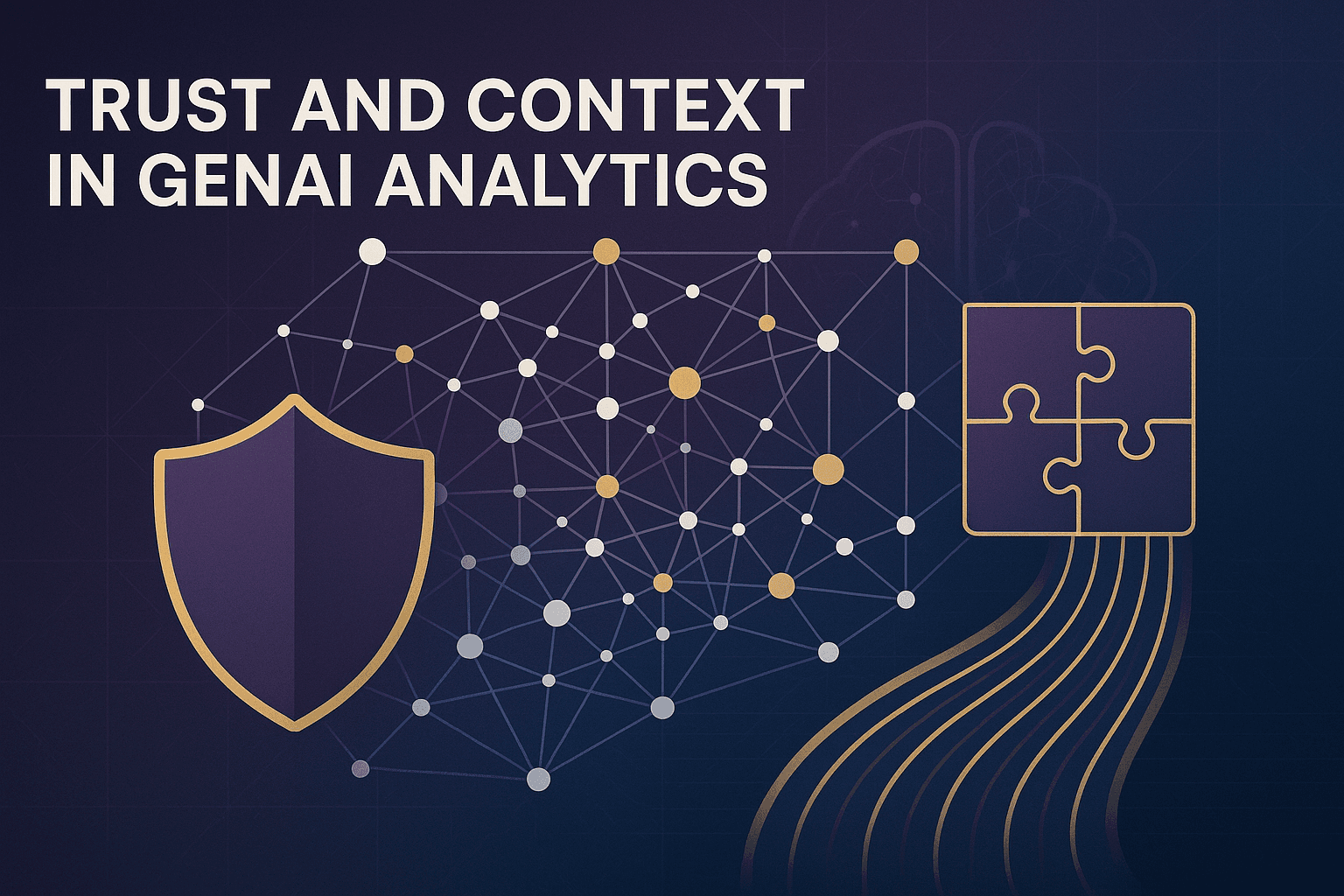
This blog explores why trust is the new currency of GenAI analytics, why context is the missing foundation, and why companies must act now to standardize and operationalize business context before democratized AI creates fragmentation and risk.
AI Isn't the Problem - Context Is
GenAI models are astonishing in their ability to generate language, explain patterns, and interpret data. But they are fundamentally general-purpose systems. They don't inherently understand:
- Your business rules
- Your metric definitions
- Your industry conventions
- Your custom logic
- Your specific data structures
They don't know what you mean when you ask for "pipeline coverage" or "active customer" or "net revenue retention" or "inventory turns".
They can answer based on typical definitions - but they don't know your definition.
Which means GenAI analytics today is like hiring a brilliant consultant who has never worked in your company, never seen your data model, and doesn't know your terminology - and then asking them to answer questions as if they did.
And we expect their answers to be right.
Why 'Mostly Right' Is Actually Wrong
Leaders often assume GenAI outputs that are in the right ballpark are acceptable. But in business, close enough is not good enough.
Imagine these scenarios:
- Finance: AI pulls revenue from the wrong date field because it doesn't understand your fiscal calendar.
- Sales: AI misinterprets "qualified pipeline" based on a generic CRM definition instead of your internal sales stage rules.
- Operations: AI miscalculates downtime because it doesn't know that scheduled maintenance shouldn't count.
- Marketing: AI includes partner-generated leads in your "acquisition cost per lead," inflating spend.
Every one of these answers will look confident. Every one of them will be wrong. And any one of them can lead to bad decisions.
As GenAI becomes more embedded in everyday workflows, the stakes rise. Wrong answers don't just cause confusion - they create:
- Bad forecasts
- Incorrect resource allocation
- Compliance breaches
- Customer experience issues
- Loss of executive trust
- Misaligned business priorities
The irony: AI gives the illusion of precision even when the logic is fundamentally flawed. Without context, it can't know better.
The Core Problem: AI Has No Idea How Your Business Works
Three major context gaps exist in nearly every enterprise.
1. Missing Business Logic
AI doesn't inherently know your definitions for:
- What counts as an active customer
- How churn is calculated
- Which SKUs belong to which product families
- How bookings, billings, and revenue are recognized
- Which costs belong in your margin calculations
These rules live today in the heads of analysts, in legacy dashboards, or inside SQL scripts scattered across teams. None of that is accessible to GenAI out of the box.
2. Missing Understanding of Data Structure
Your data model contains implicit meaning:
- How tables relate
- Which join paths are valid
- Which columns represent surrogate keys
- Which fields are authoritative vs. deprecated
- Where transformations have altered meaning
AI doesn't see any of that context unless you explicitly teach it.
3. Missing Domain Knowledge
Industry-specific logic matters:
- Financial services risk thresholds
- Healthcare quality-of-care metrics
- Manufacturing OEE calculations
- Retail sell-through vs. sell-in definitions
- SaaS subscription metrics and cohort logic
General-purpose AI doesn't know your vertical conventions by default.
Together, these missing elements create a simple but severe problem: GenAI can query your data - but it cannot interpret your business.
The Hidden Risk: Enterprise-Wide Inconsistency
Some argue: "We can just add more context into each prompt."
Sure - for a single question, a knowledgeable user can explain what they want. But enterprise-scale analytics is not a one-off interaction. When hundreds or thousands of employees begin asking AI-driven questions, manual context becomes:
- Inconsistent
- Incomplete
- Incorrect
- Impossible to audit
- Impossible to standardize
Every user begins "teaching" the AI their own version of business logic.
Imagine HR, finance, product, and sales each defining "active customer" differently in their prompts. Or different teams prompting the AI to calculate margin using modified formulas. Very quickly:
- Metrics drift
- Insights diverge
- Trust evaporates
- Decisions conflict
- Leadership loses confidence in AI tools
This is how organizations accidentally create 100 versions of the truth - faster than ever before. And because GenAI answers often sound authoritative, the risks compound.
The Urgency: Democratized AI Without Context Is Dangerous
Three trends are accelerating the urgency:
1. AI Is Becoming the Default Interface for Data
Employees will increasingly use natural language instead of dashboards. This changes the scale and speed of analytical requests.
2. Decision-Making Is Moving Closer to the Front Lines
AI brings insights to the edge - the people with the least data literacy but the greatest operational impact.
3. GenAI Is Being Integrated Everywhere
CRM systems, ERP platforms, HR tools, analytics suites - all adding AI copilots. Each one independently tries to interpret your data.
Without a shared, standardized layer of business context:
- Every tool generates answers differently
- Every department defines metrics differently
- Every user "teaches" the AI differently
This is an enterprise governance failure in the making.
If you democratize AI without standardizing business context, you are accelerating chaos, not insight.
The Solution: A Standardized Contextual Semantic Layer
Enter the contextual semantic layer - the missing foundation that makes GenAI analytics trustworthy.
This layer acts as the brain that tells AI:
- What your business terms mean
- How your metrics are defined
- How your data is structured
- What rules, constraints, and logic must be applied
- What relationships exist across systems
- What knowledge matters and what doesn't
Think of it as the enterprise knowledge and logic graph that sits between AI and your data.
What it Prevents
- Hallucinations
- Wrong answers
- Conflicting answers
- Metric drift
- Prompt-dependent variations
- "Shadow logic" hidden in user prompts or dashboards
What it Enables
- Consistency across every AI interface
- Explainability ("How was this calculated?")
- Trust - executives know AI outputs are governed
- Scalable self-service
- Business-model-aware analytics
- A unified business language across departments
It becomes the shared source of meaning for all GenAI interactions.
Just as:
- BI needed semantic layers
- ML needed feature stores
- Data teams needed catalogs
GenAI analytics needs a contextual semantic layer.
Without it, AI cannot operate safely at enterprise scale.
The Business Value: Why Leaders Should Care
This isn't just a data architecture discussion. It's a business transformation capability with massive ROI.
1. Operational Efficiency Gains
- Reduces endless ad hoc requests
- Improves decision velocity
- Frees analysts to focus on strategic work
- Automates repetitive business logic
2. Consistency Across the Enterprise
- Everyone speaks the same business language
- Every AI tool delivers the same definitions
- A single version of truth is preserved
3. Risk Reduction
- Fewer incorrect insights reaching executives
- Better auditability and governance
- Reduced regulatory or compliance exposure
4. Enables True Data Democratization
AI becomes safe to use even for non-technical roles because the context - not the user - defines the logic.
5. Accelerates Time to Insight
When the knowledge is embedded in the system, not in people's heads, answers flow instantly.
6. Strengthens Strategic Execution
Executives can rely on AI outputs to align teams around:
- Forecasting
- Planning
- Operations
- Performance management
- Customer metrics
This creates better, more confident enterprise-wide decisions.
A New Standard: Context as a Mandatory Ingredient for GenAI
In every technological shift, a new foundational layer emerges:
- Data warehouses standardized storage
- Semantic layers standardized business metrics
- Data catalogs standardized metadata
- Feature stores standardized ML data pipelines
Now, context must be standardized for GenAI.
This contextual layer becomes:
- The interpreter
- The guardrail
- The source of truth
- The knowledge engine
- The logic foundation
- The semantic backbone
It's the architectural layer that ensures AI doesn't just answer your questions - it answers them correctly.
Conclusion: Trust Isn't Optional - It Must Be Engineered
The future of analytics is conversational, intelligent, and automated. But for that future to work, enterprises must confront a simple truth:
AI doesn't understand your business unless you teach it - and unless you teach it consistently for everyone.
In the era of democratized AI, context isn't a luxury - it's the foundation. And the companies who operationalize context today will be the ones who win tomorrow.
Codd AI has been designed from the ground up to empower organizations with a standardized way to define context that deliver trusted insights via business fluent AI agents. More importantly, Codd AI automates the majority of generating the data models and business metrics while keeping the human in the loop to review and certify - reducing the risks of hallucinations. And Codd AI can be accessed via our native user experiences or from your familiar productivity tools like Slack or BI tools.
If you are interested in learning more about Codd AI, visit our resource library at www.codd.ai or schedule a quick meeting here.