

Over the past few years, conversational analytics and natural language interfaces have been heralded as the long-awaited breakthrough that would finally democratize data. Ask questions in plain English. Get answers instantly. No dashboards, no SQL, no tickets to the analytics team.
And yet, despite real advances in NLP and GenAI, many organizations report a familiar outcome: strong demos, promising pilots, and disappointing adoption.
The common explanation is technical. The models are not accurate enough. The data is not clean enough. The answers are not trusted enough.
While getting the technology side right is by no means trivial (and we have written about many of the key aspects such as the importance of context-aware semantic layers), there is a bigger issue holding organizations back: leadership behavior never changes. Organizations deploy new tools while quietly enforcing the same old analytics operating model, one built around intermediaries, artifacts, and predefined answers.
Conversational analytics does not fail because it is immature. It fails because leaders still expect analytics teams to act as translators between questions and decisions. In this blog we will discuss the old habits that keep us from realizing the promises of this new world and what you can do to change the pathway to success.
The Legacy BI Contract Leaders Still Enforce
To understand why conversational analytics is fundamentally a leadership issue, it helps to look at the unspoken "contract" that traditional BI created inside organizations.
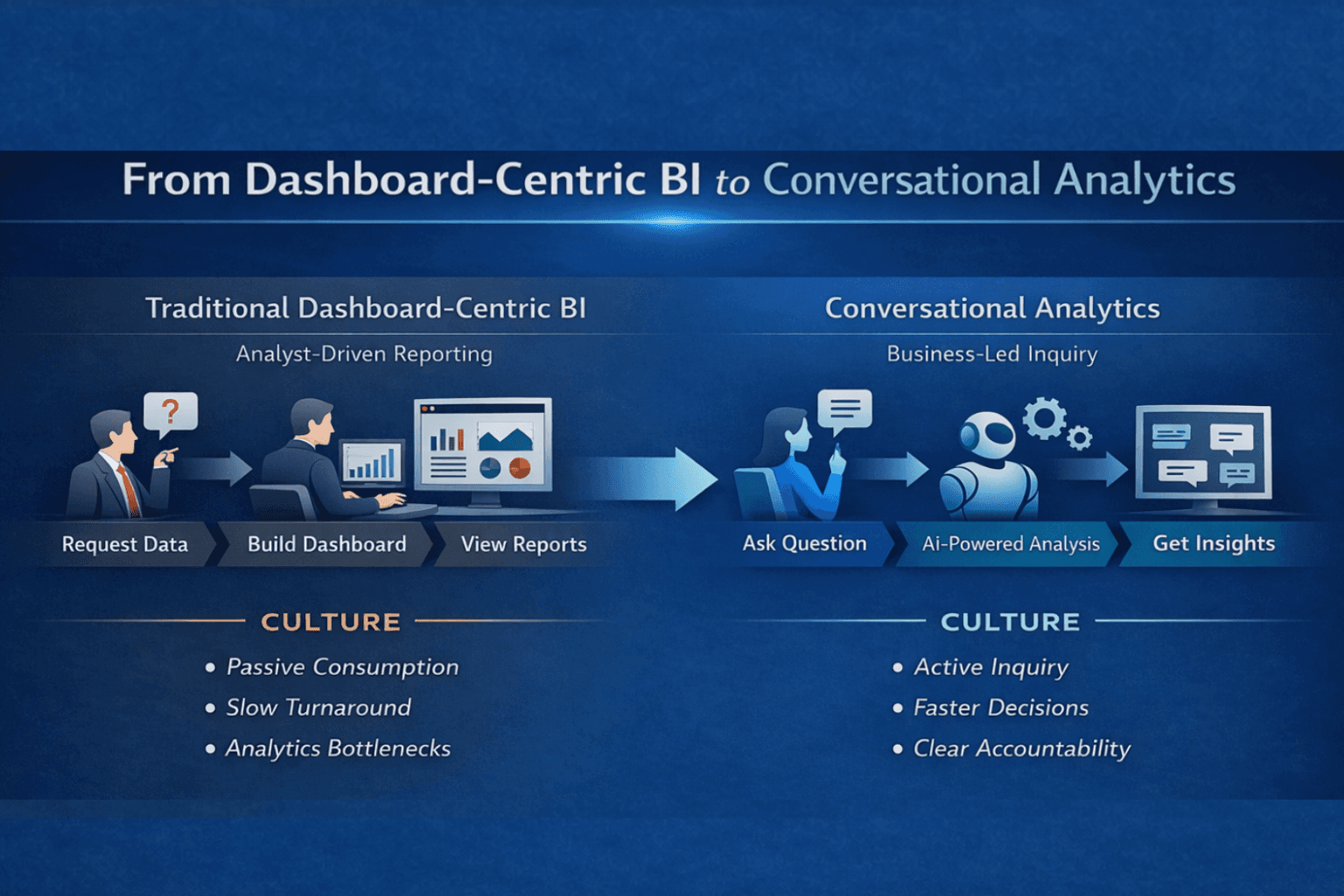
For decades, analytics has operated on a clear division of labor:
- Business leaders ask questions.
- Analysts interpret those questions.
- Dashboards and reports are built to answer them.
- Decision-makers consume the output.
This model made sense when analytics tooling was complex, brittle, and slow. It also shaped organizational behavior in subtle but powerful ways.
Leaders learned to wait for answers rather than explore questions.
Analytics teams learned to optimize for presentation rather than inquiry.
Dashboards became the primary unit of value.
Over time, this created a dependency loop. Any new question, no matter how small, required technical intervention. "Can you add one more filter?" "Can you break this out by region?" "Can we see this weekly instead of monthly?"
The result was predictable: dashboard sprawl, analytics backlogs, and decision latency that no amount of visualization polish could fix. Not to get too deep into this sprawl, but in a recent conversation an analytics leader suggested they had more than 55,000 data models and schemas in Tableau since the mandate is that every new dashboard gets its own new schema.
Conversational analytics challenges this model at its core. And that is precisely why it feels uncomfortable.
Why Conversational Analytics Breaks the Old Model
Traditional BI is built around artifacts. Conversational analytics is built around inquiry.
That distinction matters.
Dashboards assume that the right questions are known in advance. They encode assumptions about metrics, dimensions, and relationships, then freeze them into visual form. When the business changes, as it always does, those assumptions must be revisited, reimplemented, and redistributed.
Conversational analytics flips the equation. Instead of designing artifacts ahead of time, it enables real-time exploration. Questions emerge organically. Follow-ups are encouraged. Assumptions are surfaced, not hidden.
But this only works if leaders are willing to engage differently.
You cannot adopt conversational analytics while continuing to treat analytics as a service desk. You cannot expect analysts to remain the sole interface to data and still benefit from natural language interaction. And you cannot demand perfectly polished answers while asking exploratory questions.
In other words, conversational analytics does not just change how answers are delivered. It changes who participates in the process.
Old Habits That Quietly Kill Adoption
Most organizations do not explicitly reject conversational analytics. Instead, they undermine it through familiar leadership habits.
"Send Me a Dashboard"
This phrase seems harmless. It is also one of the most powerful signals leaders send.
When executives default to dashboards, they reinforce the idea that insight arrives as a finished product, something to be consumed, not explored. Conversational analytics, by contrast, is iterative by design. It invites follow-up questions, refinements, and occasional dead ends.
When leaders insist on dashboards as the end state, conversational tools become little more than faster ways to define requirements for the same old artifacts.
Treating Analytics Teams as Translators
In many organizations, conversational analytics is positioned as a productivity tool for analysts, not a capability for decision-makers. Analysts are expected to "use the AI" to answer questions more quickly, then relay those answers upward.
This approach preserves the bottleneck. It also strips conversational analytics of its core value: direct engagement between business questions and data.
The technology changes. The workflow does not. Adoption stalls.
Expecting Certainty Instead of Conversation
Conversational analytics surfaces nuance. It exposes assumptions. It highlights data gaps and metric ambiguity.
For leaders accustomed to dashboards that project confidence, even when that confidence is unwarranted, this can feel like regression. The instinctive response is to blame the tool rather than confront the underlying complexity.
But complexity was always there. Dashboards simply hid it.
The New Expectation: "Ask the Data Yourself"
The promise of conversational analytics is not that leaders become analysts. It is that leaders become better interrogators of information.
Asking the data yourself does not mean writing queries or understanding schemas. It means engaging directly with questions, following lines of inquiry, and challenging assumptions in real time.
This represents a fundamental shift in leadership responsibility. Insight is no longer something delivered. It is something discovered.
Organizations that succeed with conversational analytics recalibrate expectations accordingly. Leaders are encouraged to explore. Iteration is normalized. Partial answers are acceptable starting points rather than failures.
This does not reduce the importance of analytics teams. It elevates them. Their role shifts from report production to context stewardship: defining metrics, ensuring consistency, enforcing governance, and maintaining trust.
What Leadership Looks Like in a Conversational Analytics Culture
Technology alone cannot create this shift. Leadership behavior must change in visible, deliberate ways.
Modeling Curiosity
Leaders who succeed with conversational analytics model the behavior they want to see. They ask questions openly. They explore follow-ups in meetings. They treat uncertainty as a signal to investigate, not a weakness to hide.
This signals to the organization that inquiry is valued over polish.
Rewarding Inquiry, Not Just Answers
In dashboard-centric cultures, success is measured by the quality of the artifact. In conversational cultures, success is measured by the quality of the questions.
Teams are encouraged to probe, test, and refine. Learning is prioritized over presentation. Over time, this creates a more resilient decision-making culture, one that adapts faster because it is not bound to static views of the business.
Redefining the Analyst Role
Perhaps the most important leadership action is reframing what "good analytics work" looks like.
In a conversational analytics model, analysts are no longer judged by how many dashboards they maintain. They are valued for the clarity of business definitions, the robustness of metrics, and the integrity of context.
This shift reduces burnout, increases leverage, and aligns analytics effort with long-term value.
Why This Shift Feels Uncomfortable, and Why That Is the Point
Conversational analytics exposes things dashboards often conceal:
- Conflicting definitions of key metrics
- Implicit assumptions baked into reports
- Gaps in data quality or coverage
- Uncertainty in causal relationships
When these issues surface, it can feel like the system is failing. In reality, the system is finally telling the truth.
Dashboards create the illusion of certainty. Conversations reveal reality.
Organizations that interpret discomfort as failure will retreat to familiar tools. Those that interpret it as learning will build more adaptive, data-fluent cultures.
The Risk of Getting This Wrong
The risk is not that conversational analytics fails technically. The risk is that it succeeds just enough to reinforce old habits.
Organizations that treat conversational analytics as a UI upgrade will see:
- Low sustained usage (it is estimated that less than 25% of BI tool licenses ever get deployed)
- Recreated analytics bottlenecks
- Erosion of trust when answers conflict with dashboards
Organizations that treat it as a leadership and operating model shift will see:
- Faster decision cycles
- Greater accountability for interpretation
- Reduced dependency on intermediaries
- More resilient analytics foundations
The difference is not the technology. It is the mindset.
The Hard Truth About Conversational Analytics
Conversational analytics is not primarily an AI problem.
It is not a data problem.
It is not even a tooling problem.
It is a leadership problem, and an opportunity.
The organizations that thrive in the next era of analytics will not be those with the most advanced models or the slickest interfaces. They will be the ones whose leaders are willing to change how they engage with data, moving from consumption to inquiry, from certainty to exploration, from dashboards to dialogue.
Conversational analytics does not democratize insight by itself. Leadership does.
About Codd AI
Codd AI is an AI-powered analytical platform designed from the ground up for the GenAI age of analytics. It is designed to overcome the risks of hallucinations by providing an enriched context-aware semantic layer that serves as the foundation for GenAI to interpret questions, understand results, and generate business-relevant insights. Whether you are using our built-in conversational Canvas, Metric Boards, or embedding this into Slack or your BI tools, Codd AI provides the governed and trusted foundation for transforming how your business generates insights and makes decisions.
To learn more, visit us at Codd.AI or schedule a quick intro call.