For the past few years, generative AI has dominated conversations in analytics and business intelligence. We have seen copilots bolted onto dashboards, chat interfaces layered on top of data warehouses, and countless proof-of-concepts promising to "democratize insight."
During 2026, that experimental phase will be something of the past.
GenAI will no longer be judged on novelty or conversational fluency. It will be judged on whether it can reliably support real business decisions at scale. That transition, from experimentation to infrastructure, will fundamentally reshape how analytics platforms are designed, bought, governed, and used.
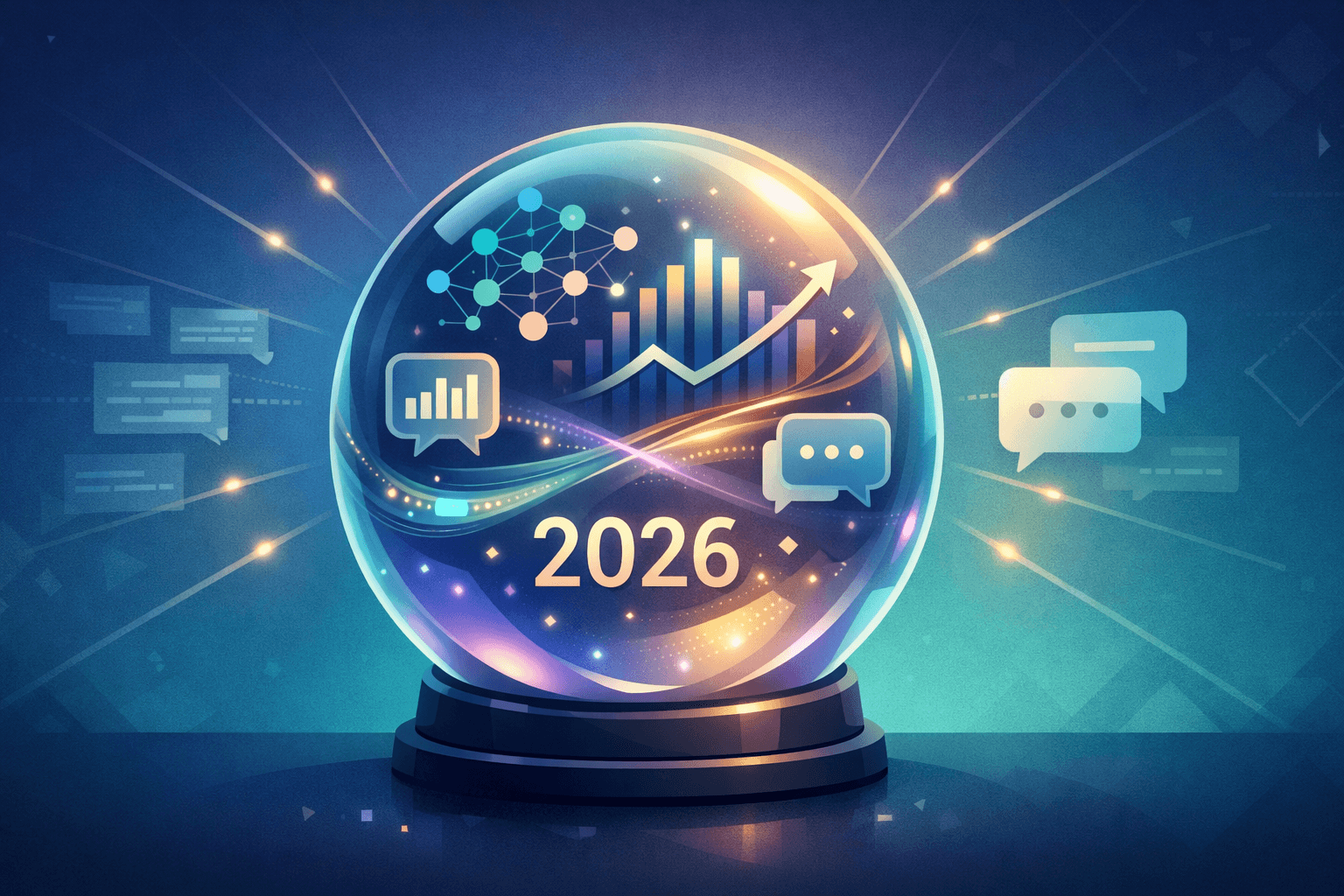
Based on conversations with numerous organizations big and small, here are ten predictions that outline how GenAI-powered analytics will materially change in 2026, and what those changes mean for data and analytics leaders.
1. Analytics Assistants Will Become Multi-Agent, Not Single Chatbot
The single, monolithic analytics chatbot is already showing its limits. Complex analytical questions are rarely a single step. They require metric selection, data validation, join logic, assumption testing, narrative construction, and governance checks.
In 2026, GenAI analytics platforms will increasingly rely on multi-agent architectures. Instead of one assistant trying to do everything, multiple specialized agents will collaborate behind the scenes: one agent to interpret intent, another to validate metrics, another to assess data freshness, another to generate narratives or visualizations.
This mirrors how human analytics teams actually work. The difference is orchestration: GenAI coordinates the work, while humans remain responsible for approval and judgment.
Why this matters: Real analytics is a process, not a prompt.
2. Multimodal Analytics Becomes the Norm
Business insight does not live exclusively in tables and dashboards. It lives in strategy documents, contracts, slide decks, customer emails, call transcripts, product screenshots, and increasingly, video.
By 2026, GenAI-powered analytics will be natively multimodal. Users will expect to ask questions that span structured data and unstructured content in a single flow, connecting metrics to supporting documents, visuals, and narrative evidence.
An answer without context will feel incomplete.
Why this matters: The most important business signals often exist outside the database.
3. Context-Aware Assistants Replace Generic Copilots
Early GenAI copilots focused on conversational access to data. They answered questions or helped generate a chart or report, but they did not understand the business meaning behind those questions.
That will no longer be acceptable in 2026.
Winning analytics assistants will be explicitly context-aware, understanding business definitions, hierarchies, KPIs, policies, and organizational nuance. Context will persist across conversations, users, and tools, rather than being reconstructed with every prompt.
This shift marks the difference between AI that "queries data" and AI that understands the business.
Why this matters: Without context, analytics scales inconsistency and confusion. Additional reading: Beyond Co-Pilots and Chatbots: Why the Future of AI Is Context-Aware.
4. Buy Takes the Lead in Build-vs-Buy Decisions
As GenAI analytics matures, enterprises are realizing that success is not about access to models. It is about everything around them: context engineering, governance, evaluation, observability, UX, and lifecycle management.
By 2026, most organizations will conclude that building and maintaining GenAI analytics platforms internally is unsustainable beyond limited experiments. The operational burden, skills requirements, and long-term risk favor buying platforms designed for production use.
Why this matters: Analytics platforms are long-lived systems of record, not short-term experiments. Additional reading: Build vs. Buy for AI-Powered Analytics.
5. Spending Shifts from Proof-of-Concepts to Production Systems
The era of GenAI demos optimized for wow-factor is ending.
In 2026, budgets will prioritize fully productionized analytics systems with performance SLAs, cost controls, governance workflows, and measurable business outcomes. Executive sponsors will demand evidence of adoption, time-to-insight reduction, and decision impact.
"AI pilots" without operational rigor will struggle to survive budget reviews.
Why this matters: Reliability beats novelty when analytics drives real decisions.
6. Natural Language Becomes a Pervasive Query Interface
Natural language will not replace SQL or dashboards, but it will become the default entry point for analytics interaction.
By 2026, users will expect to ask questions in business language across tools and contexts, without needing to understand schemas or report structures. Technical artifacts remain, but they recede into the background.
This shift is less about technology and more about adoption. People gravitate toward systems that align with how they think.
Why this matters: Analytics adoption follows cognitive ease. Additional reading: The ROI of Conversational Analytics.
7. NLQ Grows Up: Answers Must Explain Themselves
As natural language query adoption increases, so does scrutiny.
In 2026, users will no longer accept opaque answers, even if they are fast. The winning analytics experiences will explain their reasoning: which metrics were used, what assumptions were made, which filters were inferred, what data sources were queried, and how fresh the data is.
Drill paths, alternatives, and refinement prompts become standard.
Why this matters: Trust is built through transparency, not speed.
8. Analytics Platforms Are Designed for Trust and Governance by Default
Governance has traditionally lived behind the scenes in catalogs, policies, and approval workflows. GenAI changes that.
In 2026, governance becomes visible in the analytics experience itself. Certification status, lineage, validation signals, and policy enforcement are surfaced to users at the moment of insight.
Trust becomes something users can see, not something they are asked to assume.
Why this matters: GenAI raises the cost of being wrong. Additional reading: Why Trust Matters: The Urgent Need For Context-Aware GenAI and Conversational Analytics.
9. Contextualization Beats Fine-Tuning as the Core Differentiator
Fine-tuning language models can improve fluency, but it does not solve the hardest problem in analytics: business meaning.
By 2026, organizations will recognize that contextualization, including semantic layers, metric definitions, policies, and relationships, is far more durable and scalable than model tuning. Models will evolve rapidly; context will compound in value over time.
The competitive battleground shifts accordingly.
Why this matters: Models change. Context endures.
10. Critical Thinking Makes a Comeback
Perhaps the most important shift in 2026 will be cultural.
As GenAI becomes pervasive, organizations will confront over-reliance on automated answers. The response will not be to abandon GenAI, but to reinforce critical thinking, interpretation, and accountability.
Analytics teams will emphasize questioning results, understanding assumptions, and owning decisions. GenAI becomes an accelerator of thinking, not a replacement for it.
Why this matters: The best decisions are still human-owned.
Closing: 2026 Is the Year Analytics Becomes Business-Fluent
GenAI will not replace traditional analytics in 2026. It will force analytics to mature.
The platforms that succeed will not be those with the most impressive demos, but those that encode business context, operate reliably at scale, make trust visible, and elevate human judgment.
The future of GenAI-powered analytics is not about smarter answers.
It is about better understanding.
About Codd AI
Codd AI is an AI-powered analytical platform designed from the ground up for the Generative AI world. The premise for Codd AI is that, in order for GenAI to become a true analytical helper for decision makers, it will need to be fluent in your data and business rules and logic. And that the foundational knowledge needs to be explicitly defined in your GenAI app to make it context aware.
LLMs are linguistically powerful and can answer based on statistical probabilities and generalizations. With Codd AI, you get AI agents that can interpret questions in natural language, provide answers and reasoned insights, as well as recommend follow-up questions, all governed by the business context you defined.
If you or your team are interested in learning more, please schedule a 30 minute conversation.