
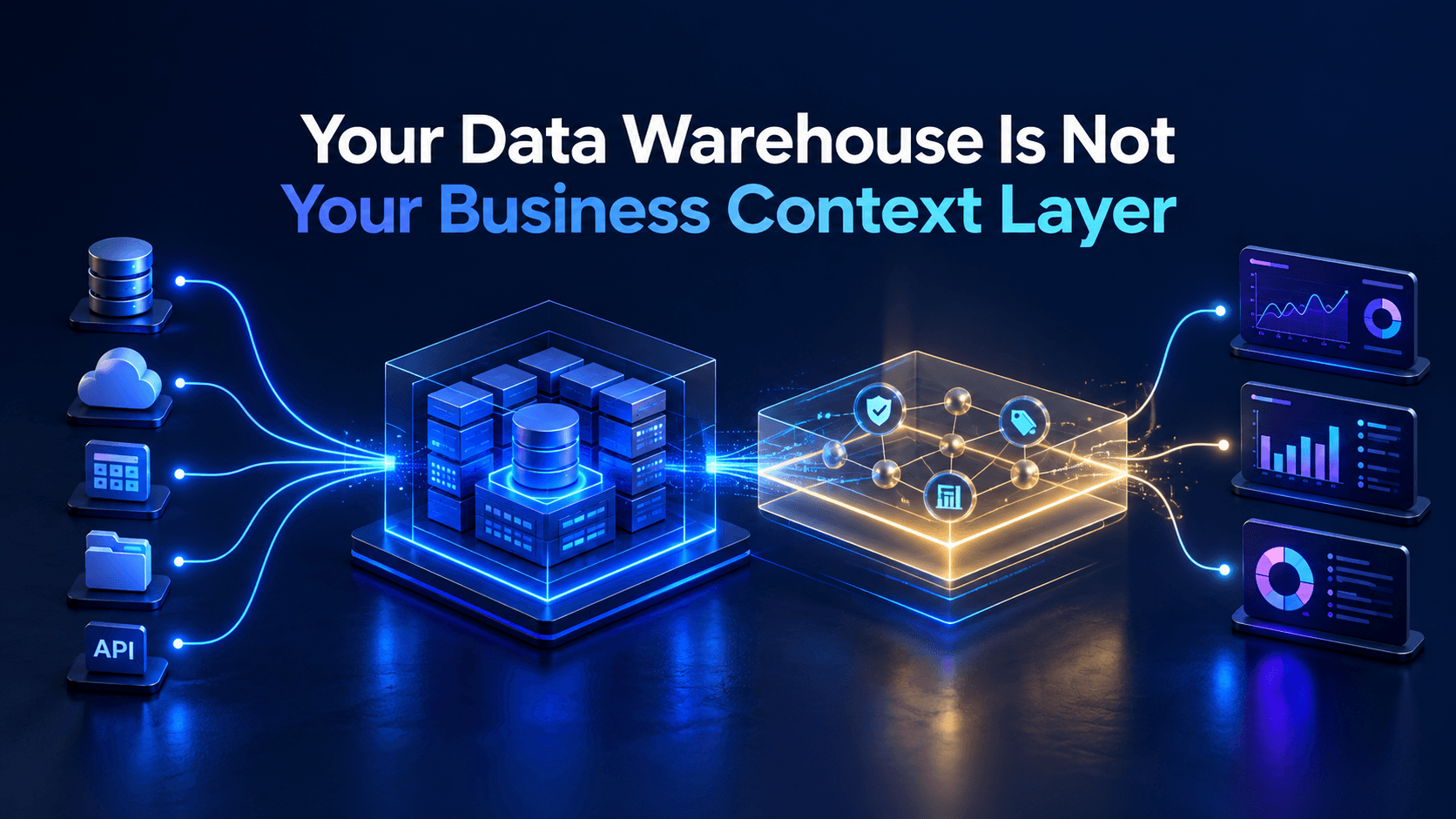
Enterprises have spent years modernizing their data infrastructure.
They've migrated to cloud data warehouses, invested in data lakes and lakehouses, built sophisticated pipelines, and consolidated massive volumes of information into platforms like Snowflake, Databricks, and Google BigQuery.
The promise was straightforward: bring enterprise data together, make it accessible, and enable better decisions.
And in many ways, these investments have delivered. Data is more accessible, scalable, and easier to process than ever before.
But now, as enterprises race to deploy generative AI and intelligent agents on top of this infrastructure, an uncomfortable reality is emerging.
Having all your data in one place doesn't mean your AI understands your business.
Your data warehouse knows where the numbers are.
Does it know what those numbers mean?
That's a very different problem.
The Illusion of a Single Source of Truth
For years, the enterprise data warehouse has been positioned as the foundation for a single source of truth.
Consolidate data from multiple systems. Standardize schemas. Apply transformations. Make information available to analytics and reporting tools.
The underlying assumption is that once data is centralized and organized, consistency naturally follows.
But consider a simple question:
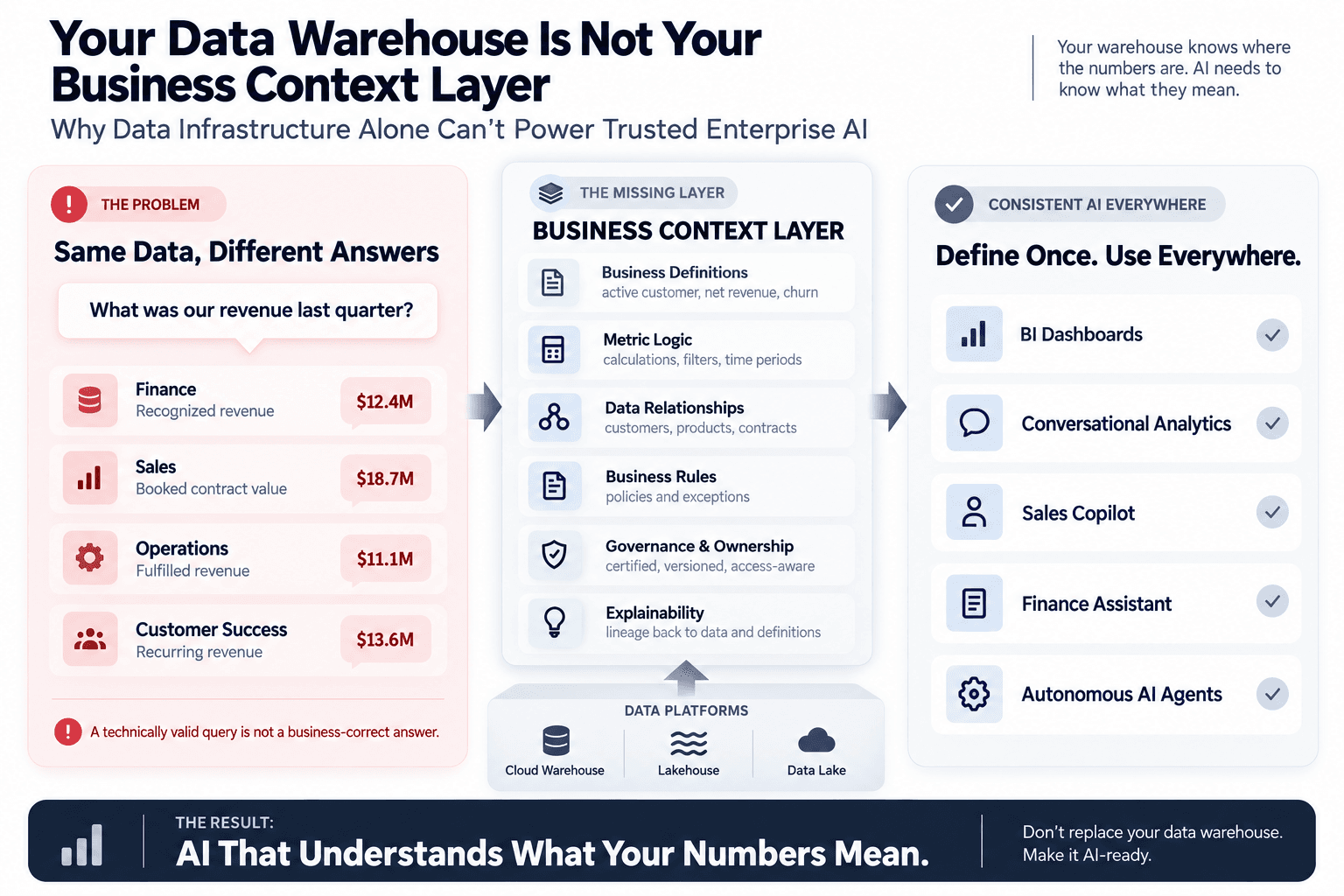
"What was our revenue last quarter?"
It sounds straightforward. Yet across an enterprise, that question can have several legitimate interpretations.
- Finance may define revenue based on recognized revenue under accounting policies.
- Sales may focus on booked contract value.
- Operations may track fulfilled or delivered revenue.
- Customer Success may measure recurring revenue from active subscriptions.
All four teams could be accessing the same data warehouse.
All four could be working with technically accurate data.
And all four could return different answers.
The problem isn't necessarily the data.
The problem is that business meaning isn't automatically standardized simply because data is centralized.
Modern data platforms increasingly support semantic definitions, governance, and business metadata. These are important advances. But the enterprise challenge extends beyond what any individual platform can store or define.
It involves how business meaning is created, validated, maintained, and consistently applied across departments, tools, and AI applications.
Data Infrastructure Understands Structure. AI Needs Meaning.
A data warehouse is fundamentally designed to store, organize, process, and retrieve data efficiently.
It understands tables, columns, relationships, schemas, and queries.
But enterprise AI must answer questions that go beyond technical structure.
Consider a user asking:
"Why did customer profitability decline in the Northeast region last quarter?"
To answer correctly, an AI system must understand more than which tables contain customer transactions.
It needs to know:
- How the organization defines customer profitability.
- Which costs are included in profitability calculations.
- How customers are assigned to geographic regions.
- Whether returns, rebates, or adjustments should be included.
- Which business rules apply to the reporting period.
- Which data the requesting user is authorized to access.
Some of this logic may already exist in warehouse models, SQL transformations, BI tools, or documentation.
But unless that knowledge is consistently accessible to the AI application, the system may make assumptions, select inappropriate relationships, or apply the wrong metric definition.
The resulting SQL could execute perfectly.
The answer could still be wrong.
A technically valid query is not the same as a business-correct answer.
This distinction becomes increasingly important as AI moves from assisting analysts to independently interpreting business questions and supporting operational decisions.
The Missing Layer Between Enterprise Data and Enterprise AI
Traditional analytics environments rely on several layers of technology.
Data warehouses and lakehouses provide the infrastructure.
Data engineering pipelines prepare and transform information.
BI tools provide visualization and reporting.
Semantic models translate technical structures into business-friendly concepts.
Each plays an important role.
But as enterprises introduce multiple AI assistants, copilots, and autonomous agents, another challenge emerges.
How do all these applications consistently understand the same business?
A sales copilot may interpret revenue using CRM definitions.
A finance assistant may rely on warehouse transformations.
An analytics agent may generate its own SQL.
A BI copilot may use definitions embedded in its reporting model.
Individually, each application may appear intelligent.
Collectively, they may produce inconsistent interpretations of the same enterprise information.
The more AI applications an organization deploys, the greater the potential for duplicated business logic, conflicting definitions, and fragmented governance.
This is where a shared business context layer becomes strategically important.
Rather than requiring every application to independently reconstruct business meaning, a shared context layer makes governed definitions, relationships, rules, and organizational knowledge reusable across the enterprise.
The objective isn't to replace the data warehouse.
It's to make the business knowledge surrounding that data consistently available wherever AI is used.
What Makes a Business Context Layer Different?
A business context layer goes beyond connecting an AI model to enterprise data.
It establishes a shared understanding of how an organization defines, relates, and governs its business information.
That understanding includes several interconnected elements.
Business definitions: What do terms like active customer, net revenue, churn, profitability, and utilization actually mean within the organization?
Metric logic: How are business KPIs calculated, and which filters, exclusions, and time periods apply?
Data relationships: How do customers, products, transactions, contracts, and other business entities relate across systems?
Business rules: Which policies, exceptions, and organizational practices determine how data should be interpreted?
Governance and ownership: Who approves definitions, which versions are trusted, and what information can each user access?
Explainability: Can an AI-generated answer be traced back to the underlying data, definitions, and calculations?
These capabilities turn disconnected technical metadata and organizational knowledge into a reusable semantic foundation.
And critically, that foundation should not depend on a single AI model, reporting interface, or data platform.
Because enterprise architecture is rarely static.
Data platforms evolve. Applications change. AI models improve.
Your business meaning should remain consistent even when the technology consuming it changes.
Why This Matters More in the Age of AI Agents
The distinction between data infrastructure and business context becomes even more consequential with agentic AI.
Traditional dashboards generally operate within predefined models and reporting structures.
AI agents introduce a different dynamic.
They interpret open-ended questions, determine which data to retrieve, select analytical approaches, and potentially initiate downstream actions.
That flexibility creates enormous opportunity.
It also introduces new risks.
Imagine three AI agents supporting the same organization:
One evaluates sales performance.
Another forecasts financial results.
A third recommends operational adjustments.
If each agent independently determines how revenue, customers, and profitability should be calculated, inconsistencies can propagate across decisions.
A discrepancy that once appeared in two dashboards could now influence automated recommendations and workflows.
Adding more sophisticated language models does not inherently resolve the issue.
An AI model can reason over the context it receives, but it cannot reliably infer every organization-specific rule that has never been made available to it.
The intelligence of an AI agent is only as useful as the business context grounding its decisions.
This is why shared context should be treated as enterprise infrastructure rather than an isolated feature inside individual AI applications.
Don't Replace Your Data Warehouse. Make It AI-Ready.
The solution isn't another data migration or a wholesale replacement of existing infrastructure.
Most enterprises have already made significant investments in cloud warehouses, lakehouses, transformation frameworks, governance platforms, and BI tools.
Those investments remain essential.
The next step is to connect their technical capabilities with a consistent, governed understanding of the business.
An effective architecture allows:
- Data platforms to continue storing and processing enterprise information.
- A shared business context layer to organize and govern business definitions, relationships, metrics, and rules.
- BI tools and AI applications to consume that context consistently while accessing the underlying data through authorized mechanisms.
This separation creates flexibility.
Organizations can adopt new AI models without rebuilding every business definition.
They can introduce new analytics applications without recreating metric logic from scratch.
They can evolve their data architecture while preserving a consistent foundation for business interpretation.
And they can improve governance by making definitions, ownership, and lineage explicit rather than scattered across applications.
The result is not simply easier access to data.
It is a more scalable foundation for trusted, context-aware enterprise intelligence.
How Codd AI Bridges the Gap
At Codd AI, we believe enterprise AI needs more than access to data.
It needs a governed understanding of the business behind that data.
Codd AI is designed to transform enterprise data relationships and business knowledge into an intelligent, context-aware semantic foundation that can be reused across analytics and AI applications.
Rather than requiring teams to manually recreate business logic for every tool or use case, Codd AI uses generative AI to accelerate the discovery and modeling of entities, relationships, metrics, and business definitions.
Human-in-the-loop validation helps ensure that business knowledge is reviewed and certified before it becomes part of the trusted semantic foundation.
With built-in governance, lineage, and explainability, organizations can understand not only what answer an AI application produces, but also the business definitions and data logic behind it.
And because Codd AI is designed to work with existing enterprise data platforms and downstream applications, organizations can extend their current investments rather than replace them.
The goal is straightforward:
Define business meaning once. Govern it centrally. Make it available wherever enterprise intelligence happens.
Whether an insight is delivered through a BI dashboard, conversational analytics interface, or AI agent, the underlying business context should remain consistent.
The Next Enterprise AI Advantage Isn't More Data
Enterprises are not suffering from a shortage of data infrastructure.
They have powerful warehouses, scalable compute, sophisticated pipelines, and increasingly capable AI models.
What many still lack is a shared, governed understanding of what their data means.
And as AI adoption expands, that gap becomes harder to ignore.
The organizations that succeed with enterprise AI won't necessarily be those with the largest data warehouses or the most AI applications.
They'll be the ones that make their business knowledge consistent, reusable, and accessible across the entire technology ecosystem.
Because a data warehouse can tell AI where to find the numbers.
A business context layer helps AI understand what those numbers actually mean.
And that distinction may determine whether enterprise AI produces more answers or better decisions.
Ready to Make Your Data AI-Ready?
Discover how Codd AI transforms enterprise data and business knowledge into a shared, governed semantic foundation for trusted AI analytics.
Learn more at www.codd.ai or schedule a conversation with one of our co-founders to explore how Codd AI can complement your existing data architecture.