It happened almost overnight. Every enterprise platform now has a co-pilot.
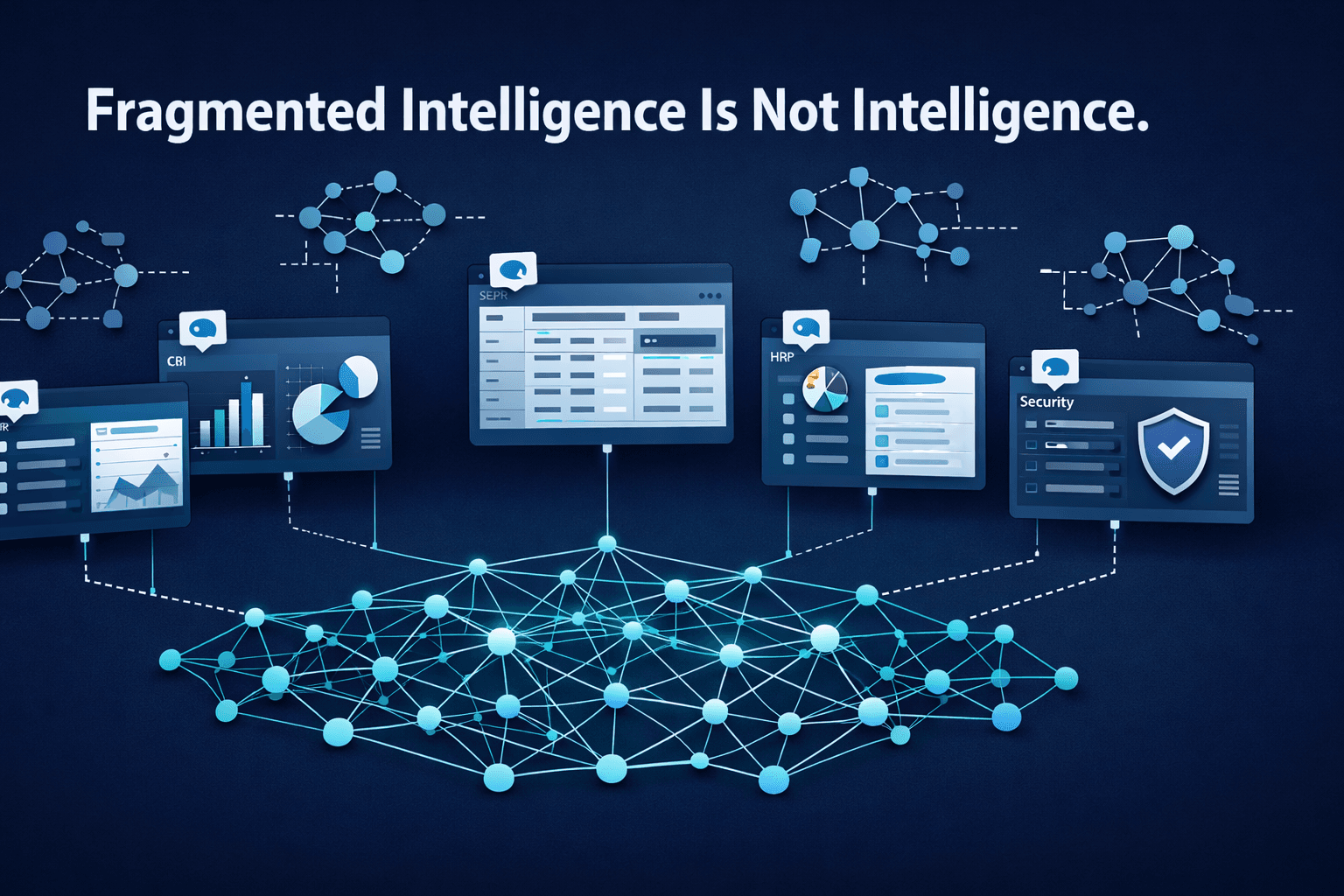
Your CRM has one. Your data platform has one. Your BI tool has one. Your HR system has one. Your security stack has one too.
Vendors like Microsoft, Databricks, and Salesforce are racing to embed conversational AI directly into their applications. From a user perspective, it feels transformative. You can ask a question in plain English and get an answer in seconds. You can summarize dashboards, generate queries, draft reports, and accelerate workflows.
It's frictionless. It's impressive. It feels like progress.
But there's a deeper question enterprise leaders need to sit with: What happens when every tool becomes its own reasoning engine?
In this blog we will discuss some of the emerging risks and what leaders can do to mitigate and future-proof their business and collective intelligence.
The Comfort of Local Intelligence
Each co-pilot is intelligent within its own world.
- The CRM co-pilot understands pipeline stages and account records.
- The data warehouse co-pilot understands tables and SQL.
- The BI assistant understands its semantic model.
- The HR co-pilot understands employee records.
If you stay inside the boundaries of one system, the answers are often useful and fast. But enterprise decisions rarely live inside a single system.
Revenue performance is influenced by sales execution, supply chain constraints, pricing strategy, workforce capacity, and macro conditions. Risk exposure spans finance, compliance, operations, and cybersecurity. Customer churn touches product usage, support tickets, contract terms, and billing behavior.
No single application owns the whole picture. Yet we are increasingly asking application-bounded AI systems to explain cross-enterprise outcomes.
That's where the subtle risks begin.
Risk #1: Conflicting Answers at Executive Level
Imagine an executive asks a simple question:
"Why did revenue decline last quarter?"
- The CRM co-pilot might point to slowed pipeline velocity.
- The BI co-pilot might show margin compression.
- The ERP system might highlight inventory constraints.
- Finance might surface pricing adjustments.
Each answer could be technically accurate. Each system is interpreting the world through its own schema, logic, and metric definitions.
But what happens when those answers don't align? What happens when two leaders walk into a meeting, both armed with AI-generated insights, and neither matches?
Now you're not debating strategy. You're debating which AI to believe.
Traditional BI already struggled with metric consistency. We spent years building governed definitions for "revenue," "active customer," and "gross margin." Now we're layering probabilistic language models on top of fragmented data estates and asking them to generate logic dynamically.
The result isn't necessarily wrong. It's inconsistent. And inconsistency erodes trust faster than inaccuracy.
Risk #2: AI Outputs Becoming an Unofficial System of Record
Vendors are careful in how they describe these co-pilots. They are positioned as assistive. They are not meant to replace governed systems of record. But behavior evolves faster than product documentation.
- Executives screenshot AI responses.
- Summaries get pasted into board decks.
- Conversational outputs shape decisions.
Once that happens, the AI response itself becomes a decision artifact.
If those outputs aren't tied to certified metrics, auditable lineage, and traceable business logic, you've effectively introduced a shadow reasoning layer into the enterprise.
For regulated industries, this isn't philosophical. It's operational risk.
When an auditor asks, "How was this number derived?" pointing to a chat transcript is not the governance model anyone intended to build.
Risk #3: Security Surface Area Expansion
There's another dimension that rarely makes it into the glossy product demos.
Every co-pilot requires access. APIs. Data connectors. Retrieval pipelines. Model endpoints. Conversational history. Multiply that by ten or fifteen enterprise platforms. And then you add the modern multi-agent workflows and the surface area explodes.
Now your security team isn't just protecting data at rest and in motion. They're protecting prompt flows, multiple agents, embedding stores, and model interactions. They're managing permissions across AI layers that didn't exist two years ago.
The attack surface has expanded quietly and rapidly.
And most enterprises did not architect for AI sprawl at this scale.
Risk #4: AI Stack Redundancy and Cost Opacity
There's also a structural cost dynamic unfolding.
Each SaaS vendor is embedding its own AI stack. Its own model calls. Its own retrieval augmentation. Its own embeddings. Its own token consumption.
From the outside, it looks like innovation. From the inside, it looks like duplication.
Enterprises are effectively funding multiple parallel AI infrastructures, none of which share context or optimization. You're paying for intelligence repeatedly, but not coherently.
If this is not a budget conversation yet, it soon will be.
Risk #5: Vendor Lock-In Shifts Up the Stack
Historically, vendor lock-in was about data gravity. Once your data lived somewhere, switching was painful. Now lock-in is creeping upward.
Co-pilots store conversational history. They encode business logic in hidden prompts. They generate artifacts and workflows that are platform-specific. Over time, the intelligence layer itself becomes sticky.
Migrating systems won't just mean moving data. It will mean re-creating reasoning patterns embedded inside proprietary AI layers.
That's a deeper dependency than most organizations realize.
Risk #6: Human Analytical Skill Atrophy
There's one more risk, and it's human.
When every workflow is AI-assisted, fewer people inspect the underlying queries. Fewer people validate the logic. Fewer people challenge outputs.
Over time, analytical rigor can weaken. The enterprise begins to accept answers without interrogating assumptions.
That doesn't mean AI is flawed. It means humans adapt. And if the culture shifts toward passive consumption rather than critical evaluation, decision quality can quietly degrade.
This isn't a technology failure. It's a leadership one.
The Real Issue Isn't "Too Much AI"
It's fragmented context.
Each co-pilot is application-aware. Few are enterprise-aware.
They understand application-specific schemas. They don't understand shared business ontology.
They interpret local data. They don't reconcile cross-domain logic.
When intelligence is decentralized without a shared contextual layer, you don't get coordinated insight. You get parallel narratives.
Many smart assistants, but no unified reasoning strategy.
A Different Way to Think About It
Imagine two organizations five years from now.
The first adopted every embedded co-pilot available. Each application reasons independently. Each team trusts the AI in their tool. Meetings often begin with reconciling numbers before discussing strategy.
The second organization invested in a shared context layer, a governed, enterprise-wide semantic foundation. Co-pilots still exist, but they consume standardized business definitions. Metric logic is centralized. Answers reconcile by design.
Both organizations use AI. Only one orchestrates it.
That difference won't show up in product demos. It will show up in decision velocity and trust.
The Question Leaders Should Be Asking
The strategic conversation isn't, "Which co-pilot should we enable?"
It's, "Who owns enterprise context?"
- Who defines revenue?
- Who governs metric logic?
- Who ensures that AI answers reconcile across systems?
- Who controls decision lineage?
If every tool becomes an AI reasoning engine, but no one owns the shared context that binds them, fragmentation accelerates, not insight.
GenAI co-pilots are not the enemy. Uncoordinated intelligence is.
The enterprises that win this next phase won't be the ones with the most chat interfaces. They'll be the ones that treat context as a control plane and orchestrate AI accordingly.
Because scaled guessing, even when conversational, is still guessing. And that's not transformation.
Codd AI Was Designed for Shared Enterprise Business Fluency
Our mission at Codd AI is to build an enterprise-scaled, business-fluent AI platform, one that is founded upon the notion of a data and business knowledge enriched semantic layer that powers every question interpretation and insight extraction. Codd AI is designed to thrive in a heterogeneous world where there is no lock-in to a specific cloud platform or data platform or BI tool.
If you are interested in finding out more, visit us on codd.ai or schedule your overview discussion.