It is just over 3 years ago that OpenAI launched their ChatGPT for "Research Preview". Since then the space of generative AI (GenAI) has literally exploded and pretty much every vendor has jumped on the bandwagon.
The good part is that this explosion has consumerized GenAI to the extent that it is pretty safe to say that the majority of typical business users are demanding this kind of easy-to-use and helpful style of interaction with technology products versus the old cumbersome user interfaces of past years.
In the world of analytics, this certainly has come to the fore in a big way and vendors massively jumped for bolting some GenAI capability onto their products and platforms. But most quickly realized that promising users to "chat with their data" is a far cry from getting those users to trust in those insights. In my blog last week I explored some of the pitfalls and reasons for why most analytics vendors backed away from chat with your data as a positioning statement.
At this stage of the market we are faced with the uncomfortable truth - the user demand for conversational analytics is going to grow, but that demand is currently being held back by a lack of trust and transparency.
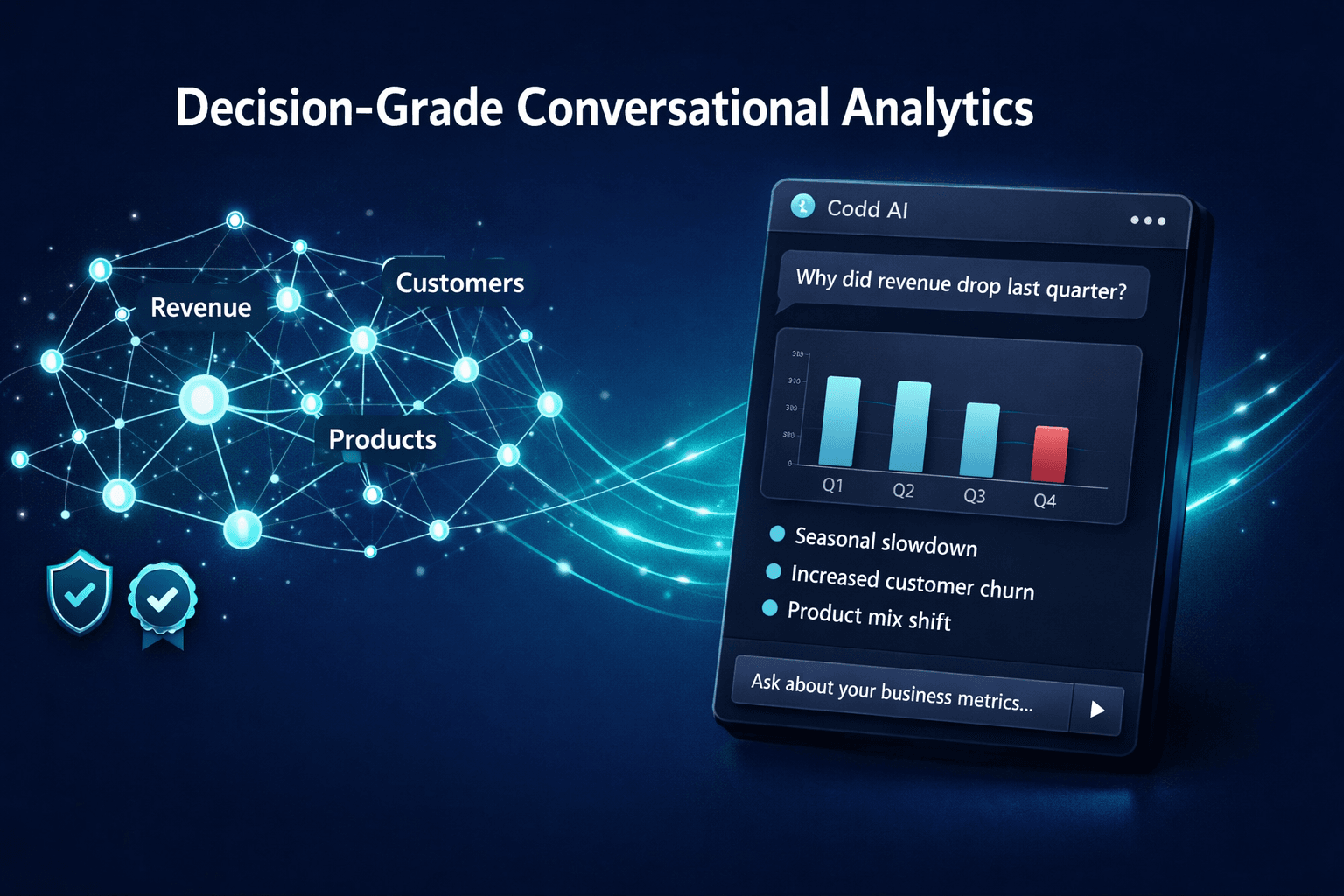
Codd AI's mission is exactly this - to deliver GenAI-powered conversational analytics that can be trusted at enterprise scale, across all of your cloud data sources, because heterogeneity is going to remain a consistent theme. And to do so while lowering the effort and costs of delivering business-fluent AI to answer and interpret every business question. In this blog I will dig a little deeper into Codd AI's journey over the last 6 months and the key innovations we delivered towards achieving that vision.
Codd AI Product Philosophy
Codd AI CEO and Founder, Ravindra Punuru, speaks about the back story in more detail, but in short we have 4 pillars to our overall focus:
Context Before Conversation
Bolting a conversational interface on top of a BI tool makes for a fun demo, but in reality it delivers very little value. BI semantic layers encode just one element of the context required: technical metadata from the database. It has no idea of business knowledge, rules and logic. The result is conversations with zero business applicability or relevance. Codd AI's foundation is an enriched contextual semantic layer that unifies both your specific business and technical knowledge. Read more in our blog When AI Speaks Your Business Language: The Power of Contextual Analytics.
Business Meaning as the System of Record
In some analytical domains some accuracy can be compromised or be slightly off. For example, in sales and marketing I can accept a variance in my total number of leads created last quarter (2,100 vs 2,134 - that is directionally the same). The same possibly can be said of pipeline created. But revenue booked cannot be treated the same. Getting the AI agent to consistently and accurately answer the question by different users is non-negotiable. Codd AI implements our enriched context as explicit guardrails for answering questions consistently and accurately - EVERY TIME!
Human-in-the-Loop by Design
A key element of building confidence and trust into GenAI systems (at least today) is to ensure review of key artefacts by humans. Since the ontology, data model and metrics are the foundational building blocks it is important to ensure a human remains in the loop to review and certify. Codd AI automates the process of ontology creation, data modeling and metrics creation using extensive GenAI-powered processes in our platform. Codd fully documents the engine's decisions and recommendations and allows human review to focus on the lowest confidence scores to ensure accuracy with minimal effort.
Governance Without Friction
Governance needs to be designed in and not bolted on as an afterthought. In addition, governance needs to scale with usage to become an enabler and not a bottleneck. Codd AI was designed with governance and transparency at the core and it scales with usage and complexity.
What Codd AI Shipped - Product Enhancements By Theme
Theme 1: Stronger Contextual Semantic Foundations
What existed before
- GenAI-powered semantic layer creation with automated data model/entity relationship model creation and automated business metric creation.
- Human-in-the-loop review and certification of data model and business metrics.
What we enhanced
- Automated ontology creation introduced as a precursor to the data model creation step - establishing richer domain-level abstractions before any modeling begins.
- Human-in-the-loop review and certification now required before data model creation starts, shifting quality assurance earlier in the pipeline.
- Expanded data connectivity with native support for CSV and Excel file ingestion, enabling teams to bring in spreadsheet-based data alongside structured database sources.
- Business knowledge integrations with SharePoint, Confluence, and REST API connectors to ingest domain knowledge from data governance tools like Collibra - bridging the gap between institutional knowledge and the semantic layer.
- Direct Snowflake semantic view management - create, update, and manage Snowflake semantic views directly from Codd, turning certified Codd Metrics into portable, governed views without leaving the platform.
Why it matters
- Higher accuracy in data model generation - starting from ontology rather than jumping straight to data models gives GenAI a deeper, more structured foundation to work with.
- Stronger analytical reasoning - richer semantic context leads to more precise and relevant AI-generated insights.
- Earlier error prevention - human certification before data model creation ensures downstream artifacts inherit validated context rather than compounding mistakes.
- Context from where knowledge already lives - SharePoint, Confluence, and Collibra integrations mean the semantic layer is grounded in real organizational knowledge, not just raw schema metadata.
- Lower barriers to data onboarding - CSV and Excel support lets teams bring in spreadsheet-based data without needing a database pipeline first.
- Portable semantic layer - directly managed Snowflake semantic views let teams leverage certified business logic across any Snowflake-compatible tool or workflow, with Codd as the single source of truth.
Theme 2: More Intelligent Conversational Analytics
What existed before
- Natural language querying over governed semantic context, consisting of technical and business knowledge.
- Automated key insights generation to augment query results.
- List of recommended follow-up questions to provide further insights.
- Context persistence across a conversation.
What we enhanced
- BI tool integration - embedded the Codd AI semantic layer into Tableau and Power BI, bringing governed analytics directly into existing visualization workflows.
- Slack and Teams integration - interact with the Codd AI query agent directly from your messaging platform, no context-switching required.
- MCP (Model Context Protocol) support - expose Codd AI's semantic layer and query capabilities to any MCP-compatible agentic flow or conversational chatbot like Claude or ChatGPT, enabling governed data access from virtually any AI interface.
- Metric Boards - one-click dashboard visualization of business metrics with built-in key insights, recommended follow-ups, and natural language conversation attached to each metric.
- Collaboration - built-in capability for users to interact with Corpus owners, ask questions on existing metrics, or propose new metrics for creation.
- Deep Dive analysis - agentic, multi-step analytical flows that chain reasoning across queries to deliver compound insights (e.g., full Balance Sheet analysis).
- Playbooks - save and reuse Deep Dive analytical flows for repeated, standardized execution across teams.
Why it matters
- Domain-expert-level dialogue - conversations now behave like a back-and-forth with a subject matter expert, not a search box.
- Meet users where they work - Slack, Teams, Tableau, Power BI, or any MCP-compatible AI agent. Ask questions from the interface you already have open.
- Open by design - MCP support means Codd AI's governed semantic layer is not locked to a single interface; any agentic workflow or chatbot can tap into it while respecting the same governance and certification guardrails.
- Standardized analytical workflows - Playbooks turn one-off deep analysis into repeatable, shareable processes that any team member can execute.
- Beyond the demo - Metric Boards, collaboration, and cross-platform access make conversational analytics a daily operational tool, not a proof-of-concept.
Theme 3: Governance, Explainability, and Trust at Scale
What existed before
- Automated data model and business metrics generation.
- Human-in-the-loop to review and certify models and metrics.
- RBAC user access controls.
What we enhanced
- Automated ontology generation as a precursor to the data modeling step, adding a foundational context layer before models are built.
- Query result certification marks - visual trust indicators on every query response so users know whether the result came from a certified metric or a newly generated query.
- Citation of reference documentation - when the system provides insights or knowledge-based responses, it surfaces the source documents and knowledge cells used to generate the answer.
- Built-in data catalog and glossary - entity catalog with lineage tracking, relationship cardinality, business term definitions with approval statuses (approved, pending, deprecated), and domain-level organization.
- Multi-channel approval workflows - approval requests routed via email, Slack, and Teams with configurable timeout actions, token-based authentication, and full audit trail.
- Data product governance - data products with lifecycle states (Draft, In Review, Published, Deprecated), quality scores, and compliance tracking.
- Granular resource sharing - share corpus, metrics, and knowledge cells with specific users, with visibility into what you have shared and what has been shared with you.
- API key management - user-scoped API keys for programmatic access with full lifecycle controls.
Why it matters
- Trust at the point of consumption - certification marks and citations give users immediate confidence in whether a result is governed or exploratory, eliminating the "can I trust this number?" question.
- Ontology as a governance accelerator - an additional layer of foundational context ensures data models are generated faster and with greater accuracy.
- Auditable end-to-end - approval workflows, ownership tracking, and modification history create a clear chain of custody from raw data to delivered insight.
- Self-service with guardrails - the data catalog and glossary give business users the ability to discover and understand data assets without needing to go through a data team, while approval workflows ensure sensitive operations stay governed.
Theme 4: Faster Time to Value for Customers
What existed before
- Automated data model and business metrics creation with human-in-the-loop to review and certify.
- Prebuilt integrations to document repositories like Confluence, SharePoint as well as REST API for integration to other platforms like data catalogs.
What we enhanced
- Automated ontology creation - eliminates the manual effort of defining domain concepts before data modeling begins, compressing what was previously a weeks-long exercise into minutes.
- Automated data product creation - data products with lifecycle management (Draft through Published) are now generated automatically, removing a manual bottleneck between modeling and consumption.
- CSV and Excel-based corpus creation - upload a local spreadsheet and have a fully enriched corpus created automatically, lowering the barrier to entry for teams without formal database pipelines.
- Metric Boards with one-click insights - pre-built dashboard visualization that surfaces key insights and follow-up questions immediately, eliminating the need to build dashboards from scratch.
- Playbooks for repeatable analysis - save and reuse Deep Dive analytical flows, turning a first-time analysis into a template that any team member can execute instantly.
- MCP and multi-channel access - Slack, Teams, Tableau, Power BI, and MCP-compatible agents mean users start getting value from day one in the tools they already use, with zero new interface to learn.
Why it matters
- Days to hours - automated ontology, data product, and corpus creation collapse what used to be weeks of manual setup into a same-day onboarding experience.
- No pipeline, no problem - CSV and Excel ingestion means teams can go from a spreadsheet on their desktop to governed, queryable analytics without waiting on engineering.
- Insights on arrival, not after configuration - Metric Boards and automated key insights mean users see value the moment their data is onboarded, not after building their first dashboard.
- Compounding speed with Playbooks - every Deep Dive analysis saved as a Playbook makes the next execution faster, building an organizational library of reusable analytical workflows.
- Zero adoption friction - meeting users in Slack, Teams, and existing BI tools removes the "learn a new platform" hurdle that stalls enterprise rollouts.
What's Next For Codd AI? - From Insights to Actions
While we continue to advance across all the pillars outlined above, our next wave of innovation focuses on a fundamental shift - making insights actionable and repeatable, not just informative.
To that end, we are introducing Actions - user-defined agentic workflows that turn passive metrics into active triggers.
What Actions Enable
- Threshold-based automation - define conditions on any certified metric (e.g., revenue drops below target, inventory falls below safety stock) and let the system respond automatically.
- Multi-channel triggers - when a condition is met, Actions can fire emails, Slack messages, Teams notifications, or API calls to external applications - closing the loop between insight and response.
- Agentic workflow orchestration - chain multiple steps into a single Action: detect the anomaly, enrich it with a Deep Dive analysis, notify the right stakeholders, and trigger a remediation call to a downstream system - all without human intervention.
- Playbook-powered Actions - combine Actions with existing Playbooks to execute a full analytical flow automatically when conditions change, turning institutional knowledge into always-on operational intelligence.
Why It Matters
- From dashboard to decision in zero clicks - insights that previously sat in a dashboard waiting to be noticed now drive immediate, automated responses.
- Governed automation - Actions inherit the same certification, RBAC, and approval workflows as the rest of the platform, ensuring automated responses are as trustworthy as the metrics that trigger them.
- Reduced response latency - the gap between "something changed" and "someone acted on it" shrinks from hours or days to seconds.
- Repeatable operational playbooks - once an Action is defined, it runs consistently every time - no missed alerts, no forgotten follow-ups, no dependency on someone checking a dashboard at the right moment.
Get Your Codd AI Trial Going Today
If you are interested in getting a first-hand view of how Codd AI can help your team, you can request a trial here. Alternatively, schedule a 30-minute overview conversation to get going.
About Codd AI
Codd AI is an AI-powered analytical platform designed from the ground up for the GenAI age of analytics. It is designed to overcome the risks of hallucinations by providing an enriched context-aware semantic layer that serves as the foundation for GenAI to interpret questions, understand results, and generate business-relevant insights. Whether you are using our built-in conversational Canvas, Metric Boards, or embedding this into Slack or your BI tools, Codd AI provides the governed and trusted foundation for transforming how your business generates insights and makes decisions.
To learn more, visit us at Codd.AI or schedule a quick intro call.