Over the past few months I've had the opportunity to speak to numerous data leaders in companies ranging from large banks, to a small logistics platform provider, and a whole lot of companies in between. They all express a level of dissatisfaction with the state of analytics and business intelligence in their organizations. They talk about bottlenecks, delays, data being all over the place, and a lack of enough data analysts.
Interestingly, some are accepting the state of affairs. Others are throwing the AI "kitchen sink" and more at the problem, believing AI will solve everything.
This blog will discuss some of the shortcomings of traditional BI and analytical approaches, but also why AI won't just magically solve your problems either.
Why Traditional BI and Analytical Approaches Fail
A lot of folks believe they have a data problem and that this is the main reason for their struggles. They don't. Well, actually, they do have a data problem, but that is not the main issue.
They have a translation problem.
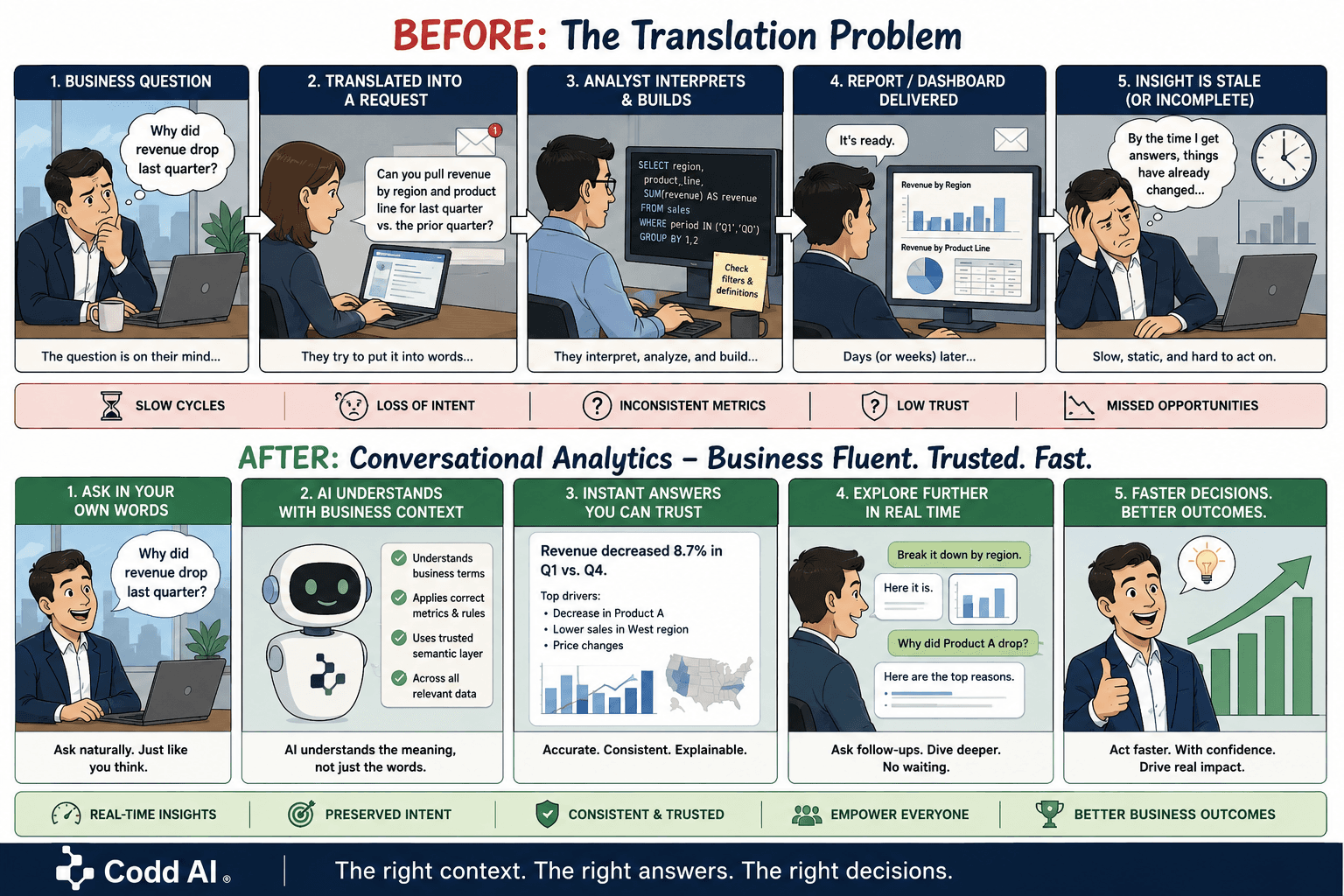
A business leader asks a question.
- That question gets translated into a dashboard request.
- An analyst interprets it.
- A report gets built.
- Days, or weeks, later, an answer is delivered.
And by then, the moment to act has already passed.
This isn't a tooling issue. It's a structural flaw in how analytics operates.
And it's exactly why conversational, or natural language, analytics is rapidly becoming essential.
But not for the reasons most people think.
The Myth: "Conversational Analytics Makes Data Easier"
The common narrative is simple:
Natural language analytics democratizes data by making it easier to ask questions.
That's true, but it's also incomplete.
Ease of use is not the real value. Because if "easy" were enough, dashboards would have solved the problem already. They didn't.
Despite billions invested in BI platforms:
- Dashboards proliferated
- Metrics multiplied
- Data access expanded
And yet organizations still struggle with:
- Slow decision cycles
- Low trust in data
- Heavy reliance on analysts
The issue isn't access.
It's the gap between business intent and data interpretation.
The Real Problem: Analytics Is a Multi-Step Translation Pipeline
Traditional analytics works like a relay race:
- A business user forms a question
- That question is translated into a data request
- An analyst interprets the request
- A dashboard or query is built
- The result is delivered back to the business
Each step introduces friction.
More importantly, each step introduces loss of meaning.
- The business user may not articulate the question precisely
- The analyst may interpret it differently
- The data model may not reflect the intended definition
By the time an answer is delivered, it is often:
- Delayed
- Misaligned
- Or incomplete
This is why so many organizations operate on approximate truth.
Why This Model Breaks in the Age of AI
For years, this model was tolerable.
Decisions were slower. Markets moved predictably. Reporting cycles were measured in weeks or months.
That world no longer exists.
Today:
- Data volumes are exploding
- Business conditions change daily
- Decisions need to be made in real time
The bottleneck is no longer data collection. It's time-to-insight. And traditional analytics is fundamentally incapable of operating at that speed.
Conversational Analytics Changes the Interface, But More Importantly, the Workflow
At its core, conversational analytics removes the translation layer.
Instead of:
Business Question → Analyst → Dashboard → Answer
You get:
Business Question → System → Answer
But that simplification understates what's actually happening.
The real shift is this:
➡️ From requesting insights ➡️ To interacting with data
This enables an entirely different mode of thinking.
Instead of waiting for answers, users can:
- Ask follow-up questions instantly
- Explore hypotheses dynamically
- Refine their understanding in real time
"Why did revenue drop last quarter?"
"Break that down by region."
"Now show me by product. How does that compare to the previous quarter?"
"What promotional offers for each product category can we leverage by each customer segment to increase revenues?"
This is not just faster analytics.
It's continuous analytical reasoning driving towards actions.
The Hidden Benefit: Decision Velocity Becomes a Competitive Advantage
In modern organizations, the winners are not those with the most data. They are the ones who can act on data fastest, with confidence.
Conversational analytics directly impacts:
- Speed of decision-making
- Quality of decisions
- Ability to respond to change
It compresses the cycle from:
Question → Insight → Action
From days or weeks, to seconds.
That's not incremental improvement. That's a structural advantage.
Why Dashboards Can't Keep Up
Dashboards were designed for a different era.
They are:
- Predefined
- Static
- Built for known questions
But modern business is driven by unknowns.
You can't pre-build a dashboard for:
- Emerging market shifts
- Unexpected customer behavior
- New competitive threats
So organizations create more dashboards.
Which leads to:
- Dashboard sprawl
- Metric inconsistency
- User confusion
Ironically, more dashboards often lead to less clarity.
Conversational analytics flips this model. Instead of building for every possible question, you create a system that can respond to any question.
The Organizational Impact: Removing the Analyst Bottleneck
One of the most overlooked implications is organizational.
Today, analytics teams act as intermediaries:
- Translating business questions
- Building reports
- Maintaining dashboards
This creates a scalability problem.
As demand for insights increases:
- The backlog grows
- Time-to-delivery increases
- Business frustration rises
Conversational analytics removes this dependency.
It allows:
- Business users to engage directly with data
- Analysts to focus on higher-value work
- Data teams to scale impact without scaling headcount
This is not just a productivity gain. It's a redefinition of roles.
The Catch: Natural Language Alone Doesn't Solve the Problem
At this point, many organizations think:
"Great, we just need a chatbot or copilot."
This is where things break down.
Because natural language is only the interface.
It does not guarantee:
- Accuracy
- Consistency
- Trust
Without proper context, conversational systems produce:
- Plausible but incorrect answers
- Conflicting interpretations of metrics
- Results that cannot be explained or validated
This is why so many AI copilots fail to move beyond demos. They answer questions. But they don't produce trusted insights.
The Missing Piece: Business Context
The real challenge in analytics has never been querying data.
It's understanding what the data means.
- What defines "revenue"?
- Which filters apply?
- How are metrics calculated?
- What business rules matter?
This context typically lives:
- In analysts' heads
- In scattered documentation
- Inside dashboards themselves
When that context is missing, AI systems guess. And guessing is unacceptable for decision-making.
From Conversational AI to Business-Fluent AI
This is where the model needs to evolve. The goal is not conversational analytics.
The goal is business-fluent analytics.
That requires a system that understands:
- Data structures
- Business definitions
- Relationships between entities
- Organizational rules and logic
In other words, a contextual semantic layer.
Why Context Changes Everything
When conversational analytics is powered by a contextual semantic layer:
- Questions are interpreted correctly
- Metrics are consistently defined
- Answers are explainable
- Results can be trusted
The system doesn't just process language. It understands the business behind the language.
This is the difference between:
❌ "AI that answers questions"
✅ "AI that supports decisions"
The Future: A Unified Interface for Data
As organizations adopt more AI tools, another problem is emerging: fragmentation.
- Every platform has its own copilot
- Every tool has its own interface
- Every system produces its own version of answers
The result? More confusion, not less.
Conversational analytics, when done right, becomes the unifying layer. A single interface where users can:
- Ask questions across systems
- Get consistent answers
- Operate with shared understanding
Final Thought: This Isn't About Convenience
It's easy to position conversational analytics as a usability improvement. But that undersells what's at stake.
This is not about making data easier to access. It's about making organizations faster, smarter, and more aligned.
Because in a world defined by speed and complexity:
- Static dashboards are too slow
- Manual translation doesn't scale
- And fragmented AI creates more risk than value
A Better Way to Think About It
Don't ask:
"Do we need conversational analytics?"
Ask:
"Can we afford to keep translating business questions into dashboards?"
Because the organizations that eliminate that gap will be the ones that move faster, decide better, and win.
About Codd AI
Codd AI is the leader in the emerging category of contextually-aware AI platforms. Codd AI automatically builds a governed contextual semantic layer from technical metadata and business knowledge and rules. This semantic layer then becomes the foundation for AI to drive conversational analytics, reasoning about your data and your business like one of your own subject matter experts. If you are interested in learning more, visit us at www.codd.ai or schedule a quick chat.