For decades, enterprise data and analytics organizations have been designed around one fundamental constraint: human capacity.
When a business leader wanted a new insight, somebody had to do the work. A data engineer might need to prepare the data. A data modeler would establish relationships and definitions. A BI developer might build the semantic model and dashboard. An analyst would investigate the results. A data scientist might apply more sophisticated models. And eventually, someone in the business would interpret the answer and decide what to do.
Every step required specialized skills, and specialized people.
AI is beginning to change that equation.
The first wave of AI in analytics has largely focused on making those people more productive. AI can generate SQL, create transformations, document pipelines, build visualizations, write Python, identify anomalies and help analysts investigate data.
But that may only be the beginning.
The bigger transformation occurs when AI moves from helping humans perform analytical work to actually performing portions of that work itself.
That transition could fundamentally reshape the data and analytics organization.
The question is no longer simply:
How can AI make my data team more productive?
It is becoming:
What should the data and analytics organization look like when AI itself becomes part of the analytical workforce?
The Traditional Analytics Organization Was Built Around Scarce Human Capacity
Consider what happens when a regional sales leader asks:
"Why did gross margin decline last quarter, which products and customers contributed most to the decline, and what should we do about it?"
That sounds like one question.
Inside a traditional analytics organization, however, it can trigger an entire chain of work.
The appropriate data must exist and be accessible. Data engineers may need to integrate or transform it. Data models must correctly represent customers, products, regions and financial relationships. Metrics such as revenue, cost and gross margin must be defined. An analyst must query the data, investigate the drivers, potentially create visualizations and ultimately interpret the results.
The architecture of today's analytics organizations reflects these dependencies.
- Data engineers build and manage the data foundation.
- Data architects and modelers establish structure.
- BI developers build semantic models, reports and dashboards.
- Analysts investigate the business.
- Data scientists perform more advanced analysis.
Governance, security and data stewardship surround the process.
The inevitable consequence is queues. Data engineering backlogs. Dashboard backlogs. Analytics requests. Data science projects.
Self-service data prep and BI were supposed to eliminate many of these bottlenecks. They certainly helped, but never fully delivered on the original promise.
The reason is increasingly apparent: the real barrier to self-service was never simply access to easier analytical tools. It was access to the knowledge required to use the data correctly.
- What does "active customer" mean?
- Which revenue field should be used?
- How should returns be treated?
- Which tables should be joined?
- What constitutes a region?
- Which margin calculation is authoritative?
Those questions still require expertise.
The First AI Era: Make Every Specialist Faster
This is where much of the industry is today.
AI copilots are appearing throughout the data and analytics stack.
Data engineers can describe a transformation and generate SQL. AI can help document pipelines, identify data quality problems and generate tests. BI developers can generate calculations and visualizations. Analysts can ask natural-language questions. Data scientists can generate Python and accelerate exploratory analysis.
These capabilities matter.
But they still largely operate within the existing organizational model.
The data engineer remains the data engineer. The analyst remains the analyst. AI simply makes each person faster.
The immediate effect is productivity multiplication.
A team that previously maintained 100 pipelines might manage 200. An analyst who previously completed five investigations each week might complete ten. BI developers might deliver dashboards in days rather than weeks.
But focusing only on productivity misses the larger opportunity.
The more interesting question isn't:
"Can ten people now accomplish the work of twenty?"
It is:
"What becomes possible when the organization suddenly has dramatically more analytical capacity?"
That question leads somewhere very different.
Beyond the Copilot: AI Becomes Part of the Workforce
There is an important distinction between AI assisting someone with a task and AI being responsible for completing the task.
Imagine a data engineering agent capable of monitoring pipelines, identifying schema changes, proposing transformations, generating tests, detecting data quality issues and recommending, or eventually executing, remediation.
Now imagine an analytical agent continuously monitoring business metrics. It detects an unexpected margin decline, investigates contributing products and customers, compares the pattern against previous periods, evaluates likely causes and recommends appropriate responses.
Neither requires a human to initiate every individual step.
This is where the evolution from Copilots to Playbooks to Agents becomes important.
- A Copilot helps a human perform work.
- A Playbook captures a repeatable analytical process that AI can execute.
- An Agent can increasingly determine when that process should run, coordinate the necessary tasks and potentially initiate an action.
The operating model starts shifting from:
Human does the work → AI helps the human
to:
Human defines the objective and guardrails → AI performs the work → Human governs the outcome
That isn't merely productivity improvement.
It is a new workforce architecture.
Every Role in the Analytics Organization Changes, and Some May Move
AI doesn't necessarily eliminate the need for data engineers, analysts, data scientists or BI professionals. But it changes the center of gravity of their work.
It may also change where those roles belong organizationally.
Historically, many analytical roles have lived within IT, centralized data organizations or Business Intelligence Centers of Excellence. Even roles positioned close to the business have often been fundamentally technical roles populated by people who came from IT.
There was a practical reason for this. Working with data required specialized knowledge of databases, SQL, BI platforms, semantic models and data infrastructure.
AI begins weakening that constraint.
Data Engineers: From Pipeline Builders to Data Platform Supervisors
Today, data engineers typically reside within IT, data engineering or centralized data platform organizations.
They spend substantial time building transformations, integrations, pipelines and tests.
As AI assumes more of that implementation work, the human role moves upward toward architecture, standards, reliability and exception management.
A future data engineer may supervise fleets of engineering agents that build, test, document and monitor pipelines.
This role probably remains relatively centralized because infrastructure, reliability, security and architecture benefit from enterprise standards.
But one engineer may oversee dramatically more data infrastructure than today.
Data Modelers: From Technical Modeling to Business Context Architecture
Data modeling may experience an even more interesting transition.
Traditional data modelers frequently sit inside IT, enterprise architecture, BI Centers of Excellence or data teams. Their work often involves translating business requirements into technical models.
In an AI-native organization, much of the mechanical model generation can increasingly be automated.
The higher-value role becomes defining, certifying and governing meaning.
What is a customer? What constitutes recurring revenue? How are products organized? Which relationships matter? Which metrics are authoritative?
The role begins shifting from data modeler toward business ontology or context architect.
And organizationally, that person may no longer sit exclusively within IT.
Context architects could become a bridge between the enterprise data organization and business functions such as Finance, Sales, Supply Chain, Marketing or Operations, because their primary responsibility is no longer simply modeling data. It is modeling the business.
BI Developers: From Dashboard Factories to Analytical Experience Designers
BI developers today commonly reside within centralized BI organizations, IT or Analytics Centers of Excellence.
Much of their workload involves building reports, dashboards, semantic models, calculations and visualizations.
AI can increasingly generate all of those artifacts.
That doesn't make BI expertise irrelevant. It changes what matters.
Instead of asking, "How do I build this dashboard?" the higher-value questions become:
- "What decisions should this experience support?"
- "What information does this role actually need?"
- "What should happen when a metric moves outside an acceptable range?"
Some BI developers may evolve into analytical experience designers or insight product owners.
And many of those roles could migrate closer to business functions.
Instead of a centralized BI team building every Sales dashboard, a Revenue Operations analytics team might own the analytical experiences and agents supporting Sales. Finance could have its own analytical products and Playbooks. Supply Chain could operate specialized agents for inventory, logistics and supplier performance.
The centralized organization provides the platform and governance.
The business owns more of the analytical experience.
Analysts: From Answering Questions to Encoding Analytical Intelligence
Analysts may see one of the biggest changes.
Today, many analysts spend substantial time answering recurring questions:
- Why did revenue change?
- Which customers churned?
- What caused margin erosion?
- Which products underperformed?
In the future, the analyst may investigate that question once, and then convert the methodology into a reusable Playbook.
Instead of repeatedly performing the analysis, the analyst defines how the organization should reason about the problem. We explored this idea in more depth in Making AI Reasoning Repeatable.
The Playbook can then be executed hundreds or thousands of times by AI.
This potentially pushes analysts even closer to the business.
Finance analysts remain within Finance. Marketing analysts within Marketing. Revenue analysts within RevOps. Supply Chain analysts within Operations.
Their competitive advantage becomes less about technical proficiency with SQL or BI tools and more about domain expertise, analytical reasoning and the ability to teach AI how the business should investigate problems.
Data Scientists: From Model Builders to AI System Designers
Data scientists will similarly spend less time on repetitive coding, data preparation and experimentation.
Their role moves toward selecting approaches, designing AI systems, validating models, evaluating outcomes and managing sophisticated analytical agents.
Some advanced capabilities may remain centralized in AI or data science organizations.
Others will become embedded directly within high-value business functions.
Again, the pattern is similar: technical execution becomes easier to distribute while expertise, standards and governance become more important to coordinate.
Data Stewards: From Data Custodians to AI Knowledge Governors
Perhaps surprisingly, data stewardship may become substantially more important.
Agents require trusted context.
Someone must certify definitions, policies, relationships, metrics and business rules. Someone must decide which knowledge is authoritative and what AI systems are permitted to use.
The steward therefore evolves from managing data definitions to governing the knowledge used by humans and agents alike.
This may become one of the foundational roles of the AI-native analytics organization.
The Organizational Boundary Starts to Move
Put these changes together and an interesting organizational model emerges.
Today's analytics organization often has a large technical middle layer sitting between infrastructure and the business:
Data Platform → Data Engineering → Modeling → BI → Analysts → Business
AI can compress portions of that middle.
The future model may look more like:
- Central Data & AI Platform: Infrastructure, security, governance, context, architecture and agent orchestration.
Connected to:
- Distributed Business Analytics & AI Teams: Finance, Sales, Marketing, Operations, Supply Chain and other functions owning domain-specific analytics, Playbooks and agents.
This is a federated model, but importantly, not an uncontrolled one.
Business teams gain analytical capacity without each rebuilding their own data infrastructure or inventing their own definitions.
That requires a common foundation.
Self-Service Finally Starts to Mean Self-Service
For decades, self-service analytics essentially meant:
"Here are tools that make it easier for you to perform analytics yourself."
AI changes the definition.
Self-service can increasingly mean:
"Tell the system what you need to understand."
The system determines which data is required, how it relates, which metrics apply, which analytical method should be used and how the results should be presented.
The user doesn't necessarily need to know SQL.
They may not need to understand the underlying schema.
Eventually, they may not even need to know which analytical technique should be applied.
But this only works if AI understands the business.
Without governed context, democratizing AI analytics can simply democratize the creation of inconsistent answers.
Abundant AI Capacity Creates a Bigger Governance Problem
There is an irony here.
The more successful AI becomes, the more important governance becomes.
Imagine hundreds of AI agents generating pipelines, transformations, models, queries, analyses, recommendations and actions.
The organization has moved from scarcity of analytical capacity to abundance of analytical capacity.
But who governs all that activity?
Governance can no longer stop at access to the database. As we argued in AI Governance Isn't Broken. It's Incomplete., it must extend across the entire data-to-action value chain:
Raw Data → Data Engineering → Semantic Context → Analytics → Decisions → Actions
- Security controls what data an agent can access.
- Data governance determines which sources and definitions are authoritative.
- Semantic governance establishes trusted relationships, metrics and business rules.
- Analytical governance determines which methods and Playbooks have been approved.
- Operational governance determines which recommendations require human approval and which actions an agent can execute autonomously.
Governance becomes a vertical control layer running through the entire analytical architecture.
Human-in-the-Loop Doesn't Disappear. It Moves.
This may be one of the most misunderstood aspects of autonomous enterprise AI.
Humans don't necessarily disappear from the process.
They move upstream.
Today's model is often:
Human creates → Human analyzes → Human decides → Human acts
The emerging model becomes:
AI creates → Human validates → AI repeatedly executes
And eventually:
Human establishes policies and boundaries → AI operates within them → Human manages exceptions
A data steward shouldn't need to validate the same definition every time an agent performs an analysis.
The organization certifies the definition.
An analyst shouldn't have to manually perform the same investigation every Monday.
The organization certifies the Playbook.
An executive shouldn't approve every low-risk operational response.
The organization establishes policies defining which actions can occur autonomously and which require approval.
Human oversight therefore moves from reviewing every transaction to governing the system that produces the transactions.
The Semantic Layer Becomes Part of the AI Control Plane
This is where the role of the semantic layer expands significantly.
In traditional BI, the semantic layer primarily helped people query data consistently.
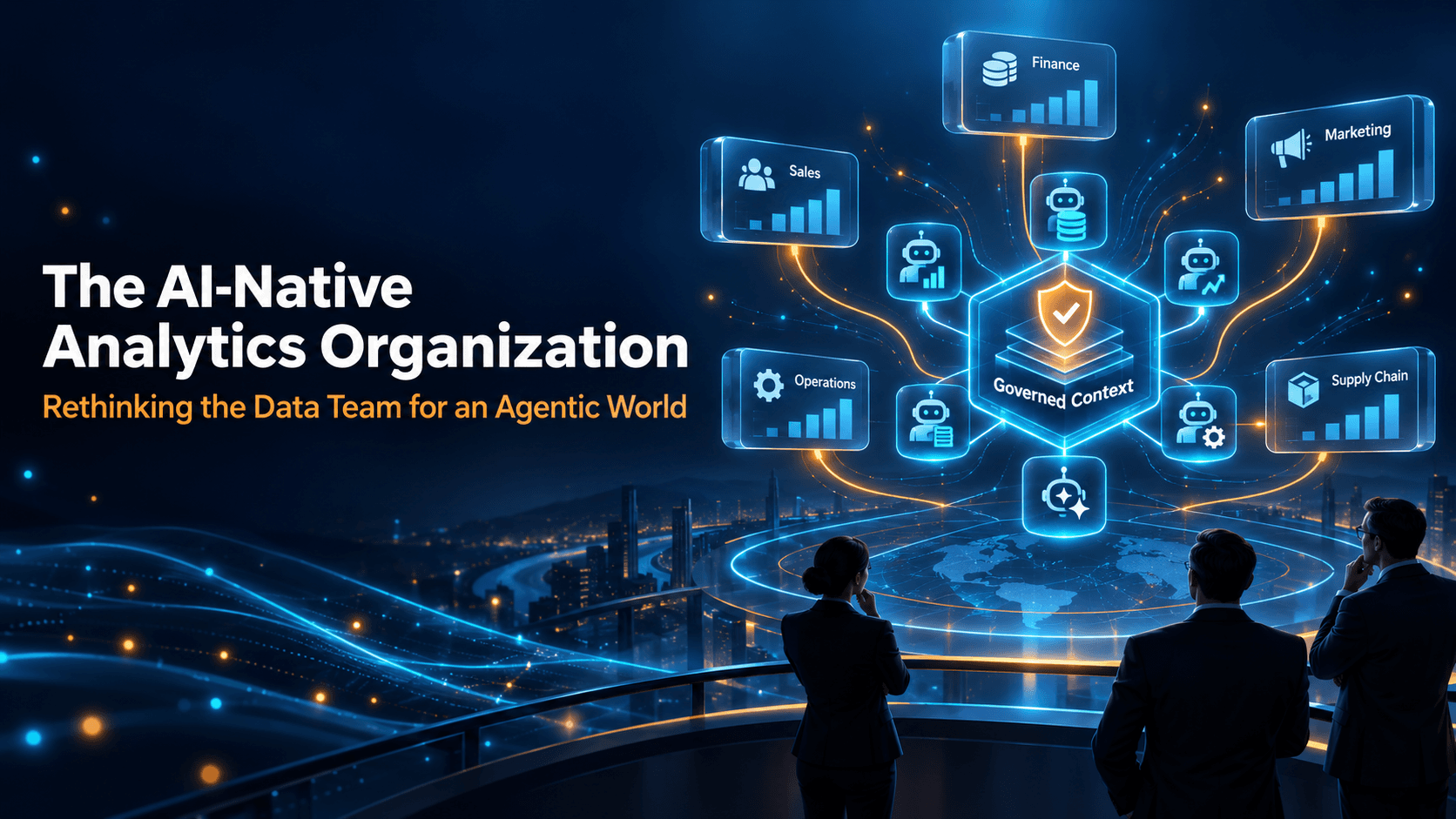
In an agentic enterprise, it can become part of the control plane through which humans and agents share a common understanding of the business.
- The ontology defines business concepts and relationships.
- Semantic models connect those concepts to physical data.
- Certified metrics establish authoritative calculations.
- Business rules provide operational context.
- Policies determine appropriate behavior.
- Playbooks capture reusable analytical reasoning.
Instead of every agent independently rediscovering how the business works, they operate from a governed contextual foundation.
That is the philosophy behind Codd AI's contextual semantic layer: create a certified foundation of technical and business knowledge that can serve BI, natural-language analytics and increasingly agentic workflows.
Because the alternative is troubling:
100 AI agents with 100 different interpretations of the business.
A New Measure of the Analytics Organization
The AI-native analytics organization may ultimately need a different way of thinking about capacity.
Today we frequently think in terms of people.
- How many data engineers do we have?
- How many BI developers?
- How many analysts?
- How many data scientists?
Tomorrow, the more meaningful question may be:
How much governed analytical capacity can we safely deploy?
Ten analysts might oversee hundreds of analytical Playbooks.
Five engineers might supervise agents managing thousands of pipelines.
A small stewardship organization might certify business knowledge consumed across millions of AI-generated analyses.
The goal isn't necessarily fewer people.
It is orders of magnitude more analytical capacity from the expertise already inside the organization.
And that may be the most important organizational shift of all.
The defining characteristic of the AI-native analytics organization won't be how many people it replaces with AI.
It will be how effectively it combines human expertise, governed business context and autonomous analytical capacity.
The organizations that get this right won't simply have more AI.
They will have redesigned the data organization so humans and agents operate from the same trusted understanding of the business, with clear boundaries defining what AI can build, what it can analyze, what it can recommend, what it can execute and where humans must remain in control.
That is the transition from an analytics organization built around scarce human capacity to one designed around abundant, governed intelligence.
About Codd AI
At Codd AI, we believe enterprise AI should reason from a shared, trusted understanding of the business, not from isolated prompts or disconnected data sources. Our AI-powered contextual semantic layer combines technical metadata, business knowledge, governance, and human certification into a reusable enterprise foundation for conversational analytics, AI copilots, and agentic workflows.
By helping organizations capture and govern business context once, Codd AI enables every AI and BI application to deliver more consistent, explainable, and trusted insights, today and as the AI landscape continues to evolve. To learn more, visit www.codd.ai or schedule a conversation with one of our co-founders.