In a previous article we spoke about the explosion of generative AI copilots on every data or BI platform. And every demo sizzles with users typing questions in natural language, and within seconds, answers appear.
For many organizations, this feels like a breakthrough. At last, analytics without writing code.
But there is a catch: at the heart of what most of these tools are doing is to simply generate SQL based on the user question. Tables are joined. Filters are applied. Aggregations are calculated. The database responds.
But is generating SQL the same as understanding your business?
The answer is no.
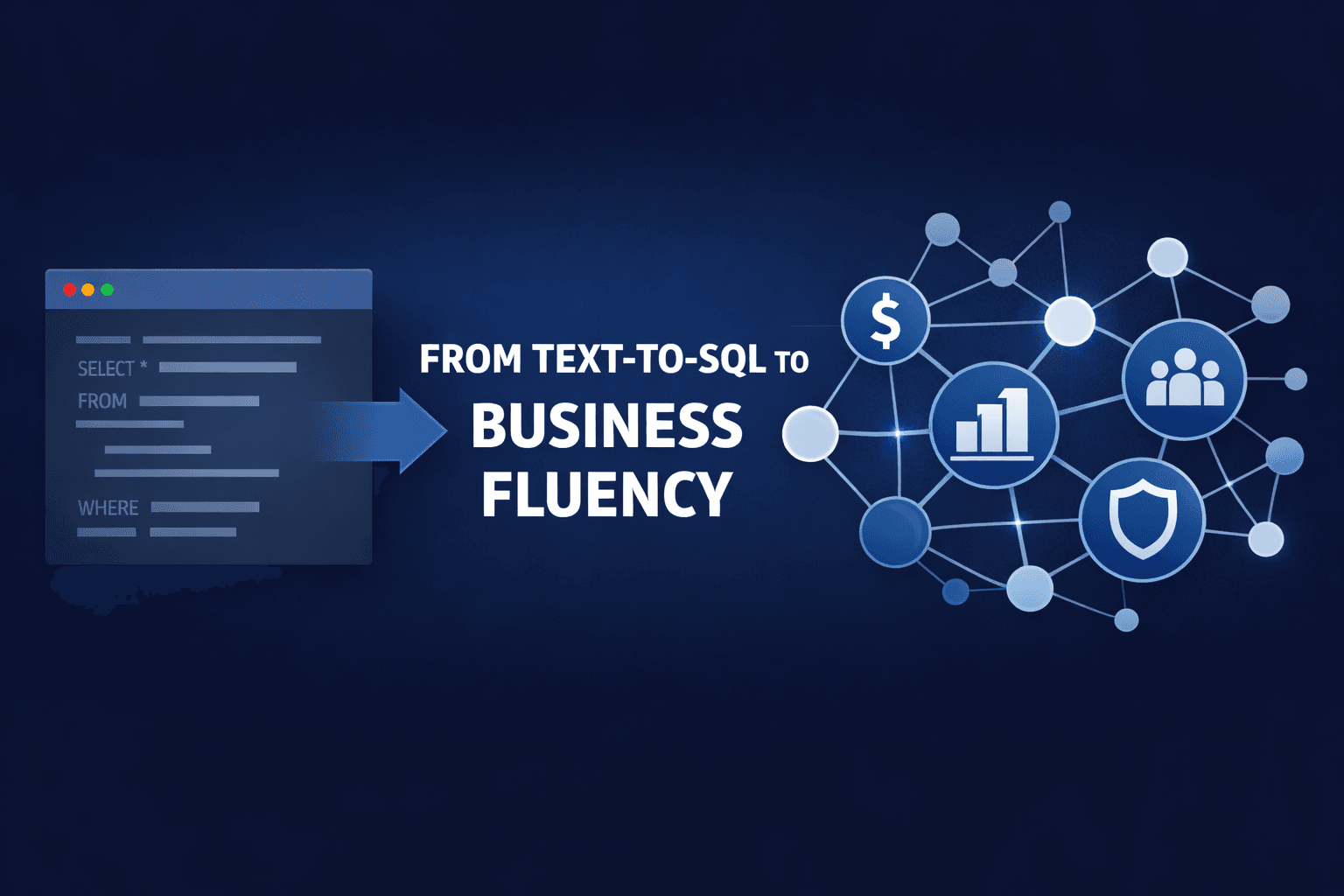
Text-to-SQL is an interface innovation. Business-fluent AI requires something far deeper: context.
And that missing context layer is what separates impressive demos from trusted enterprise analytics. In this blog we will break out some of the key differences in the approaches between Copilots (text-to-SQL) and Context-aware Semantic Intelligence (business-fluent) approaches.
What Text-to-SQL Copilots Actually Do Well
Let's be fair.
Modern copilots are genuinely powerful tools. They:
- Translate natural language into SQL syntax
- Infer joins across related tables
- Suggest filters and groupings
- Reduce manual query writing
- Improve analyst productivity
Under the hood, most of these systems rely on a technical semantic layer that contains the following:
- Database schema metadata
- Table and column names
- Foreign key relationships
- Business-friendly terms, often manually curated
In these tools the LLMs are trained to interpret user intent (via using the business terms) and map it to database structures. When the schema is clean and well-modeled, the results can look remarkably accurate.
But here is the key limitation:
They understand databases. They do not understand businesses.
Of course it is possible for a user to add additional context to the model at run time, but now we are putting the burden of explainability and transparency on each user of the system. And we have no consistency, governance or audits across the entire business.
The net is that for data teams (data engineers, BI engineers), this can eliminate friction and save some time. For non-technical users, it is something to approach with caution and double checking every result.
The Semantic Gap Between Language and Meaning
Natural language is inherently ambiguous.
When a business executive asks:
- "What is our active customer count?"
- "Show me net revenue by region."
- "What's churn this quarter?"
- "What is our total exposure?"
Those terms carry embedded business meaning. They are not just labels.
"Active customer" might mean:
- A customer with at least one transaction in 30 days.
- A customer with an active subscription.
- A customer who has logged into the platform in 90 days.
- A customer not flagged as churned in CRM.
"Net revenue" may require:
- Excluding refunds.
- Excluding credits.
- Applying currency normalization.
- Removing intercompany transfers.
- Aligning to the correct accounting periods.
The challenge in the copilot approach is that these concepts do not exist in the database and as a result are not reflected in the semantic layer. Of course, the real power of GenAI is that it will reason and attempt to solve the problem via guessing based on some general meaning it can assign to the question. But guessing is not acceptable in the world of analytics and data. Neither is it good from a governance point of view.
Where Text-to-SQL Breaks Down in the Enterprise
As organizations scale, the limitations become structural.
1. No Certified Metric Enforcement
In real enterprises, key metrics are not just queries. They are governed assets.
Revenue, churn, margin, ARR, exposure, compliance risk: these definitions are version-controlled, reviewed, and approved. Often by finance, compliance, or risk teams.
Text-to-SQL copilots dynamically generate logic at query time. They do not inherently:
- Enforce certified metric definitions
- Validate against approved business logic
- Prevent alternate interpretations
- Ensure consistency across tools
Two users can ask the same question and receive slightly different SQL, based on how the prompt is phrased.
Over time, this leads to metric drift.
And once executives see conflicting numbers, trust erodes quickly.
2. No Cross-Domain Context
Modern enterprises operate across multiple domains:
- Sales
- Marketing
- Finance
- Operations
- Risk
- Compliance
Business questions rarely stay confined to a single schema.
Consider:
"How does customer churn correlate with product adoption and margin erosion?"
Answering this requires:
- Revenue models
- Product hierarchies
- Customer lifecycle definitions
- Cost allocations
- Cross-system reconciliation
A Text-to-SQL copilot sees schemas. It does not see domain relationships.
It cannot reason about how finance definitions intersect with operational definitions. It does not understand hierarchical business logic. It lacks ontology.
Without embedded domain context, the copilot becomes a query assistant, not a business reasoning system.
3. No Institutional Memory
Businesses evolve.
Metric definitions change. Mergers introduce new systems. Product lines are restructured.
Human analysts carry institutional memory. They know why a metric was defined a certain way.
Copilots do not. They respond per query. They do not accumulate organizational intelligence.
Without a structured semantic layer embedding institutional knowledge, AI remains reactive, not contextual.
The Difference Between User Experience and Architecture
This is the central distinction.
Text-to-SQL is an interface capability, i.e. it improves a user experience.
A contextual semantic layer is an architectural foundation.
The former focuses on query generation. The latter encodes business meaning.
Consider two simplified architectures.
Text-to-SQL Model
User → LLM → Schema Metadata → Generated SQL → Database → Result
Business logic lives implicitly in table structures and naming conventions. The model infers intent based on patterns.
SQL becomes the primary vehicle of meaning.
Context-Aware Architecture
User → Business Intent
 → Contextual Semantic Layer
    • Domain Ontologies
    • Certified Metrics
    • Governance Policies
    • Knowledge Graph Relationships
 → Validated Query Generation
 → Data Platform
 → Explainable Output
In this model, SQL is no longer the source of truth. It is merely the execution artifact.
The semantic layer contains:
- Explicit business definitions
- Cross-domain relationships
- Policy enforcement rules
- Governance controls
- Version history
- Human-validated logic
AI does not guess. It reasons within boundaries.
That is the shift from query automation to business fluency.
Why This Distinction Matters Now
Generative AI is rapidly commoditizing Text-to-SQL.
Every major data platform is shipping a copilot. Over time, the capability to generate syntactically correct SQL will become table stakes.
The competitive frontier is moving elsewhere.
Enterprises do not need AI that writes SQL.
They need AI that:
- Understands their business language
- Respects governance and consistency
- Operates across domains
- Produces explainable, auditable outcomes
In other words, they need AI that speaks their business fluently. And fluency requires context.
The Economic Risk of Skipping the Context Layer
Organizations that rely solely on Text-to-SQL copilots often encounter predictable patterns:
- Conflicting KPI outputs across tools
- Analyst time spent reconciling discrepancies
- Executive skepticism toward AI-driven answers
- Proliferation of shadow logic
- Increased compliance exposure
- Loss of confidence in data-driven decision-making
The cost is not technical. It is organizational.
Trust breaks down.
Data teams revert to manual validation.
AI becomes "assistive," not authoritative.
In contrast, organizations that embed a contextual semantic layer achieve:
- Consistent metric definitions across tools
- Cross-domain alignment
- Reduced reconciliation effort
- Explainable AI outputs
- Faster executive decision cycles
- Stronger governance posture
The difference is structural, not cosmetic.
The Path to Business-Fluent AI
We are witnessing an evolution in analytics maturity:
- Manual SQL and dashboards
- Technical semantic layers
- Text-to-SQL copilots
- Contextual semantic intelligence
- Autonomous business reasoning
Text-to-SQL is a step forward. But it is not the destination.
The real transformation occurs when AI is grounded in:
- Business ontologies
- Structured knowledge graphs
- Certified metric frameworks
- Governance and validation workflows
- Human-in-the-loop refinement
This is what turns AI from a query assistant into a business collaborator.
Writing SQL Is Easy. Encoding Business Truth Is Hard.
Generating SQL will soon be (or is already) ubiquitous.
Understanding revenue, churn, risk, compliance, exposure, and margin in the precise way your enterprise defines them is not.
That requires:
- Context engineering
- Semantic modeling
- Governance design
- Domain knowledge integration
Text-to-SQL solves a usability problem.
A contextual semantic layer solves a trust problem. And in enterprise analytics, trust is the real currency.
As generative AI continues to evolve, the winners will not be the platforms that can write the most SQL. They will be the ones that can encode, protect, and operationalize business truth.
About Codd AI
Codd AI has been designed from the ground up for the world of context-rich GenAI. But Codd AI approaches this in a very different way to most GenAI interfaces that claim to be context focused:
Unified and Automated: Of course we combine technical metadata and business know-how into a unified semantic layer, but we automate the creation of a business level ontology, data model and business metrics. In modern data estates the data modeling has been neglected and takes a massive amount of time of scarce data resources to model every time someone needs data.
Governed: Along with extensive automation, Codd AI ensures human-in-the-loop review and certification of models and metrics. That ensures the AI will have a deterministic foundation that will be used for all queries.
Operationalizing Insights to Actions: Codd AI uniquely allows deep analytical agentic sequences to be stored as playbooks for reuse by all users. This ensures accuracy and consistency as the AI is not trying to come up with different reasoning pathways to answer the same questions.
Interoperable and Available Where Your Users Are: Codd AI offers a rich native user experience with built-in Canvas and Metrics Boards. In addition Codd AI can natively be engaged via your existing BI tools, Slack or Teams or any other MCP client or server.
If you are interested in finding out more about Codd AI, have a look at our resources section or schedule a 30 minute overview.