Large language models know an extraordinary amount about the world. They understand accounting terminology, sales processes, supply chains, financial concepts, healthcare terminology, manufacturing processes, and thousands of other business domains.
What they don't inherently understand is your business, your specific rules and logic.
They don't know exactly what your company means by an active customer. They don't know which revenue calculation Finance considers authoritative. They don't know how your organization defines churn, which products belong to which hierarchy, when your fiscal quarter ends, or why a particular customer segment excludes certain accounts.
And they certainly don't automatically understand how all those concepts map to the database tables, columns, joins, calculations, and business rules buried across your data environment.
Organizations increasingly recognize this problem. The response has been to give AI more company-specific information through fine-tuning, RAG, larger prompts, vector databases, knowledge bases, and increasingly sophisticated AI agents.
All of these techniques have a role.
But they also raise a more fundamental architectural question:
Should the authoritative understanding of your business actually live inside the AI model, or be reconstructed by it?
Alternatively, should you adopt an architecture that separates the AI's reasoning capability from the organization's governed business understanding?
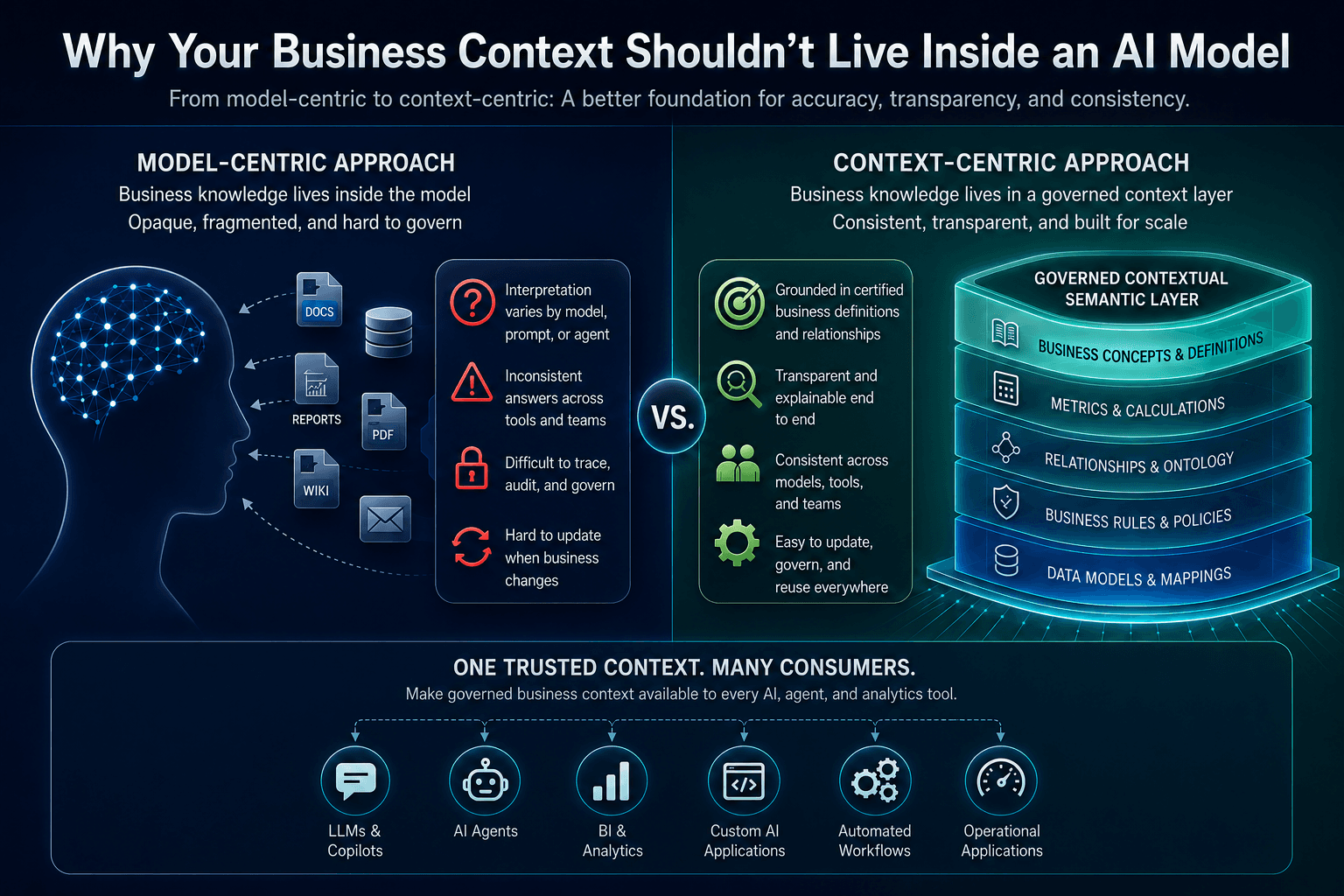
Going down this path, instead of teaching every AI system independently how your business works, you create a shared, governed context layer that any authorized AI system can use.
That distinction has significant implications for accuracy, transparency, consistency, governance, and ultimately the scalability of enterprise AI.
Knowing About Your Business Isn't the Same as Understanding Your Business
Consider a seemingly straightforward question:
"What was our net revenue in North America last quarter?"
A powerful LLM can easily understand the language.
But producing a trustworthy answer requires considerably more than language comprehension.
What exactly does net revenue mean inside your organization?
Perhaps it is:
Gross Revenue - Returns - Discounts - Credits
But perhaps certain business units treat rebates differently. Maybe intercompany transactions must be excluded. Perhaps acquired businesses follow different rules until they are integrated into the corporate reporting model.
Then there is North America.
Does that mean customer headquarters? Billing address? Sales territory? Transaction location? Does Mexico belong to North America for financial reporting but Latin America for sales reporting?
And what does last quarter mean? Calendar quarter or your company's fiscal calendar?
Finally, the AI needs to know where the relevant data resides, which tables should be used, how those tables relate, which joins are valid, and which filters must be applied.
This is the difference between understanding language and understanding a business.
Training or fine-tuning a model on company information can make it much better at recognizing terminology, patterns, and domain-specific language. Retrieval can give it access to relevant documents at runtime.
But neither of these automatically establishes an authoritative representation of business meaning.
A contextual semantic layer approaches the problem differently.
Instead of expecting the model to reconstruct meaning from the information available to it, business concepts, relationships, metrics, definitions, and rules are explicitly represented and governed.
The model doesn't have to infer what Net Revenue probably means.
It can be given the certified definition.
That distinction is critical in the world of analytics.
Accuracy: Reduce What AI Has to Infer
Generative AI is inherently probabilistic.
That is one of its strengths. It enables models to reason across ambiguous questions, interpret language, synthesize information, and solve problems that traditional deterministic software struggles with.
But in enterprise analytics, not everything should be open to interpretation. Neither should interpretation differ every time the same question is being asked.
If Finance has certified a particular calculation for Gross Margin, you don't want an AI agent deciding at runtime which of several plausible definitions seems most appropriate.
If the business has an approved definition of an Active Customer, the AI shouldn't reconstruct that definition from five documents, three dashboards, and a collection of previous queries every time someone asks a question.
The more business meaning AI must infer, the more semantic degrees of freedom we introduce into the system.
Consider two architectural approaches.
In a model-centric architecture:
Question → Retrieved Context → LLM Interpretation → Data → Answer
The model may need to determine which retrieved information matters, reconcile conflicting definitions, infer relationships, and construct the appropriate business logic.
In a context-centric architecture:
Question → AI Reasoning → Certified Business Context → Governed Data Relationships → Data → Answer
The AI is still reasoning. But it is reasoning within a much more constrained and authoritative representation of the business.
This latter framework doesn't make the LLM deterministic. It does something arguably more useful: it reduces how much business meaning the LLM is required to invent or infer.
For enterprise analytics, that can be a critical difference.
Transparency: Why Did AI Give Me This Number?
A further challenge in the world of AI powered analytics is transparency into the responses. Imagine an executive asks an AI assistant about quarterly revenue and receives this answer:
$427.3 million.
The obvious next question is:
Why?
- Where did the number come from?
- Which definition of revenue was used?
- Which business rules were applied?
- Which data sources contributed?
- Which customer hierarchy determined North America?
- What was excluded?
If the business understanding primarily exists as learned model behavior, answering those questions becomes difficult.
You can ask an LLM to explain its answer. But an explanation generated after the fact isn't necessarily the same thing as auditable lineage.
A governed contextual semantic layer offers a different path.
Potentially, the answer can be traced through:
Question → Net Revenue → Certified metric definition → Calculation and business rules → Business concepts and relationships → Physical data model → Source data → Executed query → Result
This changes the nature of explainability.
Instead of asking the model to explain why it believes something, the enterprise can inspect the governed business logic used to arrive at the result.
That's an important distinction.
Enterprise AI doesn't just need explainable answers. It needs explainable business meaning.
Consistency Becomes Even More Important in an Agentic Enterprise
Today, many organizations are thinking about AI in terms of copilots and chatbots.
Tomorrow's environment will be considerably more distributed.
A large enterprise could eventually operate hundreds or thousands of specialized AI agents and AI-powered applications.
Finance may have agents analyzing spending and forecasting cash flow. Sales may have agents identifying pipeline risks. Customer Success may have agents detecting churn signals. Supply Chain may have agents monitoring inventory and suppliers.
Alongside them will be BI platforms, embedded AI applications, conversational analytics tools, custom applications, and multiple general-purpose AI assistants.
Now consider what happens if each system develops its own understanding of the business.
The Finance agent has one definition of ARR.
The Sales agent has another.
The executive dashboard has a third.
The forecasting agent interprets customer segments differently again.
Every individual AI system could be working correctly according to the context it has been given, and the enterprise could still receive different answers to the same question.
We will have recreated one of the oldest problems in enterprise data: multiple versions of the truth. Except now we will have done it at machine speed.
This is semantic fragmentation.
And agentic AI could dramatically amplify it.
A shared contextual semantic layer provides an alternative architecture.
Instead of embedding business meaning separately into every application or agent, they can consume a common governed representation of customers, products, metrics, relationships, definitions, and rules.
Different models can reason differently. Different agents can perform different jobs.
But they can start from the same understanding of the business.
Business Knowledge Doesn't Stand Still
There is another practical problem with embedding too much business knowledge into models: businesses change.
Imagine your organization defines an Enterprise Customer as:
Annual Contract Value ≥ $200,000
The company changes its segmentation strategy, and beginning next quarter the definition becomes:
Annual Contract Value ≥ $250,000
Where should that change occur?
If business knowledge is distributed across fine-tuned models, prompts, RAG repositories, AI applications, dashboards, and agent instructions, seemingly simple changes can become surprisingly difficult to manage.
- Which systems contain the old definition?
- Which AI applications have retrieved outdated documents?
- Which agents still use the previous threshold?
A governed semantic layer treats business context as managed enterprise metadata rather than model knowledge.
The definition can be updated, reviewed, certified, versioned, and made available to every consuming system.
This isn't merely a technical advantage.
It is an operating model for business knowledge.
Business Context Needs Governance
AI can play an enormous role in discovering and generating business context.
In fact, this is where AI becomes particularly powerful.
It can inspect database metadata, analyze BI reports, read documentation, identify calculations, discover relationships, extract business rules, propose metrics, and help build semantic models dramatically faster than traditional manual approaches.
But generating business context and certifying business context are two different things.
If an AI discovers three definitions of Customer Lifetime Value across an organization, which one is correct?
Perhaps all three are correct for different purposes.
That is ultimately a governance question, not a language-model question.
- Important business concepts need ownership.
- Metrics need certification.
- Relationships need validation.
- Definitions need versioning.
- Business rules need lineage.
- Changes need auditability.
And access may need to be controlled based on roles and policies.
This is why human-in-the-loop governance remains so important.
In a previous blog, Your Business Knowledge Is Everywhere, we discussed how AI can dramatically accelerate the discovery, generation, and maintenance of enterprise context.
Humans remain responsible for deciding which context the organization trusts.
Once certified, that context becomes reusable infrastructure rather than something every AI application must rediscover independently.
Your Business Knowledge Shouldn't Be Locked Up In Your LLM
There is another reason to separate business context from the model consuming it: AI models are changing extraordinarily quickly.
The model your organization considers best today may not be the model it wants to use two years from now, or even six months from now.
Different models may also be appropriate for different workloads.
A company might use one frontier model for sophisticated reasoning, a smaller model for high-volume analytics, an open-source model for sensitive workloads, and another provider because of regional, regulatory, cost, or latency requirements.
An additional challenge with incorporating changing business logic in the LLM is the time, cost and effort to retrain and then validate this across all the different use cases. Making sure that an old definition is removed from the LLM and totally replaced with the new definition is an extremely complex undertaking.
This makes model independence increasingly important.
If substantial amounts of business understanding are tightly coupled to a particular model, application, or AI platform, changing models becomes more complicated.
But if the organization's business context exists independently, the architecture changes.
The contextual semantic layer becomes persistent.
Models become consumers of that context.
Models can change. Business understanding doesn't have to.
This is more than model portability.
It is context portability, a theme we explored in The AI Model Will Change. Your Business Context Shouldn't.
The organization retains ownership of its business meaning regardless of which AI technology happens to be consuming it.
A Different Architecture for Enterprise AI
This leads AI and data leaders toward a different way of thinking about enterprise AI architecture.
At the bottom are the organization's data and knowledge sources: databases, cloud data platforms, ERP applications, CRM systems, BI environments, documentation, policies, glossaries, and the knowledge held by subject-matter experts.
Above those sources sits a governed contextual semantic layer.
That layer represents the business:
Concepts. Relationships. Metrics. Definitions. Rules. Policies. Data mappings.
AI can help discover and generate this context, while technical experts and business stewards review and certify it.
The resulting context can then be exposed through interfaces such as APIs, SQL, or MCP to many different consumers:
LLMs. AI agents. Conversational analytics. BI platforms. Custom AI applications. Automated workflows.
This creates an important separation of concerns.
- Models provide reasoning.
- Agents perform tasks.
- Enterprise systems provide data.
- The contextual semantic layer provides governed business understanding.
No single model needs to become the organization's repository of business truth.
Where Platforms Like Codd AI Fit
This is the architectural philosophy behind Codd AI's contextual semantic layer.
Codd brings together technical metadata and business knowledge and uses AI to help transform that information into an analytical representation of the enterprise.
The process moves from discovery through generation, review, certification, and ultimately delivery.
Technical metadata provides information about tables, columns, schemas, and relationships.
Business knowledge provides the definitions, terminology, calculations, rules, and context that technical metadata alone cannot explain.
Together they can be used to generate an analytical ontology, physical data models, metrics, relationships, and other semantic artifacts.
Critically, AI-generated context doesn't simply become enterprise truth.
Technical experts and business stewards can review and certify the resulting artifacts before they are made available to downstream consumers.
Once governed, that same context can support conversational analytics, BI, AI applications, and agentic workflows.
The goal isn't to replace LLMs or compete with them.
It is to give them something they fundamentally need:
A consistent, transparent, governed understanding of the business they are being asked to reason about.
Don't Teach Every AI Your Business
As enterprise AI evolves, organizations may need to rethink where business understanding belongs.
Fine-tuning will remain valuable.
RAG will remain valuable.
Prompt engineering will remain valuable.
Knowledge bases, knowledge graphs, and specialized models will all have important roles.
But authoritative business meaning is too important to be implicitly embedded across hundreds of models, prompts, applications, and agents.
Organizations need a way to define what Customer means once.
What Revenue means once.
What ARR means once.
How products relate to customers once.
How business concepts map to physical data once.
Then govern those definitions and make them available wherever they are needed.
That suggests a different question for enterprise AI leaders:
"How do we create one governed understanding of our business that every AI system can use?"
Because the future of enterprise AI may depend less on which model knows the most, and more on whether every model and agent is working from the same understanding of the business.
Talk to the Codd AI Founders
If you are on your AI journey and are looking to explore ways to build your business contextual semantic foundation, schedule a 30 minute no pressure chat with one of our founders.