
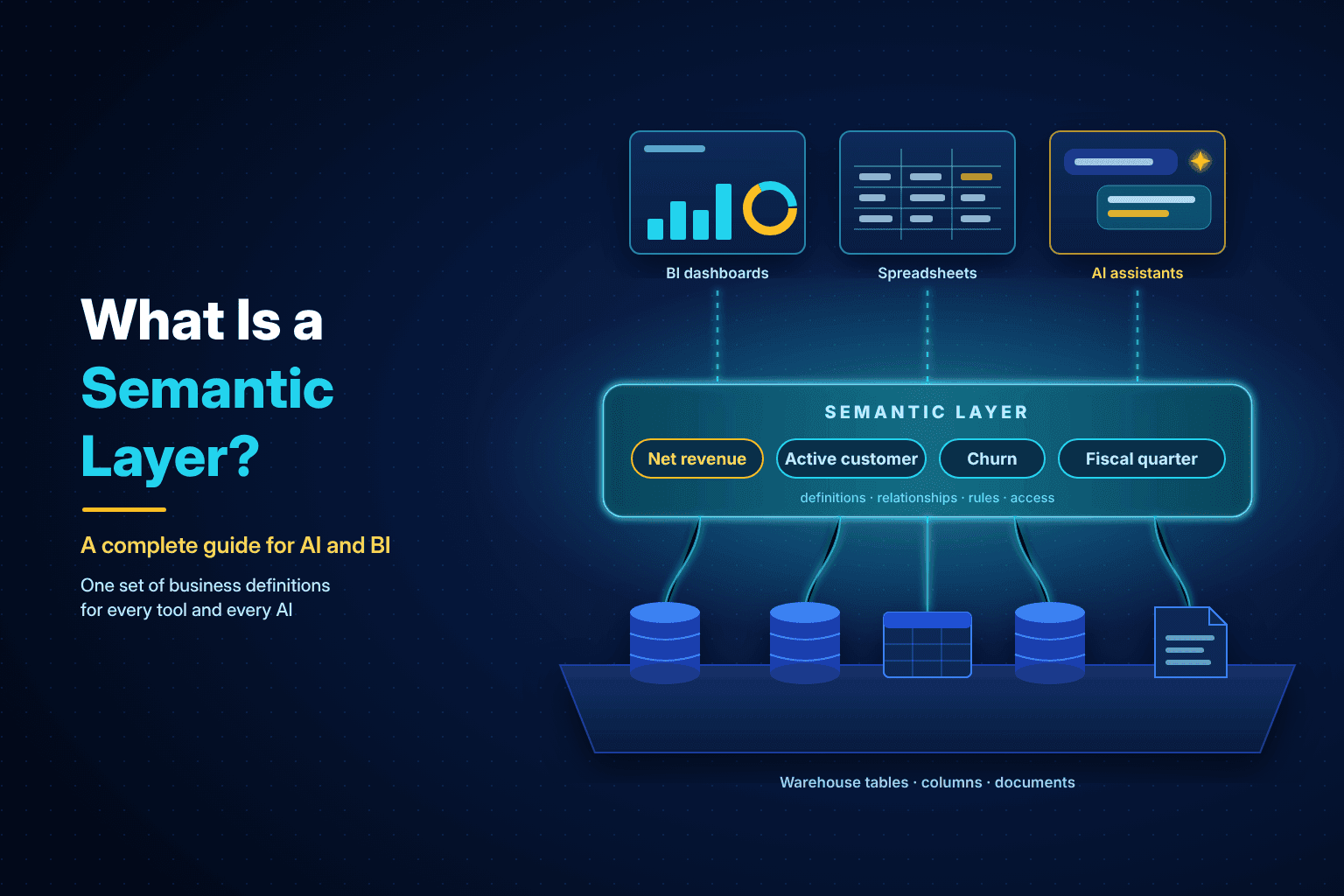
A semantic layer is a business-friendly map of your data. It sits between where data is stored (a warehouse such as Snowflake, Databricks, or BigQuery) and the people and tools that use it (BI dashboards, spreadsheets, and AI assistants). It translates technical tables and columns into business terms like Revenue, Active Customer, or Churn Rate, and it defines exactly how each one is calculated, so every team and every tool gets the same answer to the same question.
This guide explains how a semantic layer works, what goes into one, the main types you will run into, how it differs from related ideas like data models and knowledge graphs, and why it has become essential now that AI is answering business questions.
What does a semantic layer actually do?
A semantic layer turns business questions into correct data queries. When someone asks "What was net revenue by region last quarter?", the semantic layer knows which tables hold revenue, which joins connect orders to regions, which refunds and discounts to subtract, and what "last quarter" means on your fiscal calendar.
Without it, every analyst, dashboard, and AI tool has to rebuild that logic on its own. That is how one company ends up with three different revenue numbers in three different meetings.
A simple example:
| What the business says | What the semantic layer resolves it to |
|---|---|
| "Active customer" | A customer with 3+ orders in the last 90 days, excluding test and internal accounts |
| "Net revenue" | Gross order value minus refunds, discounts, and tax, in reporting currency |
| "Last quarter" | Your fiscal quarter, not the calendar quarter |
| "By region" | Customer billing address mapped to your sales territories |
Define it once, and every dashboard, spreadsheet, and AI assistant reuses the same definition.
What is inside a semantic layer?
Most semantic layers contain the same core building blocks:
- Entities: the things your business cares about, such as Customer, Order, Product, and Account.
- Relationships: how those things connect ("a Customer places many Orders", "an Order contains Products"), which tells the system how to join tables correctly.
- Metrics and measures: governed calculations like revenue, margin, and retention. (If the terms blur together, see KPI vs metric vs measure.)
- Dimensions: the ways you slice metrics, such as time, region, product line, and channel.
- Business rules: filters and exceptions that make a number correct for your company, like excluding internal accounts or applying a fiscal calendar.
- Access controls: who can see which data, so a regional manager sees their region and nobody sees sensitive fields they should not.
The more of your real business knowledge these pieces capture, the more useful the semantic layer becomes, especially for AI.
Why does AI need a semantic layer?
Large language models are fluent, but they do not know your business. Ask an AI assistant connected directly to your warehouse for "total revenue", and it has to guess: gross or net? Including refunds? Which currency? Which of the four tables with "revenue" in the name? The result is an answer that looks confident and may be wrong. This is the root of most GenAI hallucinations in analytics.
A semantic layer removes the guessing. Instead of writing SQL from scratch against raw tables, the AI works from certified definitions, so:
- Answers are consistent. The same question returns the same number, whoever asks and whichever tool they use. Without this, you get analytical drift.
- Answers are explainable. You can trace a number back to its definition and source tables.
- Answers follow your rules. Fiscal calendars, exclusions, and access controls apply automatically.
This is also why text-to-SQL on its own is not enough for enterprise analytics: generating a query is the easy part, knowing what the business means is the hard part.
What are the main types of semantic layer?
The term gets used for quite different things. As we have written before, the semantic layer has lost its meaning because so many products now claim one. In practice you will see four broad types:
- BI-embedded semantic layers. Built into a BI tool, such as the modeling layer of a dashboarding product. They work well inside that tool but the definitions usually do not travel to other tools or to AI.
- Universal (headless) semantic layers. Standalone layers that sit between the warehouse and many tools, so BI, spreadsheets, and apps share one set of metrics. Definitions are typically written and maintained by hand in code or configuration files.
- Platform-native semantic layers. Metric and semantic definitions stored inside a cloud data platform, such as Snowflake Semantic Views. Convenient if most of your work lives on that platform.
- Contextual semantic layers. These go beyond SQL translation and also capture business context: why a metric exists, which rules apply, how terms differ between departments, and knowledge that lives in documents and people's heads. This is what AI needs to reason correctly. Read more in the contextual semantic layer explained. For how this shows up for business users, see what is contextual analytics.
These are not mutually exclusive. Many companies have a BI-embedded layer today and are deciding what to put underneath their AI initiatives.
Semantic layer vs related concepts
| Concept | What it is | How it relates to a semantic layer |
|---|---|---|
| Data warehouse | Where data is stored and processed | The semantic layer sits on top and gives that data business meaning. Your data warehouse is not your business context layer. |
| Data model | The structure of tables and how they join | A semantic layer includes a data model but adds metrics, rules, and business terms. |
| Metrics layer / metric store | A central place to define metrics | A subset of a semantic layer focused only on calculations. |
| Data catalog | An inventory of data assets with descriptions and ownership | Helps people find data; a semantic layer makes data queryable in business terms. |
| Knowledge graph | A network of entities and relationships | Captures connections across concepts; useful when relationships are part of the answer. See when you need a knowledge graph. |
| Context layer | Business knowledge provided to AI | Overlaps heavily; a contextual semantic layer is a governed form of it. See context layer vs semantic layer. |
| Ontology | A formal model of concepts and their meaning | A semantic layer can be built on a practical ontology. See what ontology means for analytics. |
Do you need a semantic layer?
You probably do if any of these sound familiar:
- Different teams report different numbers for the same metric.
- Analysts rebuild the same logic in every dashboard and spreadsheet.
- New hires take weeks to learn which tables and definitions to trust.
- You want people to ask data questions in plain English, or you are rolling out AI assistants and agents.
- Every new AI tool you add quietly rebuilds the same business definitions.
You may not need one yet if you have a single small team, one BI tool, and a handful of well-understood metrics.
How do you build a semantic layer?
Traditionally, building a semantic layer has been slow, manual work. A typical approach:
- Start with real questions. List the 20 to 50 questions leadership and teams ask most often. They tell you which metrics and entities matter.
- Inventory existing definitions. Collect how metrics are calculated today across dashboards, SQL, spreadsheets, and documents. Expect conflicts.
- Model entities and relationships. Map the core business objects and how they join in your warehouse.
- Define and certify metrics. Agree on one definition per metric with the business owners, and record the rules and exceptions.
- Connect your tools. Point BI, spreadsheets, and AI assistants at the semantic layer instead of raw tables.
- Govern and evolve. Assign owners, track changes, and keep definitions current as the business changes.
The bottleneck is usually steps 2 to 4: discovering what the business already knows and encoding it. That is where AI can now do much of the heavy lifting. Platforms like the Codd AI semantic layer use AI to discover entities, relationships, and metric logic from your data, existing BI assets, and documents, then keep a human in the loop to review and certify the result. Whatever approach you choose, the principle is the same: business context should live in a governed layer, not inside the AI model.
What makes a good semantic layer?
When you evaluate options, look for:
- Speed to value: weeks, not quarters, to a useful first version.
- Business context, not just SQL: rules, definitions, and reasoning that AI can use.
- Works with every tool: BI, spreadsheets, notebooks, and AI assistants all share it.
- Human certification: people approve what becomes official.
- Governance and lineage: you can see where every number comes from and who can access it.
- Easy to evolve: definitions change as the business does, without rewrites.
We go deeper on these in what makes a good semantic layer and why semantic layers matter for AI and BI.
Frequently Asked Questions
What is a semantic layer in simple terms?
A semantic layer is a translator between your data and your business. It turns technical database tables and columns into business terms like revenue or active customers, and defines exactly how each is calculated, so everyone and every tool gets the same answer.
What is an example of a semantic layer?
A common example is defining "net revenue" once, as gross order value minus refunds, discounts, and tax, and having every dashboard, spreadsheet, and AI assistant use that single definition instead of each calculating revenue its own way.
Is a semantic layer the same as a data warehouse?
No. A data warehouse stores and processes data. A semantic layer sits on top of the warehouse and adds business meaning: definitions, metrics, relationships, and rules that make the data understandable and consistent.
What is the difference between a semantic layer and a metrics layer?
A metrics layer focuses only on defining calculations such as revenue or retention. A semantic layer includes metrics but also covers entities, relationships, dimensions, business rules, and access controls.
Why do AI and LLMs need a semantic layer?
Language models do not know your business definitions, so they guess when asked about metrics, which leads to inconsistent or wrong answers. A semantic layer gives them certified definitions and rules to work from, making AI answers accurate, consistent, and explainable.
What is a contextual semantic layer?
A contextual semantic layer extends a traditional semantic layer with business context: why metrics exist, which rules and exceptions apply, how terms differ across departments, and knowledge from documents and experts. It is designed so AI can reason about your business, not just generate SQL.
How long does it take to build a semantic layer?
Built manually, a semantic layer often takes months because definitions must be discovered, agreed, and coded by hand. AI-assisted approaches can produce a reviewable first version much faster by discovering entities, relationships, and metrics automatically, with people certifying the result.