
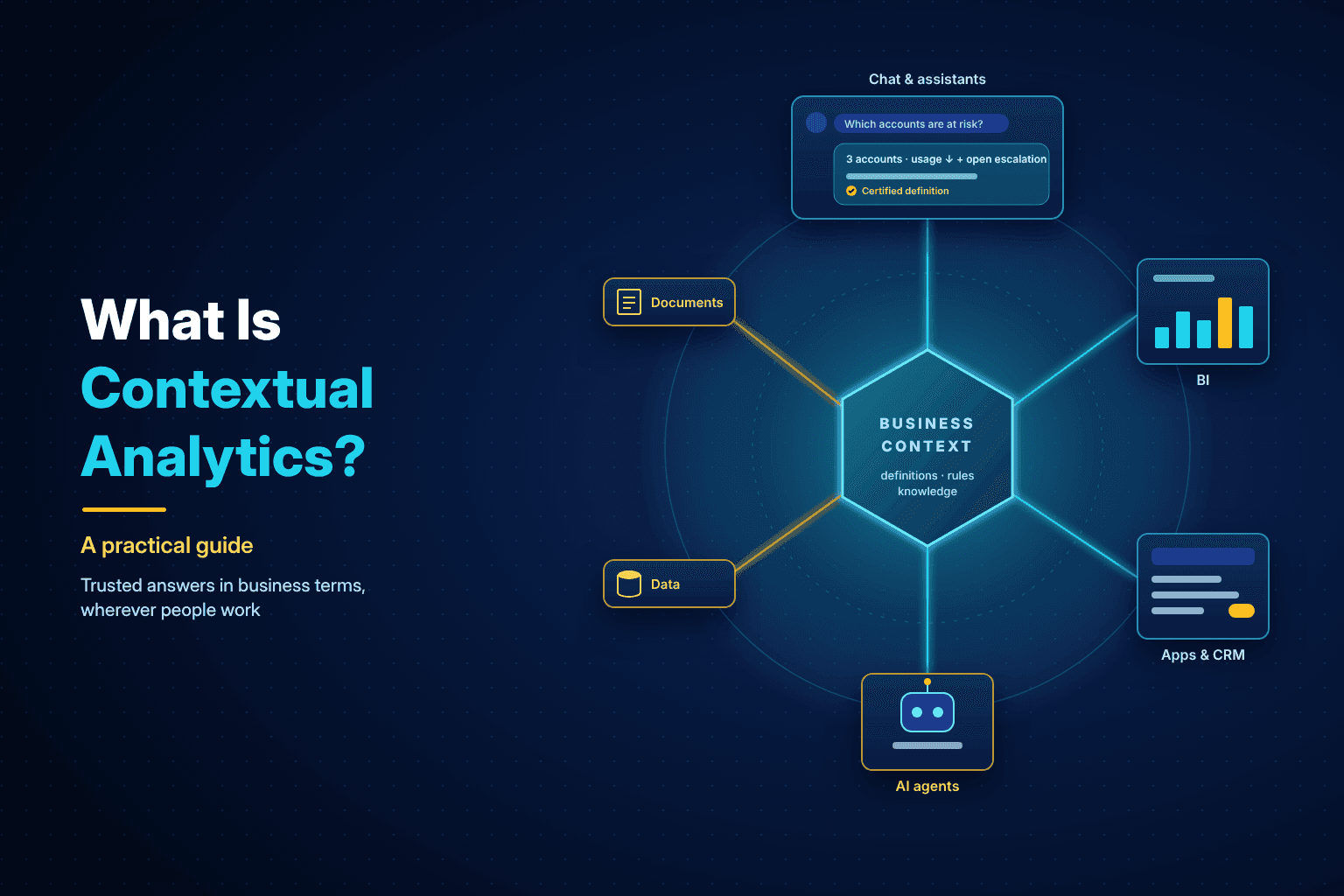
Contextual analytics is analytics that understands the business context behind the data and delivers answers where people already work. Instead of handing someone a dashboard to interpret, it answers their question in business terms, using the company's approved definitions, rules, and knowledge, inside the tool they are already using: a chat app, a CRM, a spreadsheet, or an AI assistant.
This guide explains what contextual analytics means, the two ideas the term combines, how it works, how it compares to embedded, conversational, and traditional analytics, and how to get started.
What does "contextual analytics" mean?
The term is used in two ways, and modern contextual analytics combines both:
- Analytics in the context of work. Insights are delivered inside the applications and workflows where decisions happen, rather than in a separate BI tool people have to visit. A sales manager sees pipeline risk inside the CRM; a support lead gets churn signals inside the ticketing tool. This meaning grew out of embedded analytics.
- Analytics that understands business context. The system knows what your business means by revenue, active customer, or churn, which rules and exceptions apply, and how concepts relate. It answers the way your best analyst would, not the way a generic query engine would. This is the part AI depends on.
The first idea is about where answers show up. The second is about whether they are right. Delivering analytics everywhere only helps if every answer uses the same trusted meaning, which is why the two now go together.
Why contextual analytics matters now
Generative AI has made it easy to ask questions of data in plain English. It has not made the answers reliable.
Ask an AI assistant "What was Q3 revenue growth in EMEA?" and it may answer instantly and confidently, while calculating revenue from bookings instead of recognized revenue, including renewals you did not mean to, and missing an adjustment your finance team applies every quarter. As we described in when AI speaks your business language, AI today understands your words but not your world.
Three shifts make context the deciding factor:
- Everyone is asking questions directly. Self-service through chat and AI assistants removes the analyst who used to apply context by hand.
- Every tool now has its own AI. Without shared context, each copilot reasons differently and the same question gets different answers, a problem we call analytical drift.
- AI is starting to act, not just answer. Agents that trigger actions need to be right about meaning, not just fluent in language.
How does contextual analytics work?
Contextual analytics rests on a layer of business understanding between your data and the people and tools that use it:
- A contextual semantic layer. Governed definitions of entities, metrics, relationships, and rules, plus the business knowledge around them: why a metric exists, which exceptions apply, how terms differ across departments. (New to the idea? Start with what is a semantic layer, then read about the contextual semantic layer.)
- Knowledge from beyond the database. Definitions and reasoning often live in documents, BI reports, tickets, and people's heads. Contextual analytics brings that knowledge in and makes it governed. See why your business knowledge being everywhere is a problem for enterprise AI.
- Natural language and AI on top. People ask questions in plain English; the AI resolves them through certified definitions instead of guessing at raw tables.
- Delivery in the flow of work. Answers reach people in chat tools like Slack, in AI assistants through MCP, in BI tools, and in business applications.
- Explanations with every answer. Each result shows which definition, data source, and logic produced it, so people can trust it and auditors can trace it.
An example: a regional manager types "Which accounts in my territory are at risk this quarter?" in Slack. A contextual analytics system knows the manager's territory, uses the company's certified definition of "at risk" (for example, declining usage plus an open escalation), applies the fiscal calendar, respects access controls, and replies in the thread with the accounts and a short explanation of how they were identified.
Contextual analytics vs other approaches
| Approach | What it does well | What it lacks without context |
|---|---|---|
| Traditional BI and dashboards | Curated, governed reports for known questions | Answers only the questions someone built a dashboard for; users must interpret results |
| Embedded analytics | Puts charts inside other applications | Usually shows the same fixed views in a new place; meaning still varies by tool |
| Conversational analytics | Lets anyone ask questions in plain English | Without business context, answers can be fluent but wrong. See why most vendors backed away from chat with your data |
| Augmented analytics | Uses ML to surface trends and anomalies automatically | Finds patterns but may not know which ones matter to the business |
| Text-to-SQL copilots | Turn questions into queries quickly | Generate SQL without knowing your definitions. See text-to-SQL vs business-fluent AI |
| Contextual analytics | Combines natural language, delivery in the flow of work, and governed business meaning | Requires investing in a shared, governed context layer first |
Contextual analytics does not replace these approaches. It gives all of them the same foundation, so a dashboard, a Slack answer, and an AI agent agree on the numbers. This is also why conversational analytics is replacing dashboards only where the context is in place.
Contextual analytics use cases
- Finance: answer revenue, margin, and forecast questions using the exact definitions finance certifies, with an audit trail.
- Sales and revenue operations: pipeline, bookings, and account health in the CRM or chat, using one definition of every stage and metric.
- Customer success: churn risk and usage trends surfaced where account teams work, based on the company's agreed risk signals.
- Operations and connected products: turning machine and product telemetry into answers customers and operators understand. See from machine telemetry to customer value.
- Regulated industries: consistent, explainable answers for insurance, banking, and healthcare, where every number may need to be traced.
Do you need contextual analytics?
You likely do if:
- Different teams or tools give different answers to the same question.
- Business users still route most questions through analysts.
- You are rolling out AI assistants or agents and cannot yet trust their numbers.
- Important definitions live in documents, spreadsheets, or individual experts rather than in a governed system.
- Your AI analytics pilots stall after an impressive demo.
How to get started with contextual analytics
- Pick a domain and its real questions. Start with one area, such as revenue or customer health, and collect the questions leaders actually ask.
- Capture the context. Gather definitions, rules, and exceptions from dashboards, SQL, documents, and the people who know them.
- Build and certify a contextual semantic layer. Model entities, relationships, and metrics, and have business owners approve them. AI can now do much of the discovery work, with humans certifying the result.
- Deliver answers where work happens. Connect chat, AI assistants, BI tools, and applications to the same layer.
- Measure trust and adoption. Track answer accuracy, how often analysts must step in, and how many people self-serve. Then expand to the next domain.
Readiness matters as much as technology. Our conversational analytics readiness checklist and why natural language analytics is not a technology project cover the organizational side.
At Codd AI, this is the problem we focus on: Codd AI analytics is built on an AI-generated, human-certified contextual semantic layer, so every answer, in every tool, uses the same business meaning.
Frequently Asked Questions
What is contextual analytics in simple terms?
Contextual analytics is analytics that understands what your business means by its data, such as how revenue or an active customer is defined, and delivers answers inside the tools people already use. It gives people trusted answers instead of raw numbers to interpret.
What is an example of contextual analytics?
A manager asks in Slack which accounts in their territory are at risk this quarter. The system applies the company's certified definition of "at risk", the fiscal calendar, and the manager's access rights, then replies with the accounts and an explanation of how they were identified.
What is the difference between contextual analytics and embedded analytics?
Embedded analytics places charts and dashboards inside other applications. Contextual analytics also delivers insights in the flow of work, but adds business context, so answers use approved definitions and rules and stay consistent across every tool.
How is contextual analytics different from conversational analytics?
Conversational analytics lets people ask questions in natural language. Contextual analytics makes those answers trustworthy by grounding them in governed business definitions and knowledge. Conversational analytics without context often produces fluent but wrong answers.
Why does AI need contextual analytics?
Large language models understand language but not your business. Without context, an AI assistant has to guess how metrics are calculated and which rules apply. Contextual analytics gives AI certified definitions to reason from, making its answers accurate, consistent, and explainable.
What is a contextual semantic layer?
A contextual semantic layer is the foundation of contextual analytics. It extends a traditional semantic layer with business knowledge, rules, and relationships, including knowledge from documents and experts, so people and AI interpret data the same way.
How do you implement contextual analytics?
Start with one business domain and its most common questions, capture the definitions and rules behind them, build and certify a contextual semantic layer, then connect chat tools, AI assistants, and BI tools to it. Expand domain by domain as trust grows.